.png)

Getting a brand’s signature color to look identical across an entire packaging line is harder than it appears. Standard four-color printing, leaning on custom spot inks reformulated job to job, introduces drift where consistency matters most — across multiple SKUs and repeat runs. Extended gamut printing addresses this by fixing a seven-color ink set on press, so brand color is reproduced the same way every time.
Arkay Packaging has printed premium folding cartons for global beauty and consumer brands for more than 100 years, across four generations of family ownership. As a G7 color management–certified manufacturer running offset production on solid bleached sulfate board, our view of extended gamut printing is operational — what it takes to hold ECG color at production scale, against the premium packaging specifications prestige brands demand.
What Is Extended Gamut Printing?
Extended gamut printing (ECG) is a seven-color offset process that expands the standard CMYK ink set with three additional process inks — orange, green, and violet — to form a CMYKOGV palette. The added inks reach the saturated oranges, vivid greens, and deep violets that four-color CMYK cannot — colors brands have traditionally specified as custom spot inks.
The mechanism lives in prepress. Color conversion software and ICC profiles translate a job’s Pantone spot color calls into their CMYKOGV equivalents, so the press simulates a brand’s specified colors without mixing dedicated spot inks. The seven-color set stays loaded across jobs rather than being reformulated for each new color.
The coverage gain is significant: standard four-color CMYK reproduces roughly 40–55% of Pantone Solid Coated colors, while a CMYKOGV extended color gamut set reproduces approximately 90% (Printing United Alliance; X-Rite). The industry-standard specification for this expanded space is Idealliance’s XCMYK, a gamut wider than the GRACoL benchmark used for conventional CMYK offset.
How ECG Improves Color Consistency on Packaging
ECG improves color consistency by removing the biggest source of run-to-run variation: the spot ink itself. With a fixed CMYKOGV set on press, there is no reformulating and re-inking between jobs — the same inks and profile produce the same result every time.
That fixed palette only performs, though, on a press that starts from a known baseline, which is where G7 calibration becomes the foundation. G7 standardizes a press to neutral gray balance and tonal response benchmarks before any ECG profile is applied. It does not add color — it controls the starting point so the profiles produce predictable output, run after run.
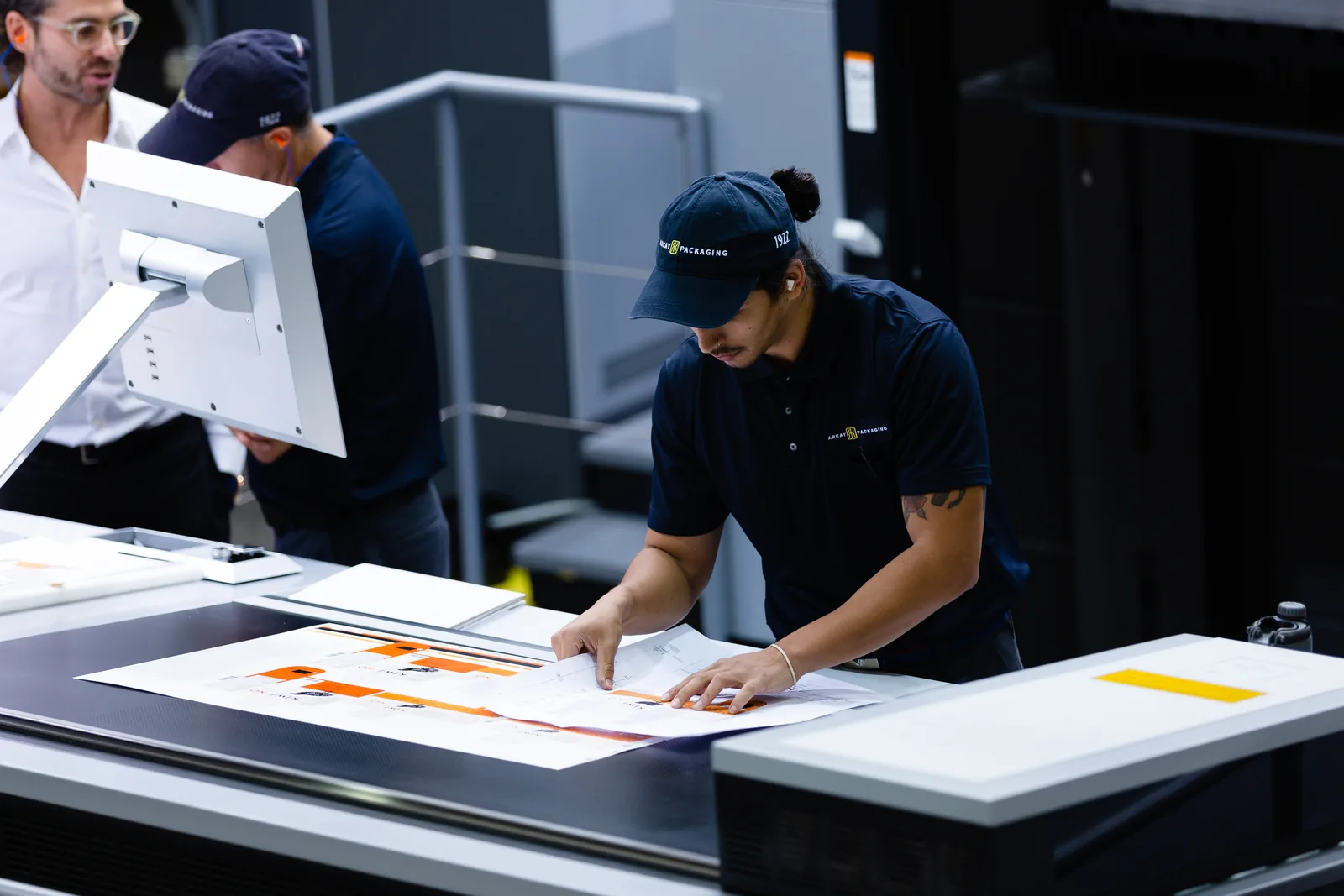
The final layer is measurement. Inline spectrophotometers verify color against target ΔE values at the press in real time, catching and correcting deviation before it accumulates. The payoff: run 1 matches run 50, and the lipstick carton matches the foundation carton in the same line.
Cost and Efficiency Advantages of ECG Printing
ECG’s efficiency comes from what it removes from the press schedule, not from the ink price. Because the CMYKOGV set stays loaded, jobs with different color requirements run in sequence without washing down the press and re-inking for each spot color — which significantly reduces the changeover time a spot-color workflow builds into every job (Printing United Alliance).
Fewer dedicated spot plates follow from the same logic: instead of an open-ended list of custom Pantone plates per job, ECG works from four process colors plus three additional inks — fewer plate changes and less makeready waste at setup.
At a multi-brand facility, the gains compound: one press running a fixed CMYKOGV set can produce cartons for several brand programs in a row, each matched from its own calibrated profile, without re-inking between them — production efficiency and waste reduction.
ECG Applications: Multi-SKU and Private Label Packaging
ECG’s value shows up most clearly in two scenarios: multi-SKU brand lines and private label production.
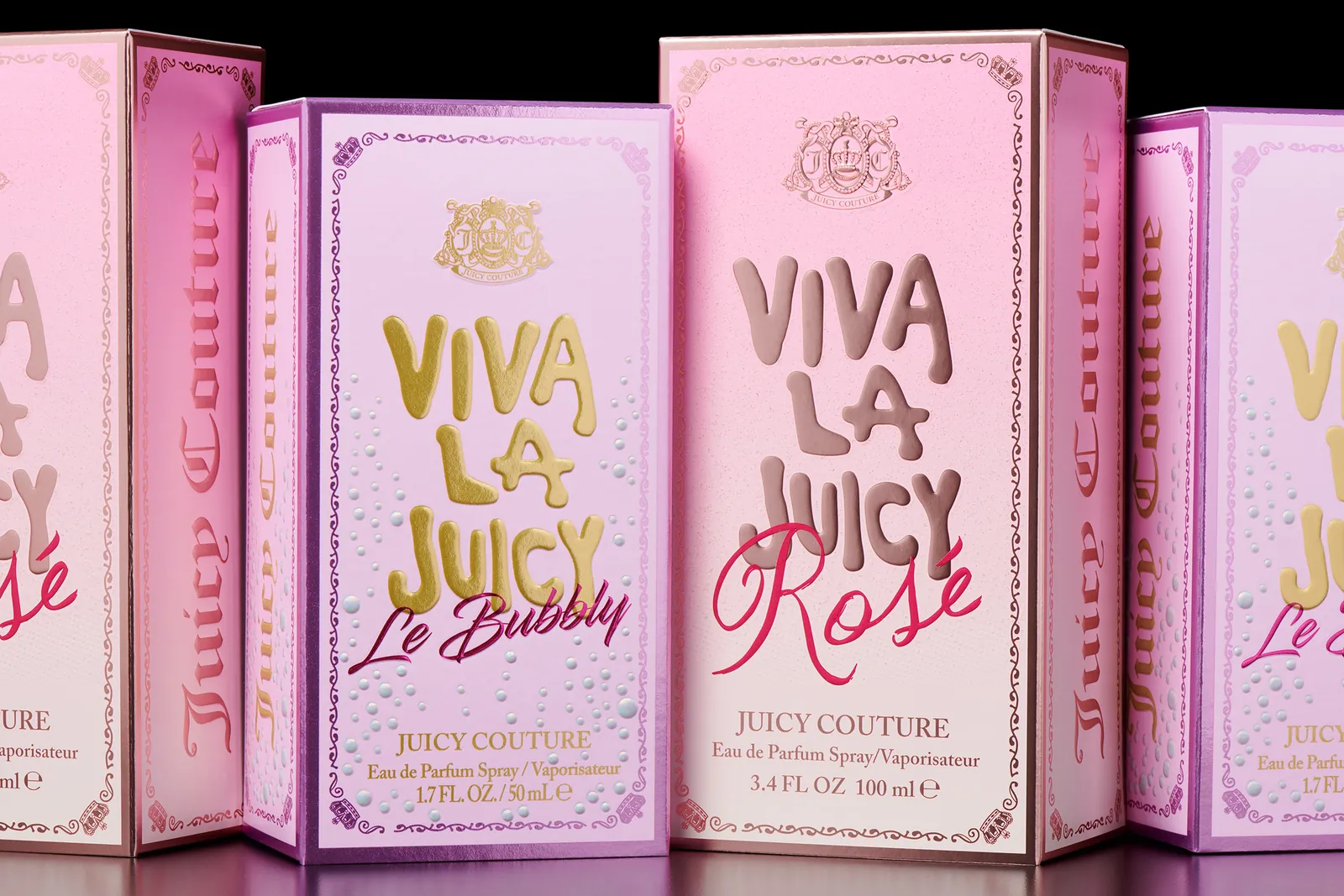
Consider a beauty brand carrying fifteen foundation shades, eight eye palette cartons, and six skincare boxes. Every carton must carry an identical logo color — not just within a single run, but across reorders placed months apart. Reproducing that logo from a fixed CMYKOGV profile, rather than separately mixed spot inks per SKU, holds the color steady across the whole line. This is why extended gamut matters most for cosmetics packaging and personal care packaging, where one brand color has to read the same across dozens of units on a shelf.
Private label and contract manufacturing benefit from the same fixed palette differently. A manufacturer producing cartons for multiple retail clients can serve each client’s Pantone specs in sequence, drawing every color from calibrated profiles rather than freshly formulated ink. Accuracy comes from the profile, not the batch — reducing the drift and approval cycles that slow multi-client production.
ECG on Folding Cartons: Why Substrate and Process Matter
Extended gamut printing performs only as well as the surface it prints on. ECG is an offset process built for coated paperboard — for premium folding cartons, that means solid bleached sulfate (SBS) board, which delivers the brightness, smoothness, and ink receptivity ECG color profiles depend on to render color accurately.
Substrate consistency is central. Uncoated and recycled-fiber boards introduce surface variability — differences in absorbency and brightness — that make repeatable extended gamut results harder to achieve. A coated SBS surface gives the profile a stable, predictable target, which is why it is the right board for packaging that has to hold ECG-level color accuracy.
At Arkay, SBS runs from 14pt to 28pt caliper. And because this is extended gamut offset printing — a CMYKOGV process, not a digital or flexo technique — the color is built into the print itself, on the substrate the finished carton is made from.
How Arkay Engineers ECG Color Precision
Reliable extended gamut printing is a production discipline. Arkay’s rests on four things working together.
First, expertise. G7 calibration is the prerequisite for consistent ECG output, and Arkay’s prepress is led by a G7 Expert — Prepress Manager John Humphries, who brings more than 20 years of color and brand management to the press floor. G7 certification means every job starts from the verified baseline that extended gamut profiles are built on.
Second, measurement. Arkay’s Heidelberg presses integrate AI-assisted color management, giving operators real-time control over color as a run progresses.
Third, vertical integration. Prepress, printing, finishing, die-cutting, folding and gluing, and QA all happen under one roof in Roanoke, so profiles calibrated in-house translate straight to press — no external separation house, no profile translation loss. That single-facility model is visible across Arkay’s production process.
Fourth, focus. Printing on SBS exclusively means every profile is calibrated for one substrate — a more predictable target than a multi-substrate shop can offer. Alongside the accurate base print, Arkay’s proprietary Paint on Press process — developed under Chairman Emeritus Howard Kaneff and capable of up to 20 variations — adds color-matched coating effects. With more than a century of experience across four generations, Arkay treats color as something engineered, not hoped for.
Bring ECG Color Precision to Your Folding Carton Line
Let’s talk about color precision for your next packaging program. Whether you are weighing extended gamut printing for a multi-SKU beauty line or need a partner who can hold brand color across every reorder, Arkay’s team can walk you through what ECG requires on your cartons. Start the conversation, or explore Arkay’s color management and printing capabilities to see how the full production stack fits together.
Frequently Asked Questions
What is extended gamut printing (ECG) and how does it work?
Extended gamut printing (ECG) is a seven-color offset process that adds orange, green, and violet to standard CMYK, forming a CMYKOGV palette. In prepress, ICC profiles convert Pantone spot color calls into CMYKOGV equivalents, so the press reproduces brand colors from a fixed ink set instead of custom spot inks. Roughly 90% of Pantone Solid Coated colors reproduce this way, versus about 40–55% with standard CMYK (Printing United Alliance; X-Rite).
How does extended gamut printing improve color consistency on packaging?
It removes the variability of reformulating spot inks between runs: a fixed CMYKOGV set stays on press, so the same inks and profile produce the same color every time. G7 calibration reinforces this by standardizing gray balance and tonal response before the ECG profiles are applied — so cartons look the same on run 1 and run 50, and match across every SKU in the line.
What are the cost and quality advantages of ECG printing for private label packaging?
For private label and multi-brand work, ECG lowers cost by removing spot color plate changes between jobs — one CMYKOGV press can run cartons for several clients in sequence without washing down inks or pulling new plates. Quality improves because each color comes from a calibrated profile rather than a freshly mixed ink, reducing color drift and shortening approval cycles.
How does a G7-certified print facility benefit ECG color accuracy?
G7 calibration standardizes a press to neutral gray balance and tonal targets — it does not add color, but it sets the verified baseline that ECG profiles are built on. Without it, an extended gamut ink set can drift because the press itself is an uncontrolled variable. A G7-certified facility starts every ECG job from a measured baseline, making color repeatable across runs, operators, and years.
Can extended gamut printing replace all spot colors in packaging?
For most packaging, nearly — but not entirely. ECG reproduces approximately 90% of Pantone Solid Coated colors, covering the vast majority of brand-critical requirements. Colors at the extreme edges of the visible spectrum and specialized metallic or fluorescent effects still call for dedicated spot inks or specialty coatings.
.png)