
What “AI-Optimized Packaging” Actually Means
The packaging industry is not short on AI headlines. Strip away the noise, though, and AI in packaging is not one system or a single breakthrough — it is a set of tools applied to specific tasks: generating design options, analyzing data, inspecting quality, and predicting problems before they happen.
The appetite is real. In one survey of more than 200 paper and packaging executives, 95 percent said companies should invest in generative AI and 77 percent expressed a strong intention to deploy it soon (McKinsey, via Packaging Dive, 2025). But intent is not the same as magic. The value shows up in narrow, measurable places — faster iteration, fewer defects, less waste — not in replacing the judgment that decides whether a package works.
AI is also the latest chapter in a longer story of packaging innovation — the same push toward precision and efficiency that drove offset color management and inline inspection now extends into machine learning. With more than 100 years of manufacturing behind it, Arkay approaches AI the same way it approaches any tool: useful where it earns its keep, honest about where it does not. This guide maps how AI is optimizing packaging across design, production, and logistics, the benefits it delivers, and what still needs a human.
AI in Packaging Design
Design is where AI has moved fastest, because so much of early packaging development is iteration.
Generative tools now produce concept artwork, dieline drafts, and 3D mockups in minutes, letting a team explore directions that once required days of manual work. AI can also recommend substrates and structures against goals like material use, durability, and sustainability, and simulate physical testing virtually — Colgate-Palmolive has explored simulations for bottles, caps, and spray pumps to shorten the test cycle and cut prototyping cost. Artwork automation is delivering some of the clearest gains: using AI-enabled artwork software, Colgate-Palmolive reported cutting packaging development time by 60 to 70 percent for large SKU runs (Packaging Dive, 2025).
Material discovery is a frontier of its own. Nestlé and IBM built a generative AI tool to identify new high-barrier packaging materials — the kind of search across chemical possibility space that is impractical by hand.
One clarification matters here: generative design tools are something brands and design teams use upstream, not a service a folding carton manufacturer provides. Arkay does not generate designs with AI. What it does is take a design — however it was created — and engineer it into a carton that can actually be produced.
AI in Packaging Production
On the production floor, AI is less visible than a generative mockup but arguably more consequential, because it governs consistency at scale.
The core applications are machine vision and prediction. Vision systems inspect printed and formed cartons far faster and more consistently than the human eye, flagging defects the moment they appear. AI color management holds a brand’s palette on target across a run. Predictive maintenance monitors equipment to anticipate failures before they stop the line — Nestlé, for example, uses high-resolution imaging with machine learning to anticipate issues on its production lines and recommend fixes.
The through-line is that production AI does not design or decide; it watches, measures, and predicts, so that variance is caught early and the run stays consistent. That is quality assurance made continuous rather than end-of-line.
Beyond Design and Production: AI in Sourcing, Logistics, and Recycling
AI’s reach extends past the plant, into the decisions that surround a package.
In sourcing and planning, predictive analytics assess supplier performance and anticipate material price and demand shifts, reducing both overproduction and stockouts. In logistics, right-sizing algorithms cut the material and void fill in a shipment, lowering cost and transport emissions, and route optimization trims transit. At end of life, AI-powered sorting is improving recycling: Colgate-Palmolive partnered with an AI sorting company to help recover toothpaste tubes at recycling facilities. Across all three, the pattern repeats — AI turns data a company already has into less waste and better decisions, which is where much of its packaging value actually lands.
Which Manufacturers and Brands Use AI
The question brands ask most is who is actually doing this, not who is talking about it.
Adoption is concentrated among large CPG companies and their partners. Nestlé uses AI for both material discovery and machine-learning line monitoring. Colgate-Palmolive applies it across simulation testing, artwork automation, and recyclability. Design-tool platforms have put generative capabilities in reach of smaller brands and agencies. Adoption is still early overall — one industry source found 77 percent of packaging companies intend to use generative AI, but only about 25 percent had launched or were actively developing AI tools, with more than 60 percent of those adopters saying the impact exceeded expectations (PakFactory, 2025).
On the manufacturing side, the meaningful question for a brand is narrower: does your packaging partner use AI where it affects your product — in color, defect detection, and inspection — rather than as a talking point?
How Arkay Uses AI in Production
Arkay’s answer to that question is specific, and deliberately unglamorous.
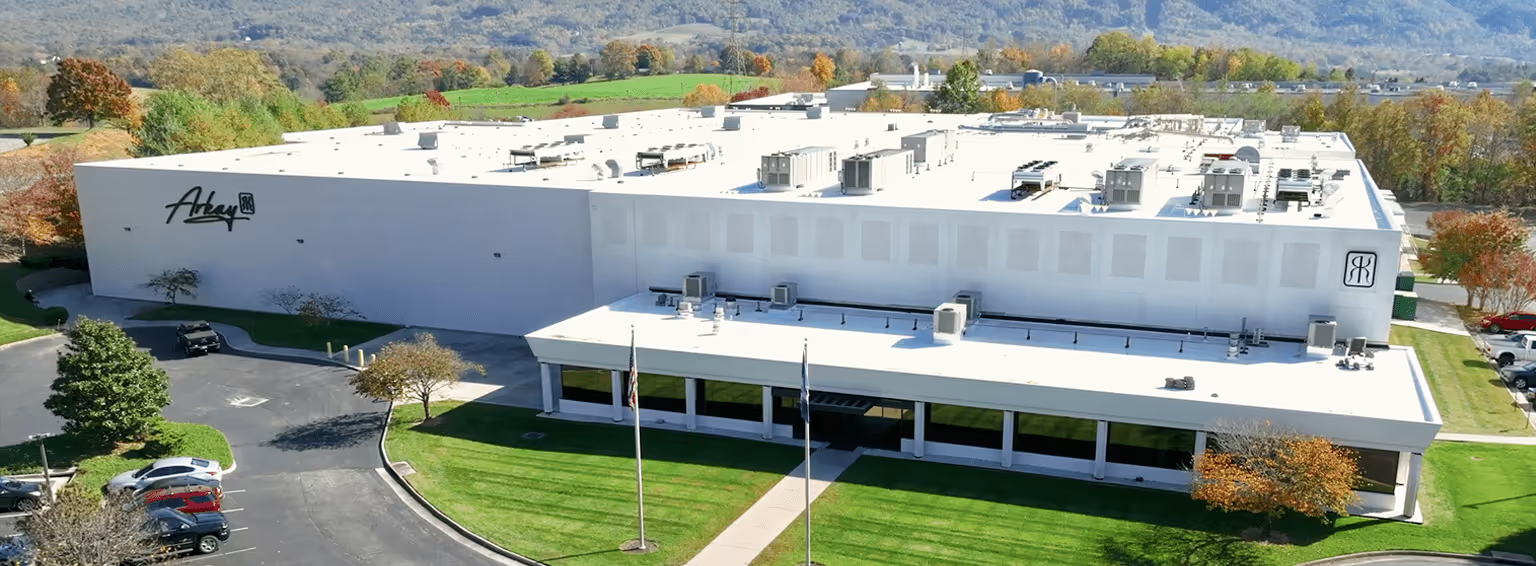
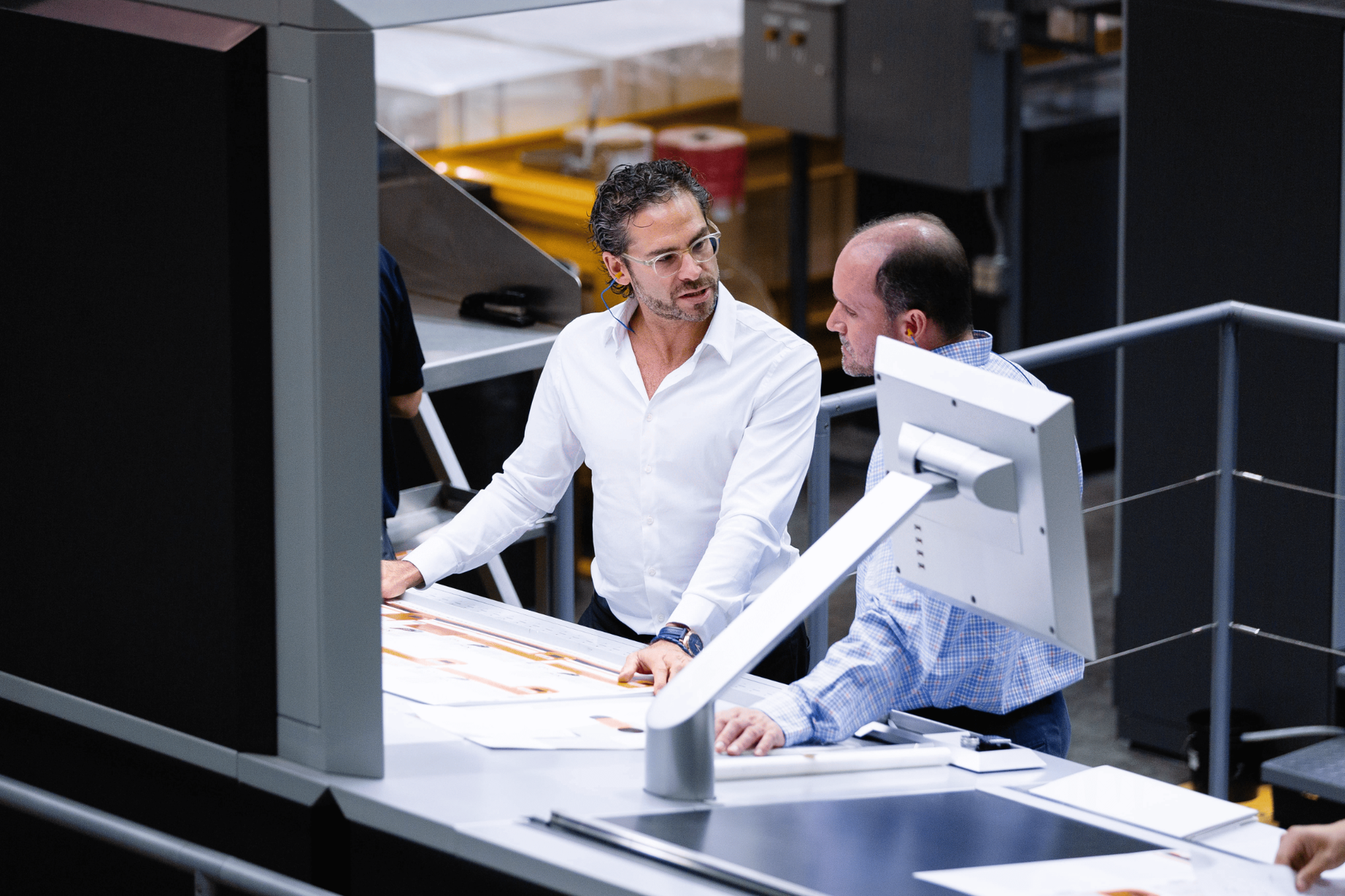
AI runs where it improves the carton, not where it makes a good headline. Arkay’s Heidelberg presses integrate AI-assisted color management to hold color consistent from the first sheet to the last; its two Diana gluers apply AI-driven defect and adhesion detection, catching a compromised glue joint before a carton ships; and AccuCheck inline inspection verifies the work as it runs. These are among the production capabilities that make consistency measurable rather than assumed, visible on the production floor in Roanoke, VA.
Just as important is what Arkay does not claim. It is not a generative-design studio and not a digital printer; AI does not replace the craftsmanship of four generations, it sharpens it — reducing waste and variance so the finished carton consistently matches the intent. That is the same principle behind Arkay’s broader innovation in premium packaging: adopt the tool where it makes the work better, and be honest where human judgment still decides. For high-volume categories like technology and electronics packaging, where consistency across long runs is everything, that production AI is what keeps the run consistent from the first carton to the last.
Put AI to Work on Your Packaging
Let’s talk about where AI actually helps your packaging — and where it does not. Whether you are exploring AI design tools upstream or want a manufacturing partner whose color and defect control are already AI-assisted, Arkay can help you separate the useful from the hype.
Reach out to Arkay’s team to discuss the production standards behind consistent, low-waste cartons.
Frequently Asked Questions
Does AI replace packaging designers?
No, it augments them. AI is good at fast iteration, pattern analysis, and simulating options, which frees designers from repetitive production work and speeds early concepts. But creative direction, brand judgment, and the decision about what is actually manufacturable still sit with people. The pattern across the industry is AI as a tool that expands what a design team can do, not a replacement for one.
Is AI-generated packaging design production-ready?
Usually not without engineering review. Generative tools are strong at concepts, artwork variations, and 3D mockups, and some produce draft dielines — but turning that into a manufacturable carton still requires structural engineering, substrate selection, and a die-line proven on real equipment. AI shortens the path to a concept; production expertise is what makes the concept run.
How do you measure the ROI of AI in packaging?
By tracking the specific things it touches, not a single headline number. On the production side, that means defect and scrap rates, rework, and changeover or downtime; upstream, it means material used per unit, overproduction, and time from concept to approved design. The gains tend to be incremental and compounding — a few points of scrap here, days off a development cycle there — which is why establishing the right baseline before adopting AI matters as much as the tool itself.
What are the limits or risks of using AI in packaging?
AI is only as good as its data and its oversight. Generative design can produce concepts that look right but do not fold, run, or protect the product, so human engineering review is essential. AI recommendations also need a manufacturer that can actually execute them at production tolerances. Treated as a tool with expert judgment on top, AI adds real value; treated as an autopilot, it introduces risk.
How can a brand start applying AI to its packaging?
Most brands start upstream, using AI design and simulation tools to explore concepts and shorten early iteration, then bring a manufacturing partner in to engineer the winning concept into a production-ready carton. On the production side, the practical step is choosing a manufacturer that already uses AI where it counts — color management, defect detection, and inline inspection — so the consistency benefits are built into the run rather than bolted on.