
When a brand team writes “cardboard box” in a packaging brief, the manufacturer reading it has a question: do they mean a folding carton for the retail shelf, or a corrugated shipping case? The answer changes every specification that follows — the substrate, the press, the finishing capabilities, and ultimately, what the consumer sees. “Cardboard” is how most people talk about packaging. It is not how packaging is specified.
That gap matters more than it sounds. Paperboard and corrugated fiberboard are different materials engineered for different jobs, and the word “cardboard” blurs the line between them. With more than 100 years of manufacturing experience across four generations, Arkay has read a lot of briefs — and the terminology confusion is one of the most common places a packaging project goes sideways before a single sheet is printed. Arkay Packaging is a fourth-generation, family-owned premium folding carton manufacturer that has operated continuously since 1922, producing finish-led packaging exclusively on SBS paperboard from its carbon-neutral facility in Roanoke, VA. This is the distinction from the floor: what each material actually is, and what specifying the wrong one costs.
What “Cardboard” Actually Means
“Cardboard” is a colloquial catch-all, not a packaging industry specification. The International Standards Organisation (ISO) does not define it as a material category — it defines “paper” as paper-based material under 250 gsm and “paperboard” as material at or above 250 gsm. There is no ISO entry for “cardboard” at all.
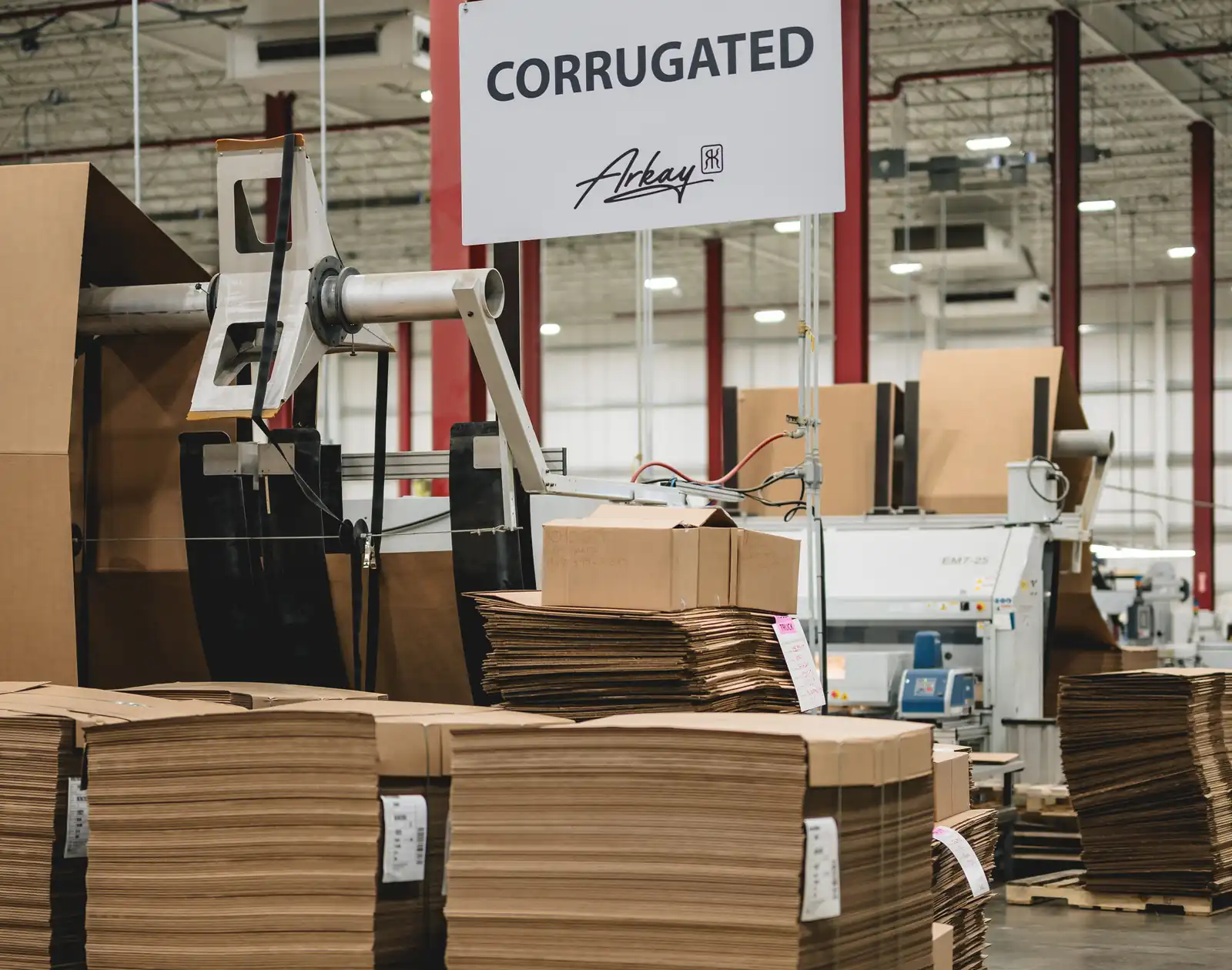
In practice, when people say “cardboard box,” they usually mean corrugated fiberboard: the fluted, multi-wall material used for shipping. Corrugated is an engineered structure of three parts — two flat outer linerboards with a wavy, arch-shaped medium glued between them. Those flutes resist compression and bending from every direction, which is exactly what a box needs when it is stacked on a pallet and moved through a supply chain. The vast majority of products shipped in North America travel in corrugated. It is built for transit protection — stackability, cushioning, puncture resistance — not for shelf presentation or print quality.
Why the Term Creates Specification Problems
Here is what competitors who explain these terms leave out: the consequence. When a brief says “cardboard” and means a folding carton, but the reader interprets it as corrugated, the error propagates. The wrong substrate gets quoted, the wrong press gets scheduled, the finishing scope comes back mismatched, and the correction surfaces late — as rework, a re-quote, or a delayed launch. Ambiguous material language is one of the quietest and most expensive ways a packaging timeline slips, and it is entirely avoidable with precise terms.
What Paperboard Is
Paperboard is the correct industry term for the solid, multi-ply substrate used to make folding cartons — the retail boxes that hold cosmetics, supplements, spirits, food, and pharmaceuticals on a shelf. Unlike corrugated, it has no fluted inner layer. It is a continuous solid board that folds cleanly along score lines, holds its shape as a retail carton, and accepts high-resolution printing and precision finishing on its surface.
Paperboard comes in several grades, and knowing them by name helps when reading or writing a brief:
SBS (Solid Bleached Sulfate): 100% virgin bleached chemical pulp, bright white on both sides, the highest printability of any grade.
CRB (Coated Recycled Board): recycled fiber content, lower brightness, and print fidelity than SBS.
FBB (Folding Boxboard): a mechanical pulp core between bleached outer layers, common in European pharmaceutical packaging.
Chipboard: a low-density recycled board used mainly as the rigid core in setup boxes — not a folding carton substrate, and the material that distinguishes chipboard construction from folding cartons.
For a full breakdown of paperboard grades and how to select the right one for your application, see our guide to paperboard packaging.
Among these, SBS is the standard for premium consumer packaging. Its bright, white, clay-coated surface delivers the highest print fidelity of any grade, which is why it dominates cartons for cosmetics, spirits, pharmaceuticals, and lifestyle products. Arkay manufactures exclusively on SBS, in a caliper range of 14 to 28pt, with 28pt as the hard ceiling. That single-substrate focus is a deliberate commitment, not a limitation: a century of running one material is what makes the finishing precision possible.
Cardboard vs. Paperboard: How the Two Materials Compare
These are not interchangeable materials. The clearest way to settle the cardboard vs paperboard question is to see the two side by side.
The takeaway is simple. Corrugated gets the product to the shelf. Paperboard is what the consumer sees and touches once it gets there. They work in the same supply chain, but they solve opposite problems — and the right specification depends entirely on which job you are asking the material to do.
Why SBS Paperboard Enables Premium Finishing
The reason premium brands specify SBS comes down to its surface. A smooth, clay-coated board built from short hardwood fibers gives finishing processes a consistent, exacting canvas — one that corrugated’s textured, absorbent kraft liner simply cannot match. That surface is what makes the following possible at production quality:
- High-resolution offset lithography is the printing method behind premium folding cartons.
- G7 color management holds color consistent within tight tolerances across an entire production run.
- Foil stamping, hot and cold, for crisp metallic detail.
- Embossing and debossing, which require smooth, consistent-caliper board, Arkay holds registration to a ±0.3mm tolerance, achievable only on a stable substrate like SBS.
- Soft-touch lamination, spot UV, and specialty aqueous coatings.
- Arkay’s proprietary Paint on Press process, developed under Chairman Emeritus Howard Kaneff, which runs up to 20 variations in a single pass — a technique only possible on SBS.
- Inline flexo coating for pearlescent, gold, and silver effects, applied through Arkay’s two double flexo coaters connected to the main press.
Corrugated cannot replicate these at the same level. Its kraft linerboard is textured and inconsistent, so it cannot hold embossed registration or fine foil detail with precision, and the printing methods typically used on corrugated liners are lower in resolution than offset. Graphics can be added to corrugated by laminating a pre-printed paperboard sheet onto the structure — a technique called litho-lam — but that is a workaround, and the printed layer is still paperboard. This surface advantage is exactly why SBS carries the finishing weight in cosmetics packaging and other premium consumer categories.
How Arkay Specifies and Sources Paperboard
Arkay has manufactured on SBS for over a century, and that focus shapes how every project is scoped. Rather than offering a menu of substrates, Arkay engineers each folding carton around the one board it knows best — matching caliper, finish, and structure to what the brand needs on the shelf, in collaboration with brand teams and their designers.
Sourcing is third-party verified. Arkay’s paperboard is FSC, SFI, and PEFC certified, and the company runs carbon-neutral operations recognized with EcoVadis Platinum — a rating in the top 1% of manufacturers globally, held consecutively since 2022. Production is also BRCGS packaging safety certified. Together, these sustainability certifications let brand teams answer material-sourcing and ESG questions with documentation, not assurances. Recyclability is anchored to the underlying board, with finish compatibility assessed against it per project.
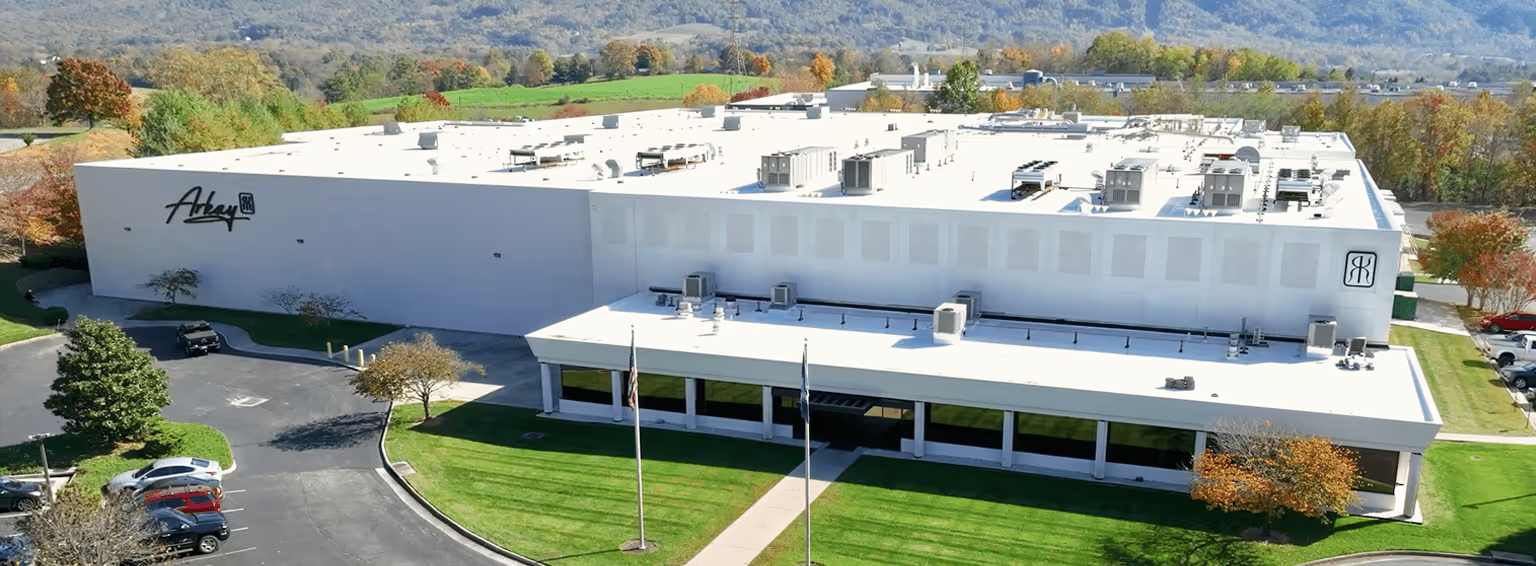
Before a project commits to a full run, brands can work through Arkay’s Design Studio in Hauppauge, NY, moving from concept to a physical SBS mock-up in about a week. That step matters for exactly the reason this article exists: it lets a brand team feel the substrate — the weight, the surface, the finish — before locking a specification, so “cardboard” never has to stand in for a decision that deserves precision. Production then runs at the 140,000 sq. ft. Roanoke facility, where a century of finishing expertise is engineered around a single, exacting board.
Let’s Talk About the Right Substrate for Your Packaging
If you’re specifying materials for an upcoming launch, the terminology is worth getting right before the brief goes out — it saves a round of corrections later. Arkay partners with brand teams to match the substrate, structure, and finish to what the product needs on the shelf. Start the conversation, and let’s talk through the right specification for your next folding carton.
Frequently Asked Questions
What is the difference between cardboard and paperboard?
“Cardboard” is an informal, colloquial term for any heavy-duty paper-based packaging material — it is not a packaging industry specification. In technical use, the material most people call “cardboard” is corrugated fiberboard: a multi-layer structure of two flat linerboards with a fluted inner medium, used for shipping boxes and secondary packaging. Paperboard is the correct industry term for the solid, multi-ply substrate used to make folding cartons — the retail boxes that hold cosmetics, food, supplements, spirits, and pharmaceuticals on a shelf. The two materials differ in structure, purpose, and capability. Corrugated fiberboard is engineered for structural strength and transit protection. Paperboard is engineered for printing quality, finishing precision, and consumer presentation.
Is paperboard the same as cardboard?
No. Paperboard is a specific, defined material classification — a solid multi-ply substrate used for folding cartons and retail packaging. “Cardboard” is a general, colloquial term that can refer to paperboard, corrugated fiberboard, or both, depending on context. ISO defines paperboard as paper-based material at or above 250 gsm; “cardboard” has no ISO definition. In packaging procurement and manufacturing, using the term “cardboard” instead of “paperboard” or “corrugated” creates specification ambiguity. When precision matters — in briefs, supplier conversations, or sustainability reporting — the correct term is “paperboard” for folding carton applications, or “corrugated” for shipping box applications.
Why do premium brands choose paperboard over cardboard for product packaging?
Premium brands specify SBS paperboard for consumer-facing folding cartons because it is the substrate that makes premium finishing possible. SBS paperboard’s smooth, clay-coated surface accepts high-resolution offset printing, foil stamping, embossing, debossing, soft-touch lamination, and specialty coatings at the quality level that communicates brand value on a retail shelf. Corrugated fiberboard’s textured, fluted structure is engineered for shipping strength — not print fidelity or finishing precision. When a cosmetics brand needs embossed type at tight registration tolerances, a spirits brand needs metallic foil on a matte substrate, or a supplement brand needs precise color matching across a full production run, those results require the consistent surface that SBS paperboard provides.
What is paperboard also called?
Paperboard is also informally called “cardboard” in everyday speech, though this usage is imprecise. In packaging specifications, paperboard is identified by grade: SBS (Solid Bleached Sulfate), CRB (Coated Recycled Board), FBB (Folding Boxboard), or chipboard. The industry term for the product made from paperboard is a folding carton. Some regions also use “cartonboard” interchangeably with paperboard.
Should paperboard be recycled as paper or cardboard?
Paperboard folding cartons — cereal boxes, cosmetics cartons, supplement boxes — are recyclable and are typically sorted with paper rather than corrugated cardboard in curbside programs. However, recycling rules vary by municipality; some programs ask consumers to break down folding cartons and place them with paper, while others accept them with cardboard. Corrugated cardboard has a significantly higher recycling rate than paperboard folding cartons, largely because corrugated is collected more efficiently at the commercial and industrial level. When in doubt, check local sorting guidelines.