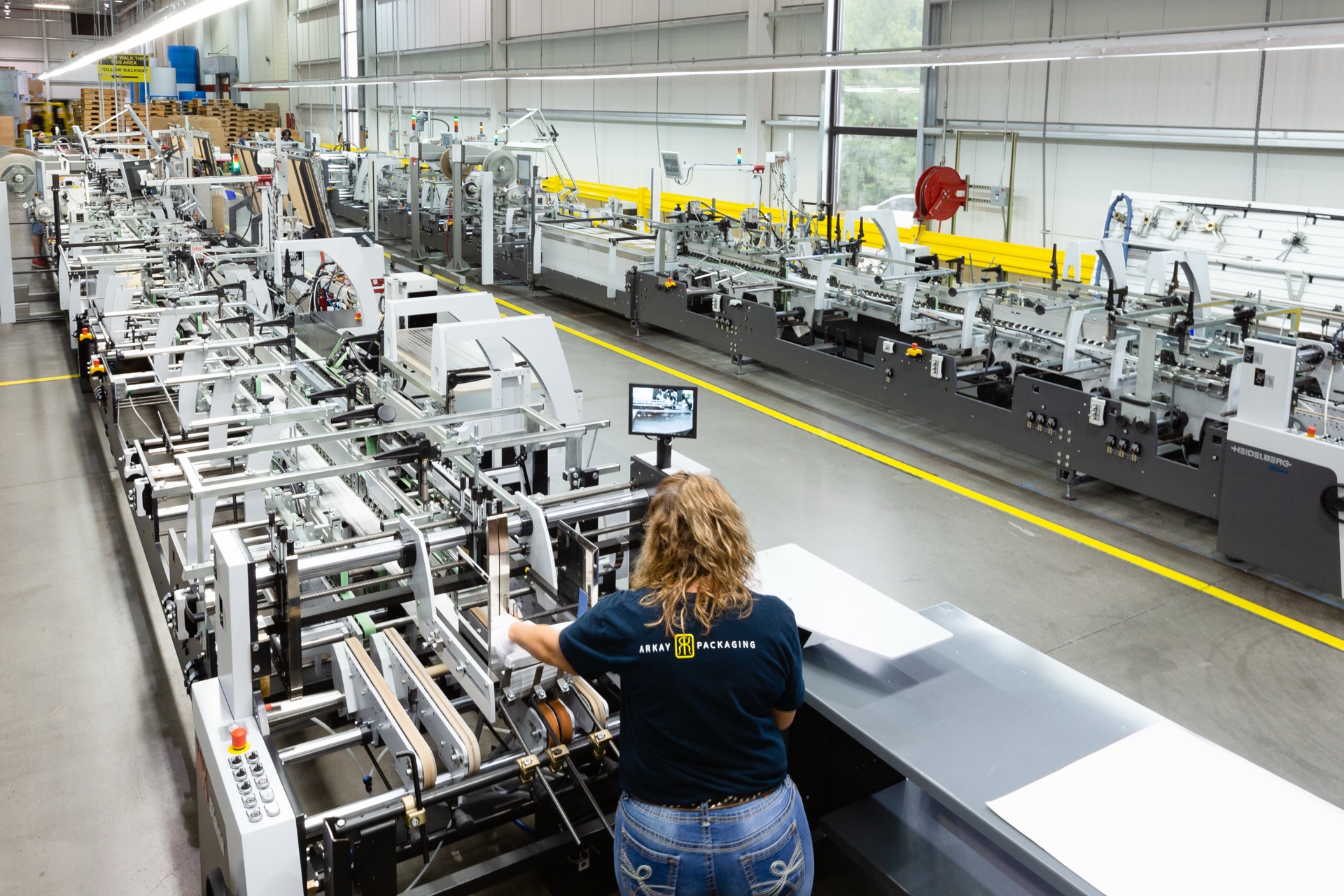
Scrap rates in packaging production run 15–25% under normal conditions (PackIoT). Material issues alone contribute to up to 30% of production downtime. For brands managing multi-SKU portfolios across seasonal launches, those numbers translate directly into cost overruns, missed timelines and wasted substrate.
Most content on packaging efficiency is written by consultants or equipment vendors. This guide is written from the production floor — by a manufacturer that has spent more than 100 years refining how folding cartons move from proof to pallet with the least possible waste.
Packaging efficiency is not about running presses faster. It is about eliminating the handoffs, rework cycles and quality failures where time and material actually disappear. That principle has driven how Arkay Packaging operates — every stage of production under one roof, with the process controls to back it up.
What Is Packaging Efficiency?
Packaging efficiency measures how effectively a manufacturing operation converts raw materials, labor and production time into finished, sellable packaging. It is not a single metric — it is the combined result of material yield, print consistency, changeover speed, finishing precision and on-time delivery.
The industry standard benchmark is OEE (Overall Equipment Effectiveness). Average OEE across manufacturing sits at 55–60%. World-class is 85%, and only about 6% of manufacturers reach it (Evocon). The gap between average and world-class is not filled by faster machines. It is filled by eliminating the waste that happens between stages — rejected runs, misaligned handoffs, finishing that does not hold up at speed.
For brand teams, packaging efficiency determines whether a product launches on time, at the approved quality, within budget. When efficiency breaks down, the brand absorbs the cost.
Where Packaging Efficiency Breaks Down
Efficiency does not fail in one dramatic moment. It erodes across dozens of small breakdowns that compound. Here is where the most consequential losses happen in folding carton production.
Color inconsistency forcing reprints. When proof and press do not match, entire runs get rejected. The approval cycle restarts, fresh substrate is consumed and the timeline slips. This is the single most expensive efficiency failure in premium packaging — and the most preventable.
Defects caught too late. Traditional quality assurance relies on manual sampling: inspectors pulling a handful of cartons per batch. Under production conditions, defects that slip past sampling — delamination, glue gaps, registration errors — reach the filling line or the customer. The cost of a late-caught defect is not just the defective units. It is the rework, the reprint, the delayed shipment and the conversation no one wants to have with the brand team.
Handoffs between vendors. Every time a carton moves from one facility to another — printing here, finishing there, inspection somewhere else — the risk of misalignment, damage and delay compounds. Version-of-record gaps between vendors are one of the most underestimated sources of packaging waste.
Finishing that does not hold at speed. Embossing that loses registration, foil that flakes, coatings that cure inconsistently — finishing failures at production speed generate scrap that looked fine in a sample room. The gap between a proof and a production run is where finishing efficiency lives or dies.
Design changes mid-run. When specifications shift after production has started, the changeover cost is not just the new plates or dies. It is the wasted substrate, the lost press time, and the downstream schedule disruption that ripples through every job behind it.
Why Packaging Efficiency Matters for Brands
Packaging efficiency is not just a manufacturing concern — it directly affects a brand’s bottom line, launch timelines and sustainability commitments.
The right manufacturing partner does not just print cartons. They reduce total packaging cost by minimizing waste across every stage, from substrate selection through final inspection. When production runs cleanly the first time — no reprints, no rejected shipments, no emergency rush orders — those savings compound across every SKU and every season.
Efficiency also drives sustainability outcomes. Less material waste means fewer raw resources consumed. Fewer rejected runs mean less energy spent reproducing what should have been right the first time. For brands under ESG pressure, choosing a manufacturer that already operates efficiently is the most direct path to defensible sustainability claims — no material substitution or label redesign required.
The brands that manage packaging cost and sustainability most effectively are the ones that treat manufacturer selection as an efficiency decision, not just a procurement decision.
How to Improve Packaging Efficiency
Five strategies that address the root causes, not the symptoms.
1. Consolidate Production Under One Roof
Every vendor-to-vendor handoff is a potential failure point — for quality, for scheduling and for specification accuracy. When printing, die-cutting, finishing, folding, gluing and inspection all happen in one facility, the production team controls every variable. Problems are caught in the same building they are created, not discovered on delivery.
Vertical integration is not just a manufacturing model. It is an efficiency strategy. Fewer handoffs means fewer errors, shorter lead times and a single point of accountability for the finished carton.
In practice: on a recent 600,000-unit luxury folding carton run, an embossing pass was inadvertently omitted from the pre-production job bag. The miss was caught only when the run moved to the die-cutter — and because the embossing line and die-cutter operate on the same production floor at Arkay, the team added the missing pass without pulling the run or losing the schedule. In a multi-vendor model — embosser at one facility, die-cutter at another — that same miss would have meant pulled inventory, an emergency reprint, or a delayed launch.
2. Invest in Proof-to-Press Color Accuracy
Color drift between proof and production is the most expensive recurring failure in premium packaging. G7 color management certification, administered by IDEAlliance, standardizes how presses are calibrated to match an approved proof. The result is repeatable color across runs, substrates and SKUs.
G7-certified operations report significantly fewer reprints and measurably faster turnaround (Kase Printing). For brands managing portfolios of color-critical SKUs — cosmetics, personal care, spirits — this is not optional. It is the minimum requirement for production-level efficiency.
3. Move Quality Inspection Inline
The difference between catching a defect at the point it occurs and catching it at end-of-line inspection is the difference between a minor adjustment and a rejected run.
AI-powered inline inspection uses camera systems integrated into folder-gluers to check every single carton at production speed. Every carton — not a sample. The result is defect detection that scales with output rather than relying on the statistical limitations of manual sampling.
Learn more about AI-powered print technology in packaging manufacturing.
4. Test Finishing Before Committing to a Run
Most finishing failures originate in the gap between what a design looks like in a sample room and what it looks like at production speed on the actual substrate. Closing that gap before a run starts eliminates the most expensive form of waste: committed substrate that does not meet spec.
Arkay’s proprietary Paint on Press process addresses this directly. Brand teams test up to 20 finishing variations — foil, embossing, coatings, laminates — on production equipment using actual press conditions. The result is a locked specification that has already been validated at speed, not approximated in a presentation.
5. Shorten the Supply Chain
Longer supply chains introduce more variability. More vendors. More transit. More opportunities for substrate to degrade, specifications to drift and timelines to slip.
As Mitchell Kaneff shared on the Printing’s Alive podcast: “Paperboard is a tree, it’s a living thing. So whatever happens after say three to six months, that opening force of that particular package on a high-speed line is not going to function as well and can have line-stopping defects.”
Domestic manufacturing shortens the cycle between substrate procurement, production and delivery — reducing the exposure to the material degradation and lead-time variability that erode efficiency.
Packaging Efficiency and Sustainability
Efficiency and sustainability are not separate conversations. They are the same conversation.
Less material waste means less raw material consumed. Fewer rejected runs mean less energy spent reproducing what should have been right the first time. Shorter supply chains mean lower transport emissions. Inline defect detection means fewer cartons produced only to be discarded.
For brands under ESG pressure, the most credible sustainability story starts with manufacturing efficiency — not a material substitution or a label claim. Third-party certifications anchor that story to auditable standards rather than marketing language.
Arkay’s sustainability credentials include EcoVadis Platinum recognition (top 1% globally, held consecutively since 2022), FSC, SFI and PEFC triple-certified paperboard sourcing, and CarbonNeutral operations. These are credentials brands inherit by choosing a manufacturer that has already made the operational investment. See our sustainable packaging article for how this applies in practice.
How Arkay Delivers Packaging Efficiency
Arkay Packaging is a fourth-generation, family-owned premium folding carton manufacturer that has operated continuously since 1922. From its carbon-neutral 140,000 sq. ft. facility in Roanoke, Virginia, Arkay delivers finish-led packaging for cosmetics, personal care, spirits and lifestyle brands.
Every stage of production — design, printing, die-cutting, finishing, folding, gluing and inspection — runs under one roof. No offshore splits. No vendor-to-vendor handoffs. No version-of-record gaps between stages.
G7 color management certification ensures proof-to-press accuracy across every run. AccuCheck AI inspection catches defects at production speed. Paint on Press validates finishing before a single production sheet commits. The Design Studio in Hauppauge, New York compresses prototyping from weeks to days.
The result is packaging efficiency built on a century of manufacturing expertise — refined by technology, not replaced by it.
Ready to discuss how your packaging program can run more efficiently? Talk to Arkay’s team.
Frequently Asked Questions
What is packaging efficiency?
Packaging efficiency refers to how effectively a manufacturing operation converts raw materials, labor and production time into finished, sellable packaging while minimizing waste, defects and delays. It encompasses material yield, print consistency, changeover speed, finishing precision and supply chain reliability.
How do you measure packaging efficiency?
Key metrics include material waste rate, defect rate at final inspection, production cycle time, changeover time between SKUs and on-time delivery rate. For brands with complex finishing requirements — foil, embossing, specialty coatings — rework rates and rejected run frequency are the most direct cost indicators. OEE (Overall Equipment Effectiveness) is the standard composite benchmark, with world-class performance at 85%.
How does vertical integration improve packaging efficiency?
Vertical integration consolidates design, printing, finishing and quality inspection under one roof, removing vendor-to-vendor handoffs. Each handoff is a potential failure point for scheduling, quality and lead time. When printing, die-cutting and finishing happen in a single facility, problems are caught and resolved within the same operation rather than discovered on delivery.
How does packaging efficiency reduce costs?
Packaging efficiency reduces costs by minimizing material waste, eliminating reprints from color inconsistency, catching defects inline instead of at end-of-line and shortening supply chain lead times. The savings compound — fewer rejected runs mean less wasted substrate, less press time and fewer schedule disruptions that cascade into rush fees downstream.
How does Arkay help brands improve packaging efficiency?
Arkay consolidates every stage of packaging production — design, printing, finishing, die-cutting, folding, gluing and AI-powered inspection — under one roof in its 140,000 sq. ft. facility in Roanoke, Virginia. This vertically integrated model eliminates the vendor handoffs where efficiency typically breaks down. G7 color management ensures proof-to-press accuracy, AccuCheck AI inspects every carton at production speed, and Paint on Press validates finishing before a run commits — reducing waste, reprints and timeline risk across the entire program.