
Most brand teams approve a design, place an order and then wait. What happens between proof approval and a pallet of finished cartons arriving at the filling line is largely a black box.
That black box is where timelines slip, quality fails and costs inflate. When a production run takes three months instead of the quoted six weeks, the issue almost never started at the press. It started upstream — in a design revision that was not locked, a substrate that was not specified correctly, or a handoff between vendors where specifications drifted.
This guide opens the packaging production process from the inside. Not a theoretical overview — a stage-by-stage walkthrough of how folding carton packaging actually gets made, where the most consequential decisions happen, and where things go wrong when the process is not managed well. The perspective comes from Arkay Packaging, which has run every stage of this process under one roof for more than 100 years.
What is packaging production?
Packaging production is the full manufacturing sequence that transforms a design file into finished, shippable packaging. For folding cartons, that sequence includes structural engineering, substrate selection, pre-press and color management, offset printing, finishing, die-cutting, folding, gluing, quality inspection and shipping.
Each stage builds on the one before it. A substrate decision affects how ink lays down. Ink laydown affects how finishing holds. Finishing precision affects whether folding and gluing maintain structural integrity. Quality issues at any point cascade downstream — which is why the most critical production capability is not any single machine, but the ability to control every variable in sequence.
As Mitchell Kaneff, Chairman and CEO of Arkay Packaging, shared on the Printing's Alive podcast: "Each thing we do is a custom shop job, almost. We make millions of custom shop jobs."
Why understanding the packaging production process matters
Brand teams that understand what happens between proof approval and delivery make fewer costly decisions. They know when a revision will cascade into weeks of delay. They know which specification choices affect quality downstream. They ask the right questions before a run starts rather than troubleshooting after it finishes.
For packaging buyers managing seasonal launches, multi-SKU portfolios or complex finishing programs, this knowledge is the difference between a predictable production timeline and an emergency reprint. The packaging production process is not complicated — but the points where things go wrong are often invisible to teams that have never seen the inside of a production facility.
The stages of packaging production
Here is what happens at each stage — and where the decisions that determine timeline, quality and cost actually get made.
1. Design and structural engineering
Packaging production starts before anything touches a press. Structural engineers create the die-line — the technical blueprint that defines every panel, fold, tab and glue point of the carton. CAD modeling tests whether the structure holds, folds correctly and survives transit.
For brands that arrive with a concept but not a production-ready design, this stage is where the concept becomes real. Arkay's Design Studio in Hauppauge, New York takes brand teams from an idea to a physical mock-up within one week — no separate design agency required. For customers visiting the studio, a mockup can be produced the same day using digital plotters and an Epson printer mounted to the chosen substrate, so they leave with a working sample in hand. That compressed timeline means design decisions get locked faster, which protects every downstream stage from the revision cycles that blow up production schedules.
2. Substrate selection
The substrate is the foundation everything else builds on. For folding cartons, that means SBS (solid bleached sulfate) paperboard, typically in the 14–28pt caliper range.
Caliper affects structural rigidity, print quality and finishing performance. A board that is too light will not hold embossing definition. A board that is too heavy risks press damage. Coated versus uncoated affects ink absorption, foil adhesion and coating cure. Getting the substrate wrong does not just affect one stage — it affects every stage that follows.
3. Pre-press and color management
Pre-press converts the approved design into the files, plates and color specifications the press needs. This is where proof-to-press accuracy is established — and where the most expensive production failure either gets prevented or set in motion.
G7 color management certification standardizes how presses are calibrated. When proof and press are aligned through a verified standard, color matches from the first sheet to the last and from this month's run to next quarter's reorder. Without that calibration, color drift across a long run forces reprints — wasting substrate, press time and schedule.
4. Printing
Sheet-fed offset printing lays down ink in precise registration across every sheet. For premium folding cartons, printing involves multiple color stations — process CMYK plus PMS spot colors — with each station adding a layer that must align with sub-millimeter precision.
Modern offset presses integrate AI-assisted color management that monitors density and registration in real-time, adjusting on-press rather than relying on post-run inspection. This is the difference between catching a color shift on sheet 100 versus discovering it on sheet 10,000.
5. Finishing
Finishing is where a printed carton becomes a premium one. Foil stamping, embossing, debossing, specialty coatings, lamination and cold foil application all happen at this stage — each adding visual or tactile dimension to the printed substrate.
The challenge is that finishing techniques that look precise in a sample room can break down at production speed. Registration tolerances tighten. Coating cure windows narrow. Foil adhesion depends on substrate temperature and press speed simultaneously.
This is why Arkay developed Paint on Press — a proprietary process that tests up to 20 finishing variations on actual production equipment before a run commits. Brand teams see exactly how foil, embossing and coatings perform at speed, on their substrate, with their design — not approximated in a proof.
6. Die-cutting
Die-cutting transforms the printed and finished sheet into individual carton blanks. Steel-rule dies punch through the sheet at precise registration, creating the panels, tabs and fold lines that define the carton's structure.
Precision matters: misaligned die-cuts mean panels that do not fold correctly, glue tabs that miss their targets and cartons that fail on a high-speed filling line. Arkay's Bobst ExpertCut die-cutters maintain that precision at production speed across every sheet in the run.
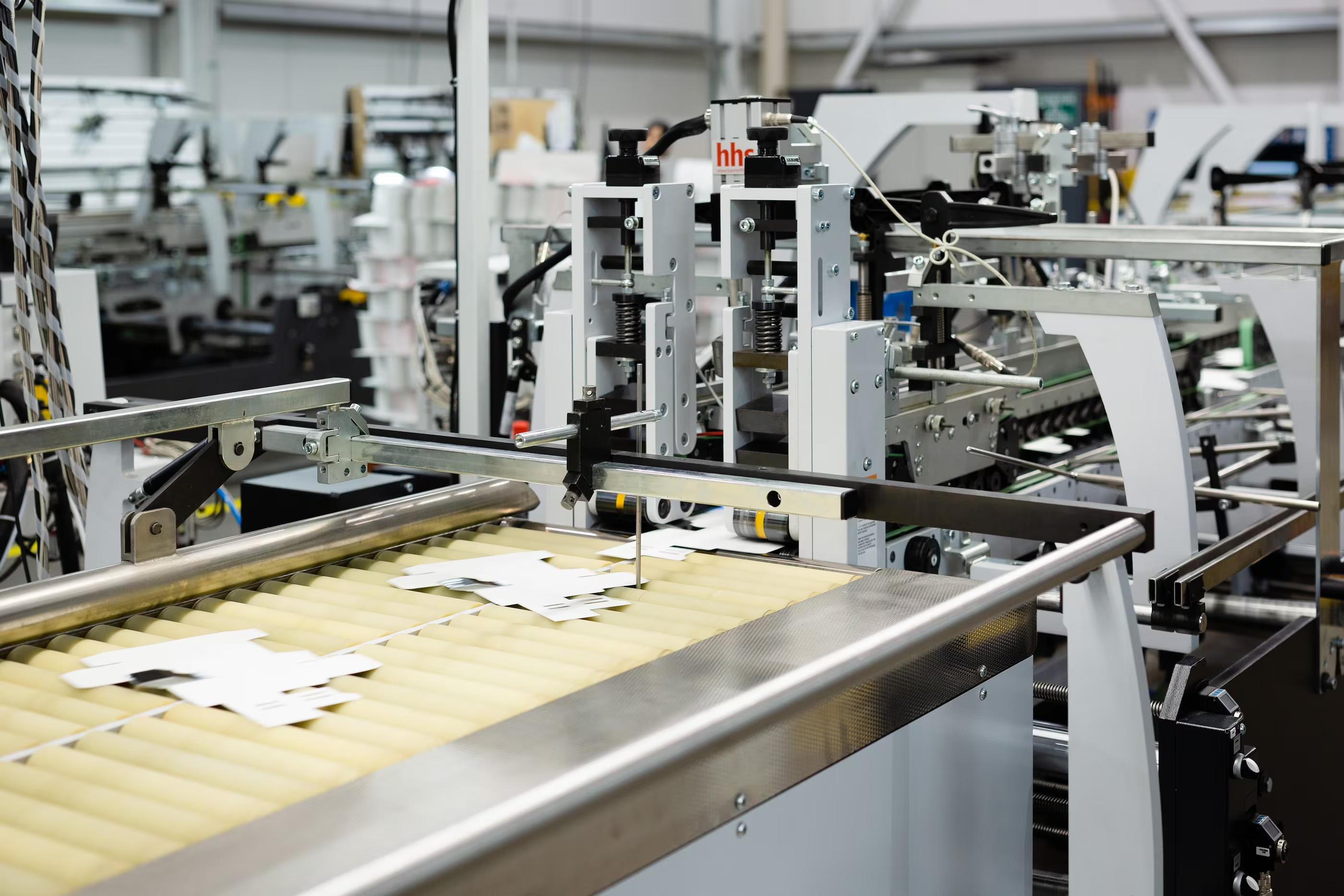
7. Folding and gluing
Carton blanks are folded along score lines and glued into their final form. This is the stage where structural engineering meets production reality — if scores are too deep, the board cracks; too shallow and it resists clean folding.
It is also the last stage before shipping, which makes it the most consequential checkpoint for quality. Arkay's Diana folder-gluers integrate AccuCheck — an AI-powered camera system that inspects every single carton at production speed, catching delamination, glue gaps, fold misregistration and print defects before any unit enters a shipping case. The system is calibrated by running the first 10 cartons of a job as a reference: AccuCheck learns the pattern, then kicks out any subsequent carton outside the established parameters. If a carton is kicked out for color, the tolerance can be adjusted in-line without halting the run. Learn more about AI-powered print technology in packaging.
8. Quality inspection and shipping
When inline AI inspection runs at stage 7, the final quality check is confirmation — not discovery. Cartons are packed into shipping cases, palletized and prepared for delivery.
For brands that have experienced the alternative — end-of-line manual sampling that misses systemic defects, leading to rejected shipments and emergency reprints — the difference between inline and end-of-line inspection defines whether a manufacturer is a reliable partner or a recurring problem.
What delays packaging production
Production delays rarely start at the press. They start in the decisions and handoffs that happen before and between stages.
Design changes after production starts. Every revision after plates are made restarts the pre-press cycle. Substrate already printed becomes waste. The downstream schedule shifts for every job behind it.
Material shortages from inconsistent supply chains. When a substrate is not available or arrives off-spec, production halts until a replacement is sourced and tested. This is why manufacturers with in-house materials management and established supplier relationships deliver more predictable timelines.
Color mismatches requiring reprints. Without G7 or equivalent color management, the gap between proof and press is a gamble. Rejected runs are the most expensive delay in packaging production — they consume substrate, press time and schedule simultaneously.
Offshore lead times and communication gaps. Sourcing from overseas adds weeks of transit time and introduces timezone coordination challenges. When an approval takes 24 hours per round because of a 12-hour time difference, a three-round revision cycle adds six days before a single sheet prints. Domestic manufacturing eliminates that compounding delay.
Finishing failures at production speed. A finish that holds on a hand-pulled sample but fails at 9,000 sheets per hour generates scrap at scale. Pre-production validation on actual equipment — not sampling — prevents this.
How to evaluate a packaging manufacturer's production process
Four questions that reveal whether a manufacturer can deliver predictably.
1. Where does every stage happen?
If printing, finishing, die-cutting and inspection happen in one facility, problems are caught and resolved in the same building. If they happen across multiple vendors and facilities, every handoff is a risk point for quality, timeline and specification accuracy.
2. What color management standard do they hold?
G7 certification, administered by IDEAlliance, is the industry benchmark for proof-to-press accuracy. A manufacturer that cannot demonstrate a verified color standard is asking you to trust their eye, not their process.
3. How do they catch defects?
Inline AI inspection checks every carton. Manual sampling checks a handful per run. The gap between those two approaches is the gap between catching a defect on carton 100 and discovering it on delivery.
4. Can they produce a mock-up before you commit?
A manufacturer that can show you a physical sample — on your substrate, with your finishing, from their actual production equipment — before a run locks reduces the single biggest source of production risk: discovering at delivery that the result does not match the expectation. Arkay offers this through its Paint on Press process and Design Studio — physical samples on actual production equipment before a run commits.
How Arkay manages the full production process
Arkay Packaging is a fourth-generation, family-owned premium folding carton manufacturer that has operated continuously since 1922. From its carbon-neutral facility in Roanoke, Virginia, Arkay manages every stage of packaging production under one roof — design, printing, finishing, die-cutting, folding, gluing and AI-powered inspection.
The production capabilities include 8-station sheet-fed offset presses with inline cold foil and two coating units, G7 color management certification, Bobst ExpertCut die-cutters, Diana folder-gluers with AccuCheck AI, and the proprietary Paint on Press process — all in a single 140,000 sq. ft. vertically integrated facility.
For brand teams across cosmetics, personal care, spirits and lifestyle goods, this means one partner manages every stage. From the Design Studio in Hauppauge where a concept becomes a physical mock-up in one week, through the press room where AI manages color on every sheet, to the glue line where cameras inspect every carton before it ships.
Ready to see how your packaging production program could work? Start a conversation with Arkay's team.
Frequently Asked Questions
What is packaging production?
Packaging production is the full sequence of manufacturing steps that transform a design file into finished, shippable packaging. For folding cartons, this includes structural engineering, substrate selection, pre-press and color management, offset printing, finishing (foil, embossing, coatings), die-cutting, folding, gluing, quality inspection and shipping.
What are the main stages of the packaging production process?
The main stages are design and structural engineering, substrate selection, pre-press and color management, printing, finishing, die-cutting, folding and gluing, quality inspection and shipping. Each stage builds on the previous one, and errors at any point cascade downstream.
What delays packaging production timelines?
The most common delays are design changes after production starts, material shortages from inconsistent supply chains, color mismatches requiring reprints, offshore lead times with communication gaps, and finishing failures at production speed. Most timeline overruns originate in handoffs between vendors or stages, not in the printing itself.
How long does packaging production take?
Timelines vary by complexity, run length and manufacturer. For folding cartons, a standard production run after design approval typically takes 2–6 weeks. Finishing complexity, multi-vendor production chains, offshore sourcing and design revision cycles extend timelines. Vertically integrated manufacturers with everything under one roof typically deliver faster because there are no handoff delays between stages. Arkay's single-facility model compresses this range, and its Design Studio produces physical mock-ups within one week to accelerate the design approval phase.
What should brands ask a packaging manufacturer about their production process?
Ask where every stage happens — one facility or multiple? Ask about color management certification (G7 or equivalent). Ask how defects are caught — inline AI inspection or manual sampling? Ask whether they can produce a physical mock-up before committing to a production run. And ask for references from brands with similar finishing complexity.
Does Arkay manage full packaging production programs?
Yes. Arkay manages every stage of packaging production — design, printing, finishing, die-cutting, folding, gluing and AI-powered quality inspection — under one roof in its 140,000 sq. ft. facility in Roanoke, Virginia. The vertically integrated model means brands work with a single manufacturing partner from concept through delivery, with no vendor handoffs between stages. Arkay serves cosmetics, personal care, spirits, food and lifestyle brands across both premium and mid-market categories.