
What Is Aqueous Coating
Every folding carton project reaches the same decision point: what finish, and why. The choice shapes how the package feels in a customer’s hand, how color reads on a crowded shelf, whether the carton stays recyclable, and what the run costs per sheet.
Aqueous coating sits at the center of that decision. It is a clear, water-based finish applied over printed paperboard as the final protective layer, dried with heat rather than cured with light. Because it can be applied inline — in the same pass as printing — it has become the default finish for folding carton production. With more than 100 years of manufacturing experience across four generations, Arkay engineers finish specifications alongside brand teams every day, and aqueous coating is where most of those conversations begin. This is a manufacturer’s guide to that finish: the variants, how it compares to UV coating and film lamination, the benefits that make it the default, and how it is applied.
Types of Aqueous Coating
Aqueous coating is not a single finish. Four variants cover the range of folding carton work, each distinctly changing the surface.
Gloss Aqueous Coating
Gloss is the most widely specified aqueous finish — a bright, reflective surface that amplifies color vibrancy, measuring roughly 30–70 gloss units at a 60-degree angle. It works across every ink type, including metallics, and can be overcoated later with UV or lamination. It is the natural choice for food packaging, cosmetics, and general consumer goods where vivid color and shelf presence carry the brand.
Matte Aqueous Coating
Matte is the counterpoint: a flat, non-reflective surface associated with premium restraint. It carries a useful, counterintuitive property — colors can appear richer under matte than under gloss, because no specular reflection washes out the tone. Matte aqueous is also pencil-receptive, and suits beauty, luxury spirits, and wellness brands that position on minimalism.
Soft-Touch Aqueous Coating
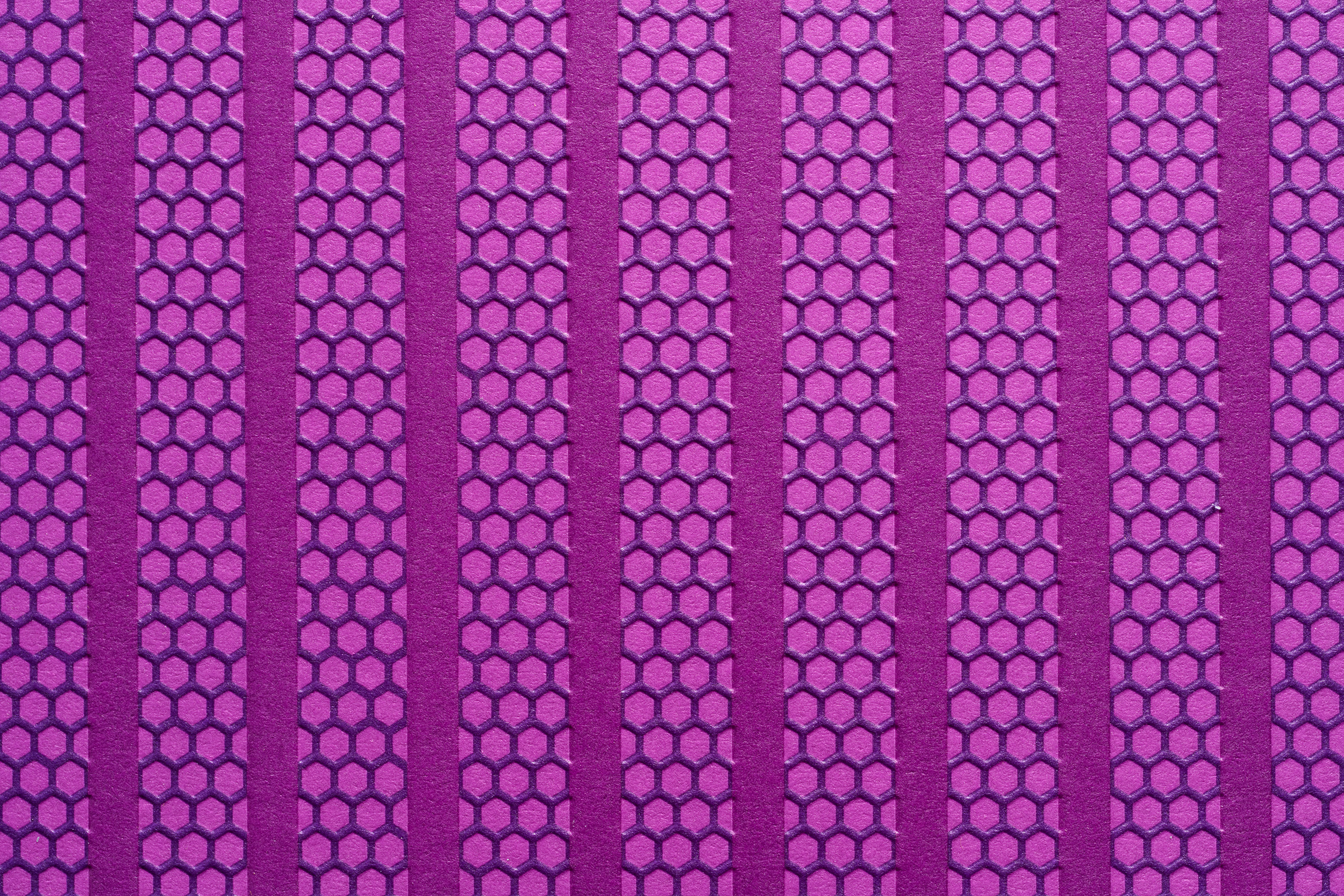
Soft-touch aqueous creates a velvety, suede-like surface through microscopic texture formed by particles suspended in the coating. It reads as matte in gloss level but adds a pronounced tactile quality the moment a customer picks up the carton. Its advantage over soft-touch film lamination is decisive for sustainability-minded brands: it is lower in cost and repulpable, whereas soft-touch film turns recyclable paperboard into composite waste. It suits luxury cosmetics, premium spirits, and wellness packaging where touch is part of the brand.
Satin Aqueous Coating
Satin sits between gloss and matte — a moderate sheen with a practical edge: it offers the best scuff resistance of the four aqueous variants. It is the right specification when a project needs to balance appearance with a measure of handling protection.
Aqueous Coating vs. UV Coating
The comparison that comes up most often is aqueous versus UV. Both are valuable; the right answer depends on the format.
The decisive factor for folding cartons is fold integrity. UV cures into a rigid, cross-linked film that fractures at score lines — a fundamental defect in a package designed to fold — and its stronger scuff resistance cannot compensate for a coating that cracks where the carton bends. UV earns its place when folding is not a factor, as in rigid display boards and luxury rigid boxes at 800 gsm and above, or when spot highlighting is the design goal. For folding cartons, the premium execution is not one or the other: it is an aqueous flood base with spot UV highlights.
Benefits of Aqueous Coating
Aqueous coating became the default for folding cartons because it delivers on the four things a carton finish has to balance — appearance, integrity, cost, and end-of-life.
- Fold integrity: it dries into a flexible film that will not crack when the carton is scored and folded, the single characteristic that makes it the standard for folding formats.
- Inline cost efficiency: applied in the same pass as printing, it adds no separate coating step, so it carries no per-sheet premium the way UV curing or a lamination pass does — which compounds across high-volume runs.
- Print and color performance: it preserves and often enriches printed color, and is compatible with every ink type, including metallics and cold foil, with no primer step.
- Food-contact options: food-safe formulations are available and widely used for food, pharmaceutical, and nutraceutical cartons, avoiding the photoinitiator migration risk that UV coating carries without a functional barrier.
- Light handling protection: it resists fingerprints, humidity, and minor splashes for normal retail handling — though it is not a moisture barrier (for that, film lamination is the right specification).
Sustainability and Recyclability
This is where a finish choice connects to a brand’s ESG commitments — and where the details matter, because broad claims do not hold up.
Aqueous-coated SBS paperboard remains a mono-material waste stream. The water-based film disperses during hot-water repulping, so no plastic fragments contaminate the paper pulp. Film lamination behaves differently: bonded BOPP or PET film typically pushes a carton past the 2% non-cellulose threshold used in the US, classifying it as composite waste that most facilities send to landfill. The polymer load tells the same story — aqueous coatings apply roughly 6 g/m² of polymer against 15–30 g/m² for PE and PLA laminates, 2.5 to 5 times less polymer per carton (Origin Sustainables; Verive.eu). Aqueous is also near-zero VOC and, because it is inherently PFAS-free, answers an accelerating regulatory trend: California and New York PFAS restrictions on food-contact packaging are taking effect through 2025–2026.
At Arkay, the finish and the substrate are aligned under the same sustainability framework. Arkay’s sustainability credentials — EcoVadis Platinum recognition, held in the top 1% of manufacturers globally consecutively since 2022 — sit alongside FSC-, SFI-, and PEFC-certified paperboard sourcing and CarbonNeutral® operations. Specifying aqueous coating on FSC- and SFI-certified board means the coating and the board carry the same responsible-sourcing logic through to end-of-life recyclability. Recyclability is anchored to the underlying paperboard, with finish compatibility assessed against it, and per-project spec documentation is available on request.
A note on food contact: aqueous coating is not automatically “FDA compliant.” Food-safe aqueous formulations are available and widely used for folding carton packaging, but the specific formulation must be matched to the intended use and verified accordingly.
How Aqueous Coating Is Applied
How a coating is applied matters as much as the coating itself — it drives cost, speed, and how the finished carton performs.
Inline Application: The Production Advantage
For folding carton production, aqueous coating is applied inline: a coater unit integrated directly into the offset press, typically as the last station in the press tower. The sheet moves from printing to coating in one uninterrupted pass. A laser-engraved anilox roller meters a precise film of coating, dual doctor blades scrape away the excess, and only the metered film transfers to the sheet.
Drying happens through infrared evaporation and forced air, generally at 100–140°C — there is no separate UV curing lamp. Because the water simply evaporates and the polymer particles fuse into a continuous film, the result is a flexible surface that will not crack when the carton is scored and folded. That single characteristic is why aqueous remains the standard for folding carton formats.
Flood Coat vs. Spot Coat
A flood coat covers the entire sheet: the standard inline method, most cost-effective, no registration required. A spot coat applies coating only to selected areas — a logo, an image, a highlighted panel — and in aqueous requires an offline silkscreen step using a photopolymer screen to mask the uncoated zones.
UV coating, by contrast, can be spot-applied in-line more readily. That is exactly why the two finishes are complementary rather than competing. When a design needs selective gloss or tactile contrast, a common premium execution is an aqueous flood base with spot UV highlights — pairing the recyclability and fold integrity of aqueous with the visual differentiation of spot UV.
Aqueous Coating vs. Film Lamination
Film lamination bonds a thin plastic layer — usually BOPP or PET — to the printed sheet in a separate machine pass.
For most standard retail folding cartons, film lamination is more than the job requires. It adds cost, slows production, and bonds a plastic film that turns recyclable paperboard into a composite that most recycling facilities cannot process. Lamination earns its premium in specific cases: e-commerce packaging that endures rough transit, ultra-luxury rigid boxes where tactile depth defines the unboxing moment, or applications that genuinely require a full moisture barrier. For brands with a sustainability mandate that still want a premium hand-feel, soft-touch aqueous coating preserves the feel without the recyclability trade-off.
When to Specify Aqueous Coating
The practical payoff is a clear decision framework.
Specify aqueous coating when the format is a folding carton and fold integrity is mandatory; when the package is for food, pharmaceutical, or nutraceutical use, where photoinitiator risk must be avoided; when sustainability and recyclability targets are in play; when the design includes metallic inks, cold foil, or embossing that a coating must not interfere with; or when the run is high-volume and the per-sheet UV premium multiplies across the order.
Consider UV coating instead when the application is a non-folding display board or rigid box, when scuff resistance above the aqueous ceiling is required for heavy transit, or when spot highlighting is part of the design brief. Consider film lamination when maximum durability is non-negotiable, as in e-commerce outer packaging, when an ultra-premium tactile experience calls for deeper haptic depth than aqueous delivers, or when a full moisture barrier is required.
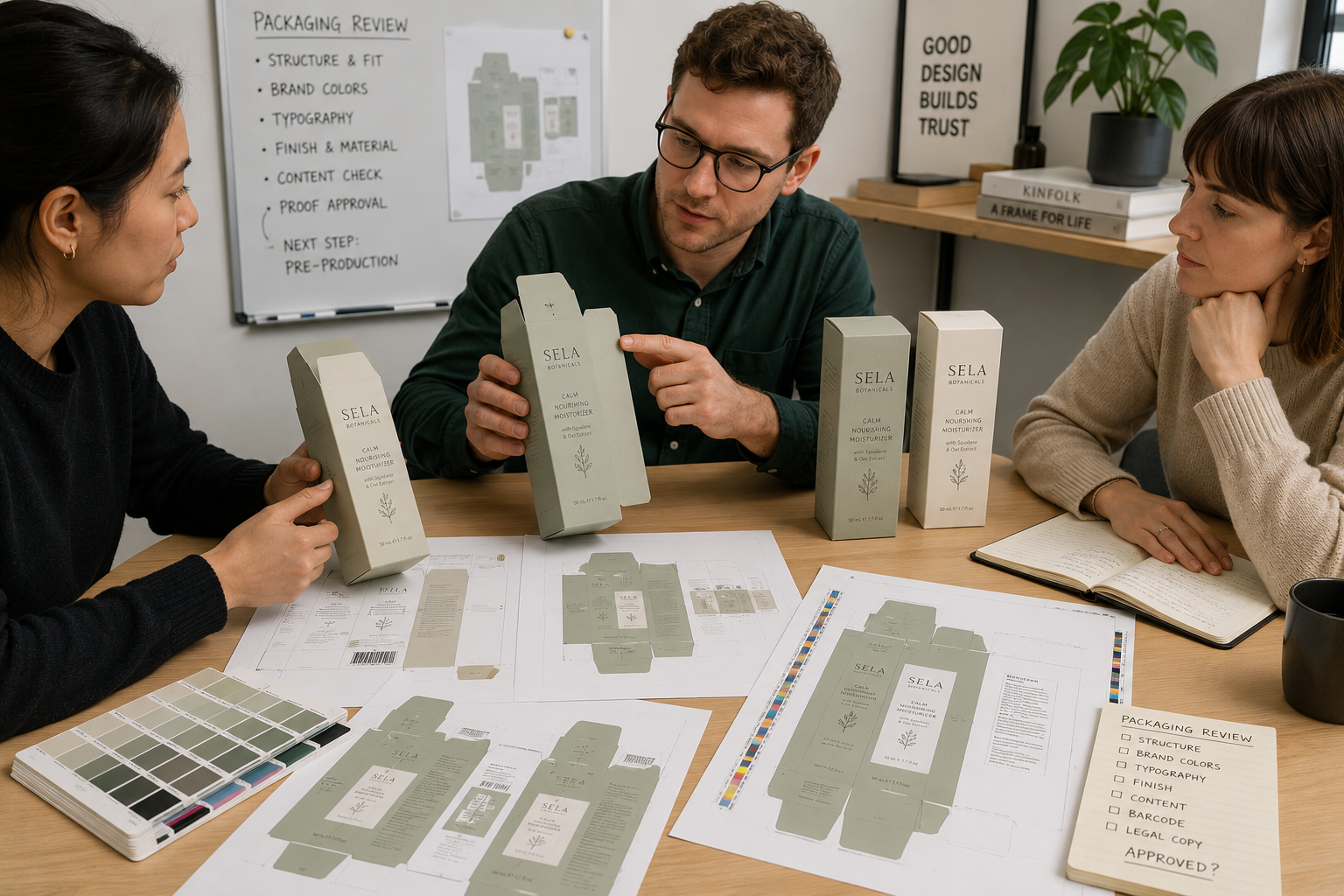
The most useful step is often to prototype before committing. Finish variants — gloss, matte, satin, and soft-touch — can be mocked up at Arkay’s Design Studio in Hauppauge, NY, typically within one week, so a team can evaluate the tactile and visual result in hand before a single sheet hits the press.
How Arkay Finishes Folding Cartons
Arkay’s finishing team has advised global beauty brands, leading consumer goods companies, and premium spirits labels through this exact decision for more than 100 years. Across four generations of family ownership since 1922, finishing has never been an add-on — it is central to what the company builds.
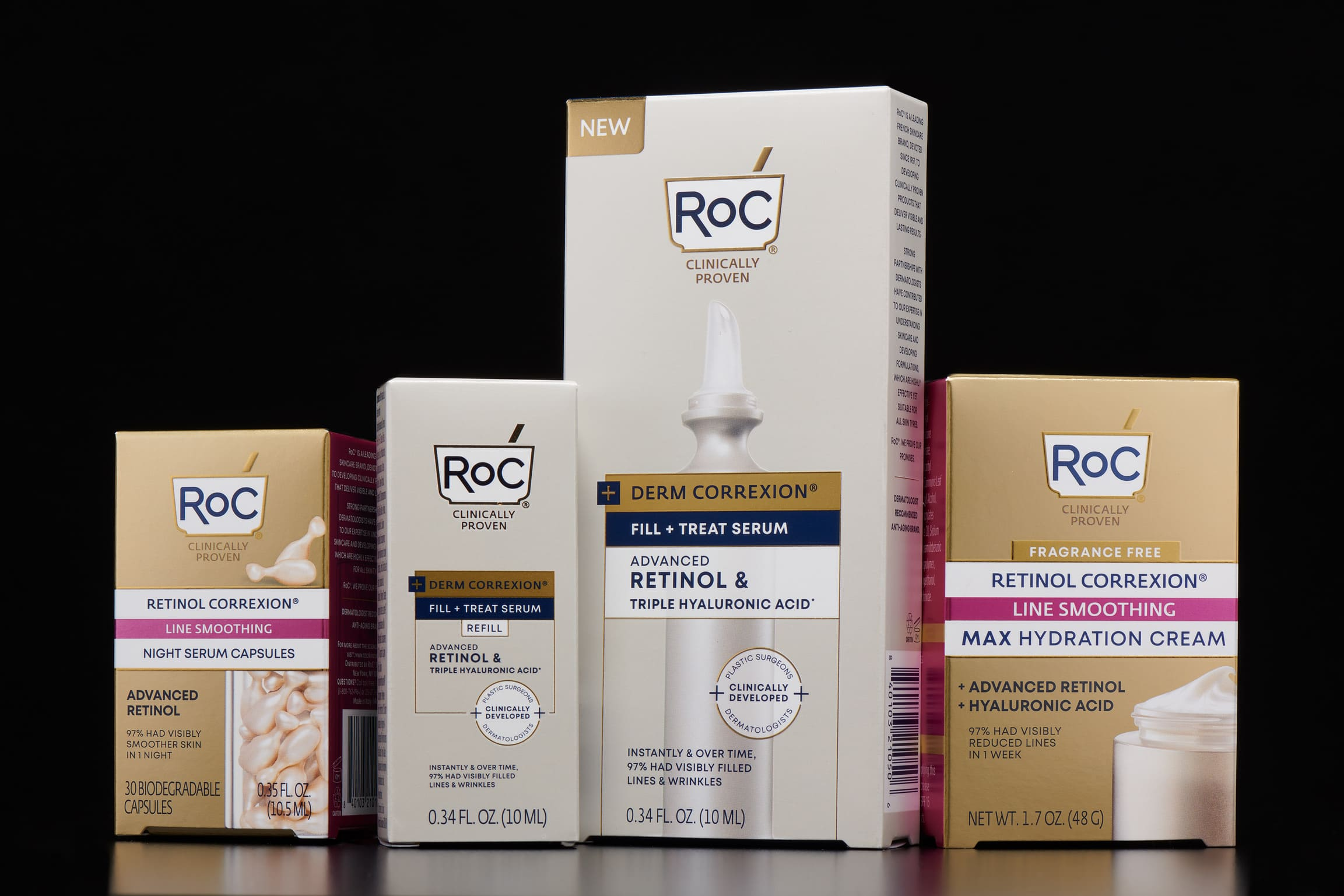
Inline aqueous coating is a standard production capability at Arkay’s 140,000 sq. ft. carbon-neutral facility in Roanoke, VA. Beyond the standard variants, two double flexo coaters connected to the main press allow inline pearlescent, gold, and silver coating effects — specialty finishes applied in the same pass as offset printing, without an additional press step. G7 color management certification keeps color consistent and predictable under aqueous coating from run to run, so a brand’s palette reads the same on the tenth run as on the first. These are among Arkay’s production capabilities that let the team match a finish to a brand’s goals rather than default to what is standard — working alongside brand and packaging design teams to specify what actually achieves the visual, tactile, and sustainability outcomes each project is after.
Talk to Our Finishing Team
Let’s talk about the right finish for your brand. Whether you are weighing aqueous against UV for a new folding carton line or exploring soft-touch aqueous as a recyclable alternative to lamination, Arkay’s team can help you specify with confidence.
Reach out to Arkay’s team to discuss your finishing specifications — or bring an idea to the Design Studio in Hauppauge, NY, and leave with a physical mock-up, typically within one week.
Frequently Asked Questions
What is aqueous coating, and how is it applied in packaging production?
Aqueous coating is a clear, water-based finish applied over printed paperboard to protect the surface and refine its look. It is the standard finish for folding carton production because it is applied inline on the offset press — metered by an anilox roller and dried with infrared heat and forced air in a single pass, with no separate coating step. That inline efficiency, combined with a flexible film that survives folding, is why most folding cartons ship with an aqueous finish.
How does aqueous coating compare to UV coating and lamination for folding cartons?
For folding cartons, aqueous coating wins on fold integrity, recyclability, and cost, while UV coating and film lamination win on scuff resistance and moisture barrier. UV coating cures into a rigid film that cracks at score lines, and film lamination bonds a plastic layer that most recycling facilities cannot separate from the fiber. Aqueous stays flexible and repulpable. The practical decision principle: specify aqueous when the carton must fold cleanly and stay recyclable, and reserve UV or lamination for rigid formats or heavy-transit durability.
What are the sustainability and print performance advantages of aqueous coating?
Aqueous coating is repulpable in standard paper streams when formulated appropriately, carries a far lighter polymer load than film lamination (roughly 6 g/m² versus 15–30 g/m²), is near-zero VOC, and is inherently PFAS-free. On press, it forms a flexible film that will not crack at fold lines, preserves and often enriches printed color, and is compatible with every ink type, including metallics and cold foil.
Is aqueous coating waterproof?
No. Aqueous coating is not waterproof. Because it dries by water evaporation rather than chemical curing, the film can re-emulsify under prolonged water exposure. It provides light moisture resistance for normal retail handling — humidity, fingerprints, and minor splashes — but it is not a moisture barrier. If a project requires a true moisture barrier, film lamination is the appropriate specification.
Is aqueous coating food-safe?
Aqueous coating formulations are available for food-contact adjacent applications and are widely used in food, pharmaceutical, and nutraceutical folding carton packaging. The specific formulation must be matched to the intended use, and food-contact suitability should be verified per application. Unlike UV coating, which carries a photoinitiator migration risk without a functional barrier layer, food-safe aqueous formulations avoid that concern.