What Is Die Cutting in Packaging?
Every folding carton begins as a flat printed sheet and has to become a three-dimensional box. Die cutting is the step that makes that possible.
In packaging, die cutting is the process of using a shaped steel tool — a die — pressed into a flat sheet of paperboard under controlled force to cut, crease, and perforate it into the exact shape that folds into a finished carton. In a single press stroke, the same die severs the outline and flaps, presses the fold lines, and adds any tear features, producing a carton blank ready for folding and gluing. (This is industrial packaging die-cutting on paperboard, a different scale and toolset from the craft die-cutting associated with home crafting machines.)
With more than 100 years spent turning printed sheets into cartons, Arkay treats die-cutting as one of the decisive stages in the build — the point where a design either becomes a carton that performs or a carton that fights the fold. This guide explains what die cutting is, how the process and tooling work, the main types, what it does beyond cutting, and its benefits.
How the Die Cutting Process Works
Die cutting looks like a single action, but it runs through several precise steps, and the tool doing the work is more sophisticated than a cookie-cutter analogy suggests.
- The cutting die: a steel rule is bent to match the die-line and set into a laser-cut base board. Crucially, one die holds three different rule types: a sharp cutting rule that severs the outline and flaps, a blunter creasing rule that presses a fold line into the board rather than cutting it, and, where needed, a toothed perforating rule that makes a partial-cut tear line for tear-strips or easy-open features.
- Makeready: before the run, the die is mounted and squared, cutting and creasing pressure is calibrated, and feed and registration are set. This setup is where a job is won or lost on precision, and experienced converters stage tooling in advance to cut changeover time.
- The press stroke: in flatbed die-cutting, the die sits in a stationary bed and a platen presses the sheet onto it, cutting, creasing, and perforating in one motion — a single pass per sheet.
- Nicks: tiny uncut bridges are left in the cutting rule so each blank stays tacked to the surrounding waste skeleton after the stroke — keeping parts from falling loose before the sheet is cleared.
- Stripping: the waste matrix around the blanks is removed, mechanically or by hand.
- Blanking: the finished blanks are separated from the sheet and stacked cleanly for the folder-gluer. The Paperboard Packaging Council calls this “a critical step — and a challenging one,” since coatings, embellishments, and paper stretch can all complicate clean separation.
The thread running through all of it is precision. Registration has to hold, the creasing matrix has to match the board, and the nicks have to be sized just right — small enough that blanks separate cleanly, large enough that nothing falls loose early.
Flatbed vs. Rotary vs. Digital: Types of Die Cutting
Not all die cutting is the same, and the method depends on the material and the run.
- Flatbed (platen) die-cutting uses a steel-rule die in a stationary bed and a reciprocating press stroke. It typically runs 1,000 to 7,000 sheets per hour, with modern presses exceeding 9,000 in optimized setups (BMC Pack; Paperboard Packaging Council, 2019), and handles thicker, rigid stocks with tight registration and fine creasing control, which makes it the standard for folding cartons and structural precision work. This is Arkay’s method.
- Rotary die-cutting uses a cylindrical die that rolls continuously over the material, reaching 10,000 to 30,000-plus sheets per hour (BMC Pack). It suits thinner, flexible substrates — labels, films, and continuous corrugated lines — and high-volume corrugated production, rather than premium folding cartons.
- Laser and digital (no-die) cutting use a laser or a CNC-guided blade to cut directly from a digital file with no physical tooling. Their value is prototyping, intricate one-off patterns, and short runs where a design change is just a file edit. They are best understood as industry context and a prototyping tool — not the production method for folding cartons at scale, where a steel-rule die holds tighter creasing and lower per-unit cost.
Arkay’s production model is offset printing paired with traditional flatbed steel-rule die-cutting. Digital and laser cutting have their place earlier in the process, for proofing a structure, but the finished production run is die-cut on a flatbed press.
What Die Cutting Does Beyond the Cut
The cut is only part of the job. What separates packaging die-cutting from simply cutting a shape is everything that happens in the same pass.
Creasing is the most important of these. The creasing rule presses a channel into the board at each fold location so the carton folds cleanly at a defined line. The width of that channel — the matrix — has to be matched to the board caliper; too narrow for the stock, and the score cracks the surface fibers instead of folding them. Perforation adds tear-strips and easy-open features. Window cutting creates the apertures that show the product, placed so the opening reveals the item without leaving the panel prone to buckling — a structural choice as much as a visual one.
Die-cutting precision also has to align with finishing. When a carton is embossed, the emboss has to register precisely against the die-cut outline and score lines on the same sheet — a tolerance Arkay holds to ±0.3mm. And the die-cut feeds everything downstream: a misaligned cut produces panels that will not fold square, glue tabs that miss, and cartons that fail on a customer’s automated filling line. The quality of the die-cut is, in effect, the quality of the finished carton.
The Benefits of Die Cutting
Die cutting earns its place in carton manufacturing because it delivers several things at once that no other method matches at volume.
- Precision and consistency at scale: a single die reproduces the exact same cut, crease, and perforation across an entire run — the tenth thousand carton matches the first.
- Custom shapes: a die can be engineered for virtually any outline, enabling structural differentiation beyond a plain rectangle.
- Clean, repeatable folds: correct creasing geometry produces consistent folds without cracking, run after run.
- Speed and efficiency at volume: modern flatbed presses cut, crease, and perforate in one high-speed stroke.
- Cost-effectiveness once amortized: a die is reusable tooling, so a custom shape becomes economical over the life of a program.
- Structural creativity: combined with creasing and perforating, die-cutting is what makes windows, tear-strips, hinges, and unconventional geometry possible on a flat sheet — the foundation of premium packaging structure.
How Arkay Die-Cuts Folding Cartons
Die cutting is where a die-line stops being a drawing and becomes a physical carton — and it is one of Arkay’s core manufacturing capabilities.
With four generations of manufacturing behind it, Arkay runs flatbed Bobst die-cutters held to tight registration, integrated with printing, finishing, and gluing under one roof at its 140,000 sq. ft. facility in Roanoke, VA. Cutting on SBS paperboard from 14 to 28pt, the team calibrates the die and pressure to each caliper, engineers the creasing matrix to fold cleanly without cracking, and sizes nicks so blanks strip and stack reliably for the folder-gluer. Because the die-cut sets up folding, gluing, and performance on a brand’s fill line, that precision is not a detail — it is what keeps a carton running clean instead of jamming.
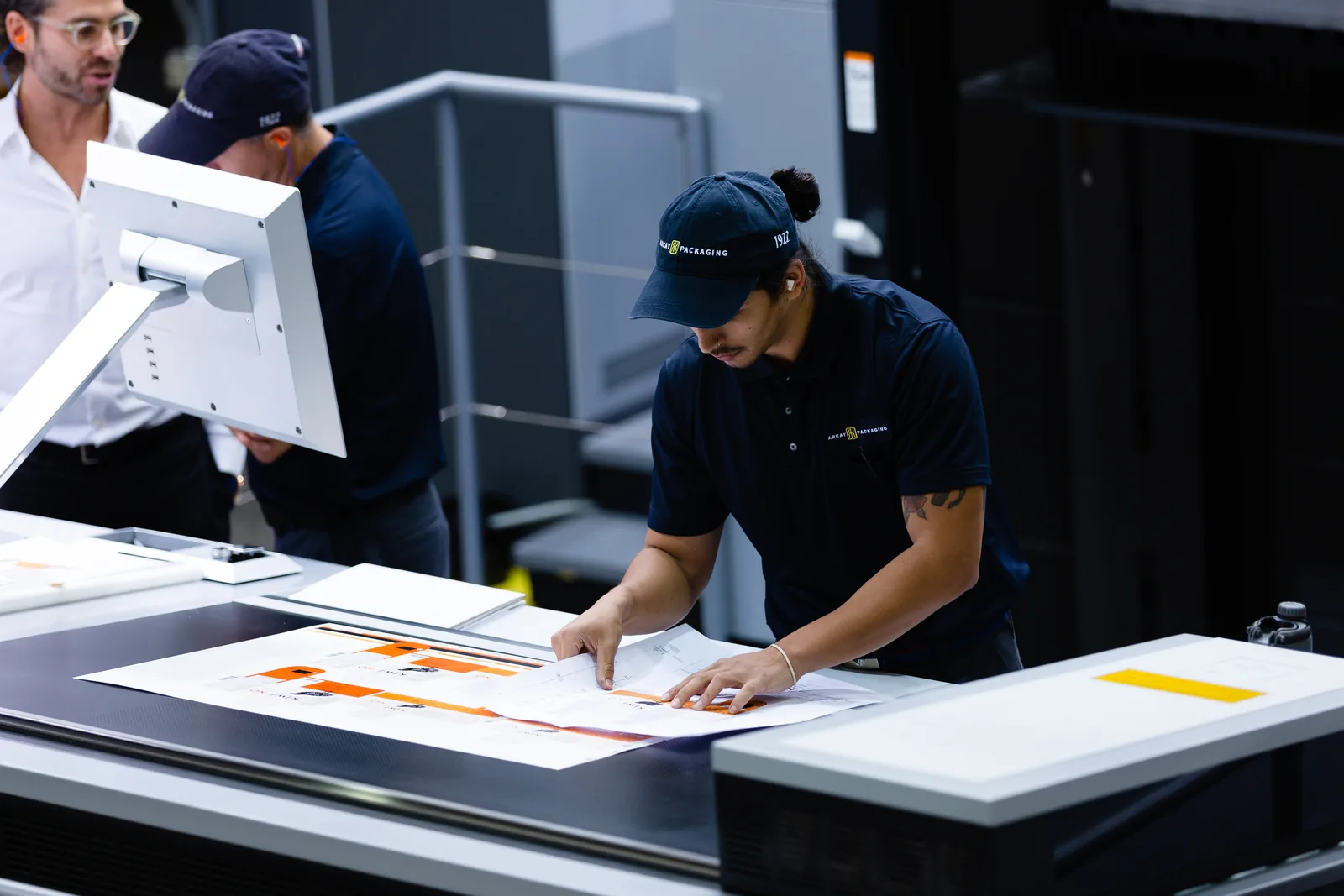
These are among the manufacturing capabilities that let Arkay hold the whole build — print, finish, cut, and glue — to a single standard, visible on the production floor. For categories like cosmetics and beauty, where a carton’s structure and windows are part of the brand, that die-cutting precision is what makes an ambitious structure manufacturable at production volume.
Get Your Carton Cut Right
Let’s talk about the structure behind your carton. Whether you are engineering a custom shape, adding a window or tear feature, or troubleshooting a carton that cracks or jams, Arkay’s die-cutting and structural team can make sure the cut performs from the first sheet to the last.
Reach out to Arkay’s team to discuss the die-cutting and finishing behind your folding cartons.
Frequently Asked Questions
What is the difference between die cutting and scoring?
They are two jobs done by the same die with different tools. Cutting uses a sharp steel rule to sever the board — the carton’s outline and flaps. Scoring, or creasing, uses a blunt, rounded rule to press a channel into the board at each fold so it bends cleanly without cracking. A folding carton die does both in one stroke: it cuts the shape and scores every place the flat sheet needs to fold.
Does a cutting die wear out or need replacing?
A steel-rule die is durable, reusable tooling that produces very large volumes of blanks, but it is not permanent — the cutting rule dulls and the ejection rubber compresses with use, and a worn die shows up as ragged cuts or parts that will not strip cleanly. A well-maintained die is checked for rule height and re-rubbered or re-ruled as needed, which is part of why die quality and upkeep separate a consistent converter from an inconsistent one.
Why do die-cut score lines sometimes crack?
Grain direction and coating matter as much as the crease itself — a fold across the grain resists and cracks more readily than one along it, and heavy coatings or aged, dry board make the surface fibers more brittle. The crease geometry has to suit the board on top of that. The reliable safeguard is engineering the fold to the specific substrate and grain, then confirming it on a physical sample before the full run rather than discovering it on the line.
Can any shape be die cut, or are there limits?
A die can be engineered for almost any two-dimensional outline, which is what makes custom carton shapes, windows, and tear features possible. The limits are structural rather than graphical: very small or intricate features can be fragile, and a window or cutout has to be placed so it does not leave the panel prone to buckling. The practical test is a physical sample — a shape that looks right on screen still has to hold up folded, filled, and shipped.
What is an example of die cutting in packaging?
A straight tuck-end cosmetics carton is a common example. A single flatbed die cuts the panel outline and tuck flaps, creases every fold line so the flat sheet folds into a box, and can perforate a tear-strip if the design calls for one — all in one press stroke, repeated identically across the entire run.