
What Is Packaging Automation
Packaging automation is the use of machinery, robotics, software, and control systems to perform packaging tasks — product handling, forming, filling, sealing, labeling, and palletizing — that were once done by hand. It does not simply swap human effort for machinery; it runs those steps at fixed, repeatable cycle times, shifting the human role toward line oversight, changeovers, and exception-handling rather than piece-by-piece work.
The pressure to automate is real and rising. In its 2025 State of the Industry reporting, PMMI attributed continued growth in packaging machinery investment directly to labor shortages and demand for smart, connected equipment, with productivity ranked the top priority across surveyed operations and 65% of them planning to add automation, cobots, or robotics in the year ahead (PMMI, 2025). Automation, in other words, is no longer a question of whether but of where on the line it pays off first.
With more than 100 years engineering folding cartons across four generations, Arkay comes at the subject from the production floor — it does not sell packaging machinery, it makes the cartons that run on it. This guide covers what packaging automation is, how automated systems work, the efficiency benefits, and one variable those systems depend on that is easy to overlook: the carton itself.
How Automated Packaging Systems Work
An automated packaging line is a sequence of stations, each handing the product to the next.
- Product handling and orientation: incoming product is identified and positioned, often by conveyors and robotic arms, ready for the packaging step.
- Forming and erecting: flat carton blanks or cases are pulled from a magazine and erected into their three-dimensional shape.
- Filling and loading: product is placed into the carton, by hand-off, drop, or robotic pick-and-place.
- Sealing, gluing, and closing: flaps are folded and bonded, typically with hot-melt adhesive on a precise timing cycle.
- Labeling and coding: batch codes, barcodes, and shipping information are applied and verified.
- Inspection: automated checks confirm weight, seal integrity, and completeness before the pack moves on.
- Case packing and palletizing: finished cartons are consolidated into cases and stacked for shipment, increasingly by robotic cells.
These stations run at one of several levels of automation. Semi-automatic systems keep a person in the workflow — loading product or clearing exceptions — while fully automated lines run the sequence with minimal intervention. Underneath sit the classic automation types: fixed automation for a single high-volume sequence, programmable automation reprogrammed between batches, and flexible automation that adjusts to SKU changes with little downtime. Most consumer-brand operations blend them, adding robotics and machine vision at the stations where consistency and speed matter most.
How Packaging Automation Improves Production Efficiency
The case for automation comes down to consistency at speed.
Manual packing is bound by fatigue, training, and staffing. Automated stations execute the same motion the same way every cycle, including unattended runs, and their sensors surface bottlenecks and downtime events so plant teams can schedule predictive maintenance instead of reacting to breakdowns. The effect is concentrated at a single station: systems integrators report that adding a robotic palletizing cell can cut a line’s labor cost by roughly half and lift its throughput by more than a third (PASCO Systems). The takeaway is not the exact figure — it is that automating the right step removes a labor-bound ceiling that manual handling can never lift.
But consistency cuts both ways. An automated line rewards inputs that are equally consistent and punishes those that are not. High-volume categories such as technology and electronics packaging run fast enough that a small, repeated variance in the carton compounds into real downtime — which is where the carton itself becomes part of how a line performs.
How Carton Design Affects an Automated Line
Here is the failure mode packaging engineers describe most often: a carton that looks perfect on the table jams the machine every few minutes. Beautiful box, terrible to run.
The reason is that an automated cartoner is mechanically unforgiving in a way a human packer is not. It is calibrated to a specific thickness, a specific squareness, a specific fold behavior — and it cannot compensate for variance the way a person’s hands do. A carton that passes a visual quality check can still stop a line calibrated to fractions of a millimeter. The variance that matters is not visible.
Several carton properties drive machinability:
- Dimensional tolerance. Automatic lock-bottom erectors need tolerances on the order of half a millimeter to self-square and lock; a glue flap even slightly too long can jam the loading process (QIN Printing).
- Caliper consistency. Feeders and formers are set to one board thickness. A caliper shift of as little as 5% can stop automated filling equipment — too thick and it jams, too thin and it forms loosely (ÉLITER Packaging Machinery).
- Grain direction and scoring. Paperboard fibers move far more across the grain than along it, so a score folded against the grain springs back and can crack at line speed rather than folding clean.
- Board freshness and moisture. Paperboard is a living material. Its opening force — how reliably a flat blank pops into shape on a high-speed line — degrades as the board ages and its moisture drifts, which is exactly when curl and warping start causing jams.
None of this is abstract. Case-erector jams trace to a handful of causes, and “irregularities in the blank from the carton supplier” sits near the top of the list (A-B-C Packaging). The cost is cumulative: a jam every ten minutes can add up to hours of lost uptime each week, and tens of thousands of dollars a year in lost productivity (Lantech). A single carton defect — excess adhesive that bonds a case shut before it even reaches the erector — is a manufacturing failure, not a machine failure. The line stops, but the box is the cause.
This is why packaging quality assurance belongs upstream of the client’s line, not just at final inspection. The defects that stop automated equipment are the ones a manufacturer has to catch before the cartons ever ship.
Designing Cartons for Automation
So can a carton manufacturer make cartons that run reliably on automated lines? Yes — it is one of the core responsibilities of structural design, not something only the machine vendor controls.
Design for automation begins with the closure. Straight-line and proven closure styles erect and lock predictably at speed; interlocking tabs, unusual fold sequences, and multi-piece constructions look distinctive but often need to be re-engineered before they scale onto a fast line. Good structural packaging design balances two audiences at once: the shelf, where the carton has to earn attention, and the machine, where it has to run clean.
Premium finishes do not have to be sacrificed for machinability. Foil, embossing, and specialty coatings can be engineered to hold the dimensional consistency an automated line requires — provided the tolerances are settled at the design stage rather than discovered on the line. And the most reliable safeguard is validation before commitment: proving fold quality, product fit, closure function, and automated-line compatibility on a physical white sample before a full run of substrate is ever committed.
That work is collaborative by nature. A folding carton is one part of a packaging system that also includes primary containers and filling equipment the brand owns, so the specifications have to be matched to the line, not dictated to it.
How Arkay Builds Automation-Ready Cartons
With more than 100 years of manufacturing experience across four generations, Arkay engineers cartons to hold their specifications from the first run to the last — because on an automated line, consistency is the whole game.
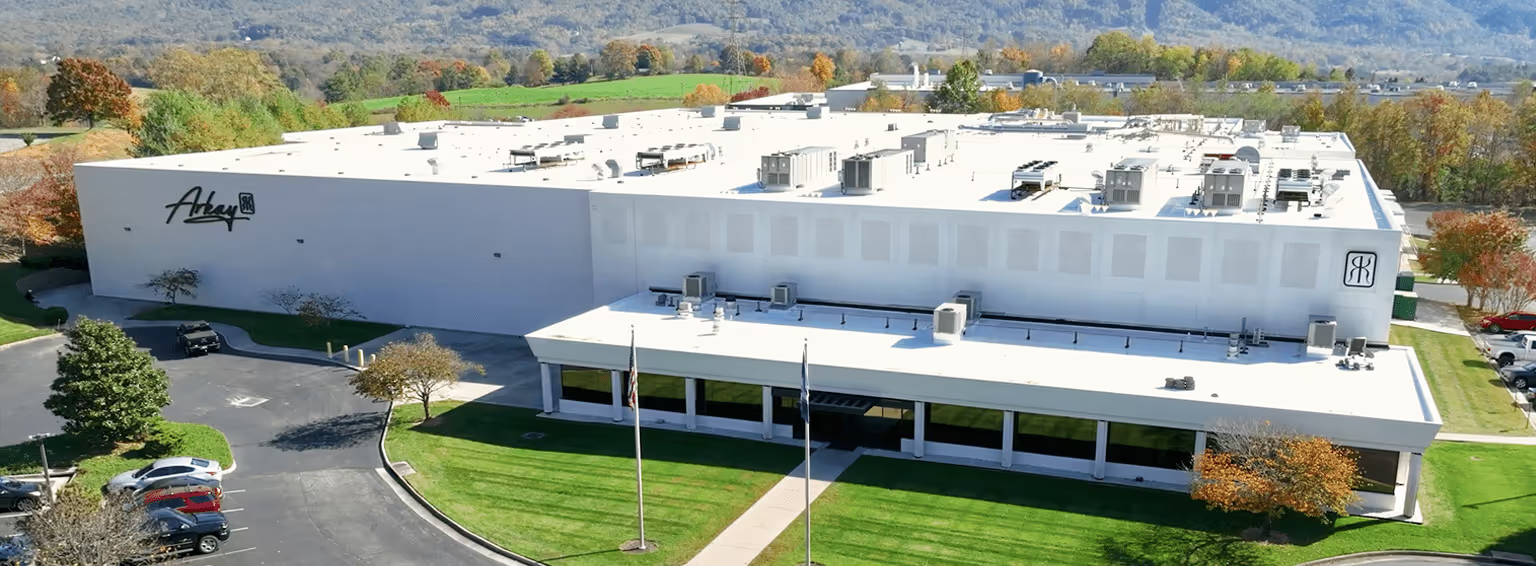
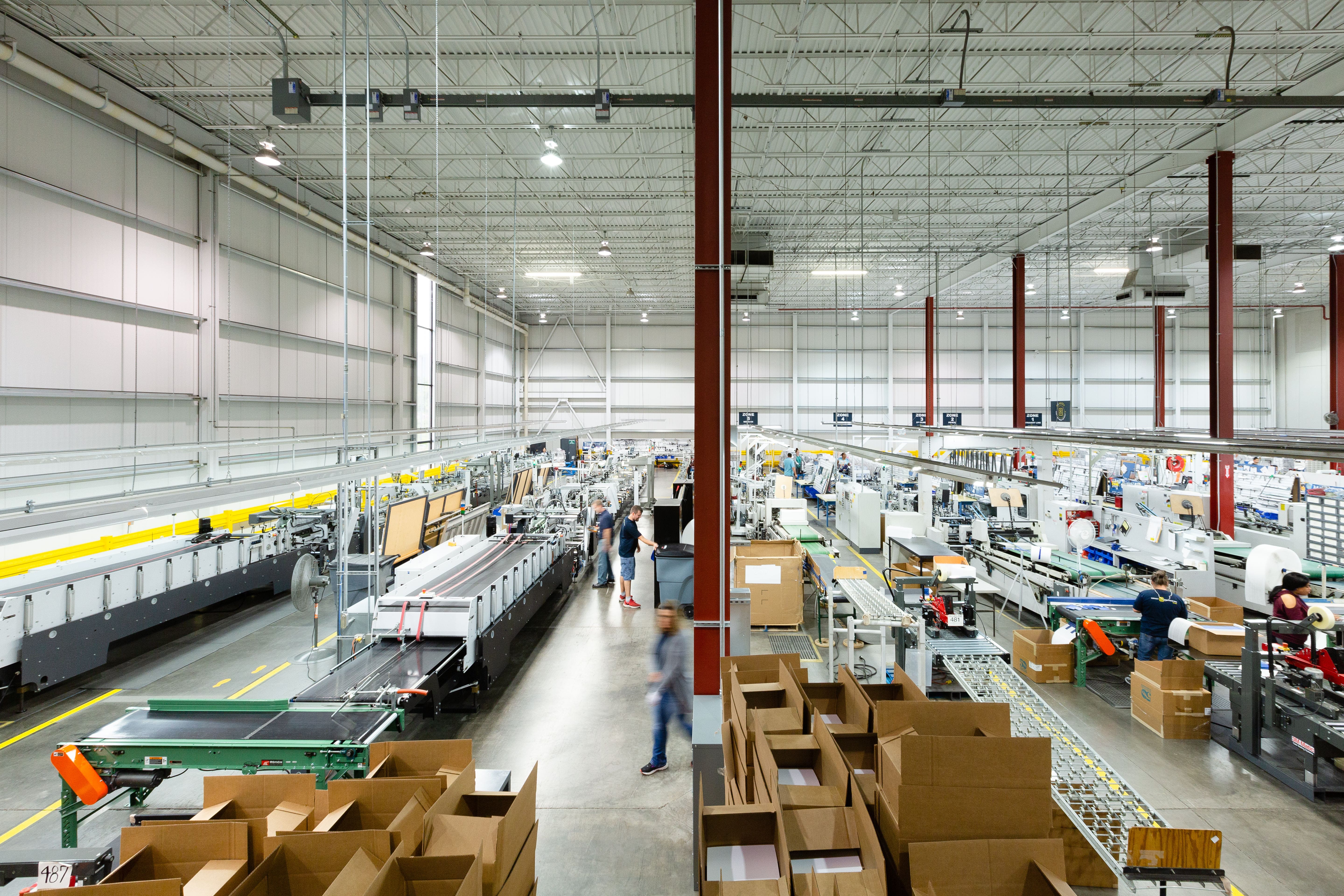
Precision is built into the equipment. Arkay’s Heidelberg presses integrate AI-assisted color management for run-to-run consistency, its Bobst die-cutters hold tight cutting and creasing accuracy, and its two Diana gluers apply AI-assisted defect and adhesion detection so a carton with a compromised glue joint is caught before it can pop open in a customer’s case erector. Inline inspection verifies the work as it runs, not after. These are among Arkay’s production capabilities that turn design-for-automation from an intention into a measured output — offset printing and finishing under one roof at a 140,000 sq. ft. carbon-neutral facility in Roanoke, VA.
Domestic manufacturing matters here more than it first appears. Because paperboard’s opening force degrades over months, a shorter path from board to press to a brand’s line means fresher board and more reliable erection at speed. Producing domestically shortens that window, where offshore supply chains extend it — one of the quieter reasons a carton either runs all shift or fights the machine. It is the same discipline visible on the production floor: control the variables the machine cannot forgive, so the line does not have to.
Let’s Keep Your Line Moving
Let’s talk about the packaging that runs clean on your line. Whether you are specifying cartons for a new automated fill line or troubleshooting a box that keeps jamming an existing one, Arkay’s team can engineer a carton built for both the shelf and the machine.
Reach out to Arkay’s team to discuss your line specifications — or bring an idea to the Design Studio in Hauppauge, NY and leave with a physical mock-up, typically within one week.
Frequently Asked Questions
What are the four types of automation?
The four commonly cited types are fixed automation (one unchanging sequence for high-volume, single-SKU production), programmable automation (reprogrammed for batch runs when the product changes periodically), flexible automation (adapts to SKU changes with minimal downtime), and integrated automation (all three unified into one coordinated line). Most consumer-brand packaging lines combine several of these across erecting, filling, sealing, and palletizing.
Can premium or custom-finished cartons still run on automated lines?
Yes — the safeguard is proving it before full production. Finishes such as foil, embossing, and soft-touch coatings can subtly change how a blank feeds, grips, and folds on a cartoner, so running a physical sample on representative equipment confirms the finished carton behaves like a plain one. When that proofing happens at the prototype stage rather than mid-run, a premium finish and a reliable automated run stop being a trade-off.
What should we ask a carton supplier before automating our packaging line?
Ask for documented dimensional tolerance bands, board caliper consistency across print runs, and confirmation that the carton style matches your specific erecting and closing equipment. A supplier who can show these with data — not just claim a carton is “automation-ready” — is the one protecting your line uptime.
Is packaging automation only cost-effective at high volume?
No. Semi-automatic and entry-level equipment has lowered the volume threshold considerably. On the carton side, specifying for machinability is worth doing at any volume, because it protects you if and when you scale onto a faster automated line later — a carton engineered to run clean does not need to be redesigned when throughput increases.
Does automation-compatible carton design also reduce material waste?
Yes, indirectly but meaningfully. A carton engineered to run cleanly on an automated line avoids the jams, misfeeds, and rejects that waste both material and press time. That precision at the design stage complements the material precision automated filling and sealing equipment already brings to a line.