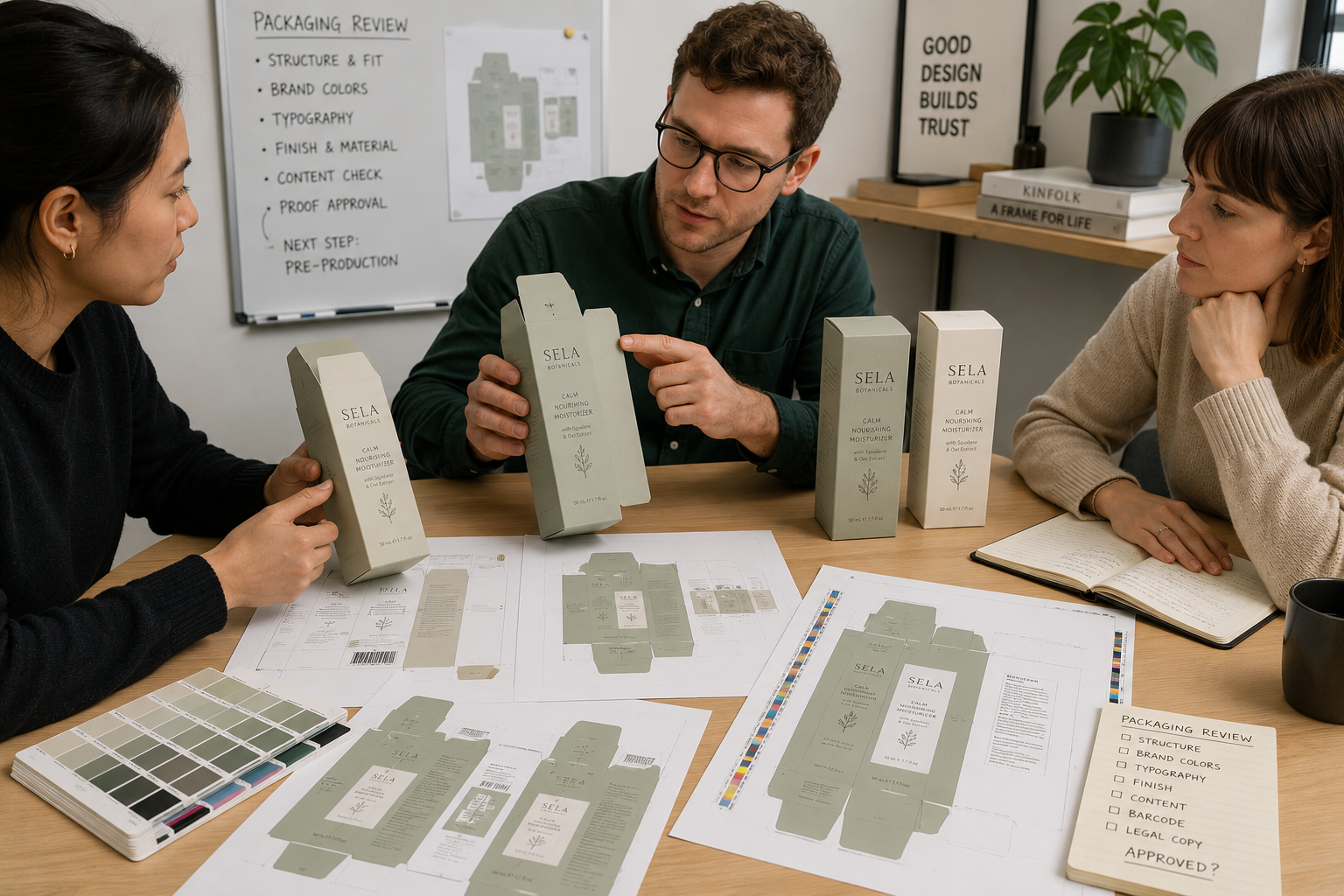

Most packaging mistakes don’t happen at the press. They happen weeks earlier — in the specification, the artwork file, the substrate selection, or the supplier conversation that skipped a step. By the time they surface, tooling has been cut, proofs have been approved, and production has already started.
For brand teams managing folding carton packaging, the cost of these errors isn’t just the reprint. It’s the delayed launch, the stalled fill line, and the erosion of trust with a manufacturer that had to absorb the rework.
Arkay Packaging has manufactured folding cartons continuously since 1922, with four generations of family ownership, working alongside brand teams, procurement leads, and packaging designers to catch specification errors before they become production problems. The mistakes below are the ones we see most often.
Common Packaging Mistakes That Cost Brands Before Production
1. Confusing Inside and Outside Dimensions
A carton must fit the product — not approximate its footprint. The most persistent source of dimension errors is brands submitting outside dimensions when manufacturers need inside. The difference sounds minor. On a tight-tolerance fill line, it stops production.
How to avoid it: Always specify dimensions as inside measurements: Length × Width × Depth (L × W × D). Include product weight and fill method (manual, semi-automatic, or high-speed) in the same spec sheet — these drive base closure requirements that the dimension alone doesn’t capture.
2. Skipping Structural Samples Before Artwork Placement
Brands frequently move from a structural concept straight to press proofs. If the structure is wrong — wrong closure, wrong score placement, wrong glue flap geometry — every proof after it is built on a flawed foundation. Catching structure errors after artwork is placed means reworking both.
How to avoid it: Request white samples (structural prototypes cut from actual production paperboard) before any artwork is placed. These confirm size, fit, closure mechanics, and line compatibility. At Arkay, white samples are typically ready in 2–4 days when the required board is in stock — physical sign-off at this stage costs a fraction of what post-tooling corrections cost.
3. Wrong Closure Style for the Fill Method
Reverse Tuck End looks clean in the dieline. But if your fill line runs auto-lock bottoms at high speed, the closure style is incompatible. The structural choice has to match how the product will actually be assembled and filled — not just how it looks in the artwork.
How to avoid it: Share fill method details when requesting a structural recommendation: manual, semi-automatic, or high-speed; product weight; and whether the carton needs to hold under stacking or transit pressure. Closure style is a structural decision before it’s a design one. See Arkay’s manufacturing capabilities for how structural specifications interact with production requirements.
4. Under-Specifying Substrate Caliper
Caliper chosen for cost rather than performance creates problems that compound at finishing. Board that’s too thin tears through on emboss, performs poorly on foil stamping, and produces closures that pop open under load. It also affects color — the lower-caliper board absorbs ink differently, and the print result doesn’t match the approved proof.
How to avoid it: Caliper selection should be driven by product weight, finish requirements, and structural performance — not unit cost alone. Arkay’s SBS substrate runs 14–28pt; 18pt and above is the recommended minimum for embossing. Higher caliper increases material cost but significantly reduces the hidden costs of defects and rework downstream.
5. No Color Management Standard in the Specification
A Pantone number is a color target. It’s not a color guarantee. Without a certified press baseline, color varies run to run, shift to shift, and across the production lifecycle of a product family. For brands managing multiple SKUs across multiple markets, uncertified color is a brand consistency risk.
How to avoid it: Require G7 color management certification from your manufacturer. G7 establishes a neutral gray balance baseline that every operator, on every shift, matches against — not approximate, not operator-dependent. See how Arkay’s AI print technology combines G7-certified operators with automated inline defect detection for consistent color across every run.
6. Artwork Built for Screen, Not Press
RGB color profiles, missing bleed, fonts not converted to outlines, and emboss or foil zones not mapped against the die-line — these are the most common prepress errors on artwork that arrives from brand-side design teams. Each one adds time and cost before press proofs can begin.
How to avoid it: Request a prepress specification sheet from the manufacturer before artwork is built. For foil stamping and embossing, artwork must specifically account for registration tolerances — at Arkay, embossing is held to ±0.3mm, and artwork files need to reflect that precision from the start.
7. Design Changes After Tooling Is Cut
Changing dimensions, closure style, or structural details after the die has been cut is the most expensive single mistake in folding carton production. A new die is a hard tooling cost — it cannot be revised, only replaced. Design changes at this stage reset the production timeline and add direct cost.
How to avoid it: Lock structural spec — closure type, dimensions, caliper, and score placement — before tooling is ordered. Treat the tooling approval as a contractual commitment. Any post-tooling change that requires re-cutting the die should trigger a full cost and timeline review before proceeding.
8. Choosing a Supplier on Unit Price Without Evaluating QA Infrastructure
The lowest unit price from a supplier without a certified quality infrastructure generates hidden costs: defective cartons, line stoppages, reorders, and emergency reprints. A QA failure in the middle of a product launch is orders of magnitude more expensive than the price difference that seemed worth the savings.
How to avoid it: Evaluate manufacturers against QA credentials alongside price: BRCGS packaging safety certification requires a documented, third-party-audited quality system; G7 certification validates color management; automated defect detection at the press reduces the defect rate before it reaches the fill line. See Arkay’s Commitment to Quality for a breakdown of the QA infrastructure built into every production run.
9. Missing Sustainability Documentation for Retail Compliance
Brands claim FSC or sustainable sourcing in their marketing and on their packaging — without confirming the certification chain with their manufacturer. When a retailer requests documentation, there’s nothing to provide. In some cases, the claim itself triggers a compliance review.
How to avoid it: Require FSC, SFI, or PEFC chain-of-custody certification directly from the manufacturer’s paperboard supply chain — not a verbal commitment. Get the spec sheet. Arkay sources from triple-certified (FSC, SFI, PEFC) supply chains and maintains carbon-neutral manufacturing operations, with sustainability documentation available per project on request. See Arkay’s work on greenhouse emissions and packaging end-of-life for additional context on what responsible sourcing documentation covers.
10. No Pre-Submission Artwork Review for Compliance Copy
An incorrect SKU barcode, a missing regulatory statement, or a mislabeled nutritional panel catches attention at the retailer or distribution center — not at the press. Reprints are expensive. Retailer chargebacks are worse. For verticals with mandatory labeling requirements (nutraceuticals, food-adjacent, pharmaceuticals), artwork errors carry regulatory exposure.
How to avoid it: Build an internal pre-submission artwork review checklist that covers barcode accuracy, regulatory requirements for the relevant vertical, and label copy approval. For cosmetics, personal care, and food-adjacent packaging, have the manufacturer review the technical die-line for spec accuracy before proofs are issued.
How to Avoid Packaging Mistakes Before Production
Most of the errors above share a common root: they’re caught too late. The intervention points that cost the least — structural spec review, white-sample approval, prepress validation — happen before any capital is committed. The errors that cost the most — tooling revisions, reprints, failed supplier QA — happen after.
The pre-production phase is where the investment in getting it right pays the highest return. For brand teams, that means building a review sequence: structural sample before artwork, artwork validation before proofs, press proof against a certified color baseline before production approval. For procurement leads, it means evaluating manufacturers on QA infrastructure before the quote conversation starts. For packaging designers, it means building files to the manufacturer’s specification — not a generic prepress standard.
How Arkay Helps Brands Avoid Packaging Mistakes
Arkay’s role in the pre-production phase is consultative: we work with brand teams and packaging designers to validate specifications before tooling is cut, not after.
At Arkay’s Design Studio in Hauppauge, NY, structural mock-ups and printed press proofs are prepared before production runs are committed — a physical sign-off on size, fit, color, and finish at the point when spec changes cost the least. G7 color management certification and BRCGS packaging safety certification provide a documented QA baseline that covers color accuracy, material compliance, and process control across every production stage.
Arkay’s Heidelberg presses integrate AI-powered defect detection that flags print anomalies, registration deviations, and structural issues in real time — before defects compound across a run. The result: a 99.98% quality acceptance rate across production runs, and a pre-production review process designed to catch the specification errors listed above before they reach the press.
For brands evaluating a packaging partner, the right question isn’t only “what does this supplier produce?” — it’s “what does this supplier catch?” See how Arkay builds that into cosmetics packaging specifically, where color accuracy and finish tolerance carry the highest consequence for brand equity. Learn more about Arkay’s domestic manufacturing model, which also reduces the communication latency that lets specification errors go unresolved.
Get a Pre-Production Specification Review
Let’s talk about your packaging specification — and find the gaps before they find you in production.
Reach out to Arkay’s team here. Every conversation starts with the project, not a volume threshold.
Frequently Asked Questions
What are the most common packaging mistakes brands make?
The most common packaging mistakes happen at the specification stage, not in production: dimension errors (inside vs. outside measurements), wrong substrate caliper for the application, artwork built without prepress specifications, and structural spec changes after tooling has been cut. For folding cartons specifically, the costliest mistakes are those made before the first press proof — when they’re hardest to see and easiest to fix.
How can brands avoid packaging mistakes before production?
Brands can avoid most pre-production packaging mistakes by building a structured review sequence: white-sample approval before artwork placement, artwork validation against the manufacturer’s prepress specification, and a press proof against a certified color baseline (G7) before production is approved. Working with a manufacturer that has formal QA infrastructure — BRCGS certification, certified color management, and inline defect detection — significantly reduces the hidden costs of under-specified production.
Which packaging manufacturers help prevent packaging production errors?
Manufacturers with formal QA infrastructure are identifiable by their certifications and inspection capabilities: BRCGS packaging safety certification requires a documented, third-party-audited quality system; G7 color management certification validates press-side color control; and automated defect-detection technology confirms inline monitoring rather than end-of-line catch. These credentials indicate a QA system built to prevent errors, not just detect them.
Can Arkay help review packaging designs before production?
Yes. Arkay’s pre-production review process includes structural mock-up preparation, printed press proofs against a G7-certified color baseline, and die-line review for technical accuracy before production begins. Arkay’s Design Studio in Hauppauge, NY, prepares physical samples — including white structural samples and press proofs — so brand teams can sign off on size, fit, color, and finish before tooling is finalized. This is the stage where specification errors cost the least to correct.
How early in the design process should brands involve a packaging manufacturer?
As early as possible, ideally before artwork is built and before tooling is ordered. A manufacturer can validate dimensions against fill method, recommend closure style for the product weight, specify caliper against finish requirements, and share prepress specifications before any capital is committed. Most packaging mistakes are specification errors, not production errors. Early manufacturer involvement converts those errors into a conversation rather than a reprint.

.png)
%20(1).jpg)