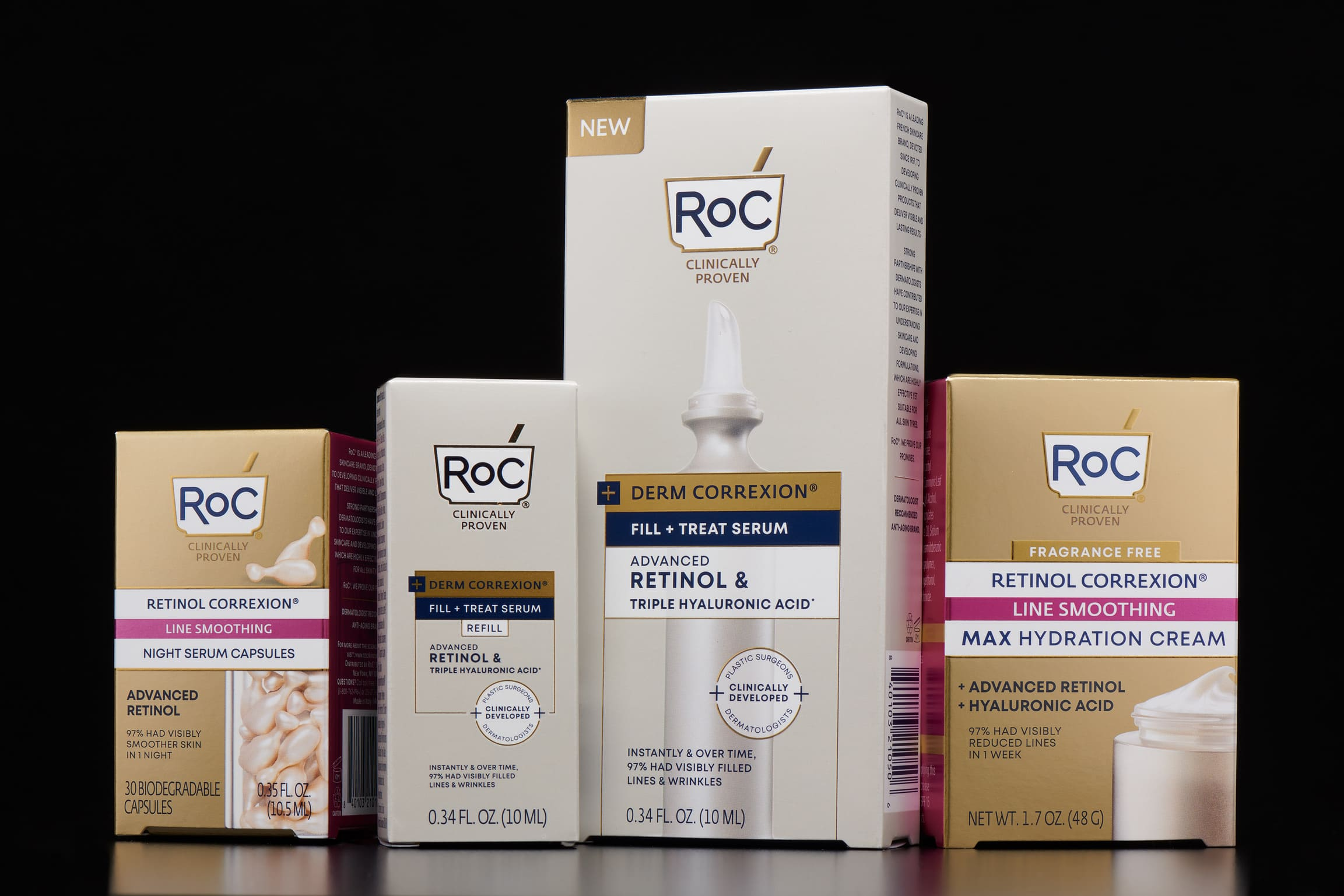

Secondary packaging is the outer layer of packaging that holds, protects, and presents the primary container — the folding carton around the fragrance bottle, the sleeve around the eye cream jar, the printed box around the supplement. It makes no direct contact with the product, but it does nearly all the visible brand work at retail.
For most premium consumer goods, secondary packaging is the first surface a shopper sees and judges — before they open the box, before they handle the product inside. That moment of judgment is short: a few seconds of shelf scanning, a tactile read of the carton in hand. Surface, structure, color, and finish fill those seconds.
Secondary packaging is also where finishing decisions live — embossing, foil, coating effects, and color precision that separate a $50 fragrance carton from a commodity box. With more than 100 years of finish-led folding carton manufacturing across four generations, Arkay Packaging has spent its history engineering exactly that layer. This is a practitioner’s view of what secondary packaging needs to do, and what it takes to make it perform.
What Is Secondary Packaging?
Secondary packaging holds and protects one or more primary packaged products and presents them at retail. It sits between the product-contact primary layer and the bulk transport tertiary layer — which means it has to perform two jobs simultaneously: survive distribution and earn attention on shelf.
Primary, secondary, and tertiary packaging each have a distinct function: - Primary makes direct contact with the product — bottle, tube, jar, vial. Engineered for product integrity and fill compatibility. - Secondary is the outer layer the shopper handles — folding carton, sleeve, printed box. Where brand communication is concentrated. - Tertiary is the bulk freight layer — corrugated shippers, pallets, stretch wrap — that never reaches the consumer.
The responsibility for brand impression sits almost entirely on the secondary layer. Primary packaging is engineered around the product. Tertiary packaging never reaches the shelf. Secondary packaging is the one layer that has to perform in both environments.
The Role of Secondary Packaging in Retail Distribution
Secondary packaging performs two jobs at once. The first is protection: the carton has to shield primary packaging from crush, abrasion, humidity, and handling damage across a distribution chain that may span months and thousands of miles — while carrying the UPC, retailer compliance labeling, and structural specs for safe palletizing.
The second job is presentation. Retail attention is brutally short. Shoppers form an impression in a few seconds of shelf scanning, well before they read a label. Ipsos, on behalf of the Paper and Packaging Board (2018), found that 72% of Americans say packaging design often influences their purchase decisions, and 63% perceive paper and cardboard packaging as premium or high-quality. Secondary packaging is not a cost to minimize — it is a brand asset that measurably shifts purchase behavior.
Types of Secondary Packaging
Three formats dominate consumer goods secondary packaging. The right choice depends on product category, price point, and retail channel.
Folding Cartons
Folding cartons are the default secondary packaging format for premium consumer goods — beauty, personal care, fragrance, nutraceuticals, and consumer electronics at the $30-and-above price point. They earn that position by balancing four things at once: branding surface area, structural protection, production scalability, and sustainability credentials.
The substrate of choice for premium folding cartons is SBS — solid bleached sulfate paperboard. Its smooth, bright-white surface accepts precision offset printing and advanced finishing more cleanly than alternative boards. Caliper runs across a 14–28pt range, with premium applications typically specified at 18pt and above for the structural integrity retail conditions demand; 28pt is the practical ceiling. Within that range, the carton is printed offset, finished, and die-cut to a custom structure engineered for the specific product.
Folding cartons are also the format where finishing delivers the most visible brand impact. Embossing and debossing, foil stamping, soft-touch coatings, and inline coating effects — pearlescent, gold, and silver applied via double flexo coater — all live here. That is the layer that separates premium secondary packaging from commodity boxes, and it is the layer on which Arkay has built its manufacturing capabilities.
Rigid Boxes
Rigid boxes — sometimes called set-up boxes — are the ultra-premium format, used where the packaging itself signals value: jewelry, prestige fragrance gift sets, and collector editions. They cost significantly more per unit and are manufactured on different equipment from folding cartons. They are worth understanding as a category, but they are a distinct product line; Arkay’s secondary packaging product is the folding carton, not the rigid box.
Corrugated Display Cases
Corrugated display cases function as shelf-ready packaging (SRP) for retail display, primarily in mass-market grocery and club channels. They prioritize structural integrity and print legibility over surface finish, and they serve a different audience and production profile than premium folding cartons. They round out the format picture, but they sit outside the premium folding carton work that defines Arkay’s scope.
What Makes Secondary Packaging Perform on Shelf
This is where most brands underinvest — and where no generic explainer goes. Performance on the shelf comes down to four engineering dimensions, and premium brands feel the difference in all of them.
1. Substrate Selection
Substrate is a strategic decision, not just a spec. SBS caliper and surface treatment determine how cleanly finishes adhere, how light reflects off the printed surface, and whether the carton holds its shape under the pressure of retail handling. The right board within the 14–28pt range is what lets a foil-stamped logo land crisp and a soft-touch coating feel the way a prestige brand intends. The wrong board undermines every finishing decision layered on top of it.
2. Color Management
For a beauty brand managing one brand color across a dozen SKUs and multiple production runs, color drift is a brand-integrity problem. G7 color management certification exists to solve it — ensuring that specified PMS values reproduce consistently from run to run and SKU to SKU. The takeaway: color accuracy is not a print nicety but a brand-standard requirement, and it is one of the clearest separators between a precision manufacturer and a commodity supplier.
3. Surface Finishing
Finishing is the brand-differentiation layer. Embossing and debossing add tactile dimension; foil stamping adds metallic contrast; soft-touch coatings change how the carton feels in hand; and inline flexo coating effects deliver pearlescent, gold, and silver via double flexo coaters connected to the press. Arkay’s proprietary Paint on Press process — developed under Chairman Emeritus Howard Kaneff — applies coordinated effects inline at up to 20 variations, which is what gives finish-led cartons their depth without bolting on extra finishing passes.
4. Structural Precision
Structure decides whether the package works in the real world. Score placement, tuck style, and die-line accuracy determine whether the carton folds square, holds shape on the shelf, and opens cleanly for the consumer. Embossing registration tolerance of ±0.3mm is what keeps a raised logo aligned exactly where the design intends. These are the details that separate a carton that presents flush at retail from one that bows, gaps, or tears at the score.
Requirements for Secondary Packaging
Compliance and sustainability requirements for secondary packaging have grown more complex as retailers embed procurement criteria into their supplier guidelines. Brands now need their secondary packaging to clear multiple requirement types before it reaches the shelf.
Retail compliance requirements typically cover GS1-compliant barcode placement (UPC/EAN), GTIN registration, and retailer-specific shelf-ready packaging (SRP) structural specs for mass and club channels. Each major retailer has its own planogram-specific barcode position, quiet-zone, and size requirements — and compliance failures result in chargebacks.
Regulated-category requirements apply when secondary packaging is destined for food-adjacent, nutraceutical, or medical device products. BRCGS packaging safety certification — which Arkay holds — provides the third-party documentation that the carton meets packaging material safety standards required by buyers in these categories.
Sustainability requirements have moved from voluntary to contractual for many major retail relationships. Arkay anchors that requirement in documented, third-party credentials: its SBS is sourced as FSC-, SFI-, and PEFC-certified paperboard. The Roanoke facility operates carbon-neutral and holds CarbonNeutral certification, and Arkay has consecutively held EcoVadis Platinum recognition — the top 1% of manufacturers globally — since 2022. Those are the sustainability certifications procurement teams can verify and audit.
Recyclability of a finished carton is assessed at the project level. Arkay’s sustainability spec sheets — covering substrate certification, finish composition, and recyclability characteristics — are available per project on request.
How Arkay Engineers Secondary Folding Cartons
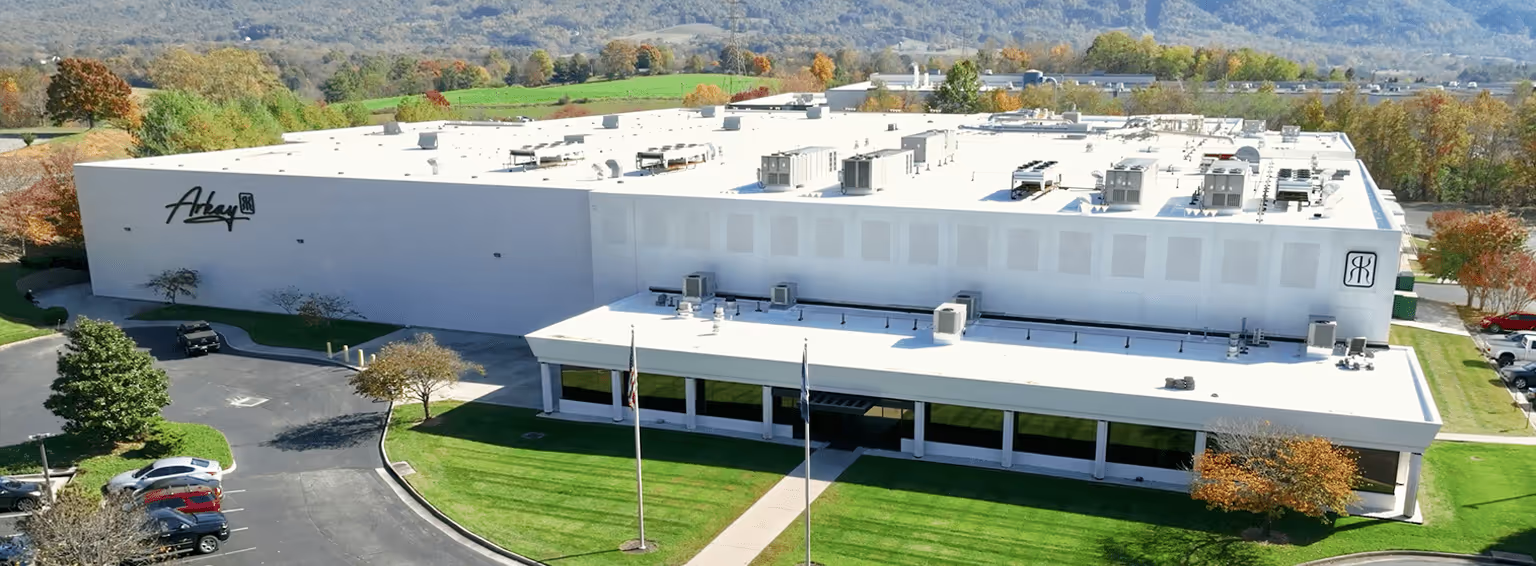
Arkay Packaging is a fourth-generation, family-owned premium folding carton manufacturer that has operated continuously since 1922. From a 140,000 sq. ft. carbon-neutral facility in Roanoke, Virginia, Arkay delivers finish-led secondary packaging for cosmetics, personal care, fragrance, spirits, and lifestyle brands — combining precision color management, proprietary finishing, and vertically integrated production under one roof. Across more than 100 years and four generations of family ownership, the work has stayed narrow on purpose: folding cartons, engineered well.
That focus shows up in the finishing. G7 color management holds brand color across runs. Paint on Press, developed under Chairman Emeritus Howard Kaneff, coordinates inline finishing effects. BRCGS packaging safety certification covers cartons destined for regulated categories like food and nutraceuticals. And the secondary production process — embossing, foil, coating, and die-cutting — is where the carton earns its shelf presence.
The bridge between a brand team’s design intent and what a press can actually execute is often where projects stall. Arkay’s Design Studio in Hauppauge, New York, exists to close that gap: brand teams can bring an idea and leave with a physical or printed digital mock-up, typically within one week — as fast as one day when urgency demands it — with production-ready prototypes following in roughly 7–10 days, depending on the project. For a brand without an in-house packaging engineer, that turns a design concept into a producible carton without a long back-and-forth. Producing those cartons domestically also keeps the supply chain tight — shorter lead times, IP protection, and same-timezone communication are part of why Arkay is proudly made in America, which matters most for brands working against fixed launch windows.
Arkay does not set fixed minimum order quantities, every engagement is evaluated case-by-case based on project fit. The conversation starts with what the packaging needs to do, not a volume threshold.
Start A Conversation With Us
Let’s talk about the right secondary packaging for your brand.
Whether you are launching a new SKU, scaling a product line, or rethinking how your packaging performs on shelf, Arkay’s team can help you engineer a folding carton that protects the product and earns its place at retail. With more than 100 years of finish-led manufacturing behind it, Arkay partners with brand teams , not as a vendor, but as a manufacturing partner.
Reach out to start a conversation about your project. If you are working in beauty, Arkay’s cosmetics packaging capabilities; for skincare and wellness products, see personal care and wellness packaging.
Frequently Asked Questions
What is secondary packaging?
Secondary packaging is the outer layer of packaging that holds and protects the primary container — the box around the bottle, the sleeve around the tube, the carton around the jar. It makes no direct contact with the product and carries the bulk of the brand’s visual communication at retail. For a prestige fragrance, the glass bottle is primary; the foil-stamped folding carton that presents it on the shelf is secondary. Secondary packaging sits between the product-contact primary layer and the bulk transport tertiary layer, and it is the only layer the shopper sees and touches in-store.
How is secondary packaging different from primary and tertiary packaging?
Primary packaging contacts the product directly — bottle, tube, vial — and is engineered around product safety and fill compatibility. Secondary packaging is the branded outer layer the shopper handles at retail: folding carton, sleeve, printed box. Tertiary packaging is the bulk freight layer — corrugated shippers, pallets — that never reaches the consumer. The practical implication: primary decisions are driven by product engineering, tertiary decisions by logistics cost, and secondary decisions by the intersection of distribution protection and brand performance on the shelf.
What are the most common types of secondary packaging?
For premium consumer goods, three formats cover most applications: folding cartons (printed SBS paperboard, the standard for beauty, personal care, and nutraceuticals), rigid set-up boxes (ultra-premium format for prestige fragrance and gift sets), and corrugated display cases (shelf-ready packaging for mass and club channels). Within folding cartons, format choice is further refined by structural style — straight-tuck, reverse-tuck, auto-bottom — and substrate caliper, which determines how much finishing the structure can support. Folding cartons account for the majority of premium CPG secondary packaging volume.
What compliance requirements does secondary packaging need to meet for major retailers?
Major retail buyers typically require: GS1-compliant UPC or EAN barcode placement meeting retailer-specific size, position, and quiet-zone specs; GTIN registration for each SKU; shelf-ready packaging (SRP) structural specs for club and mass channels; and, for supplements, food-adjacent products, or medical devices, BRCGS packaging safety certification documenting that the carton meets packaging material safety standards. Sustainability requirements have also become procurement criteria at major retailers, with many now requiring certified-fiber documentation (FSC, SFI, or PEFC) and recyclability information for finished cartons.
Is secondary packaging recyclable?
Recyclability of a finished folding carton is assessed at the project level. SBS paperboard substrate is broadly accepted in paper recycling streams. The finish layer requires evaluation: heavy foil stamping, certain laminations, and multi-layer coatings each need project-level review against recycling stream compatibility. For brands substantiating recyclability claims to retailers or consumers, the key documentation is substrate certification (FSC/SFI/PEFC), finish composition details, and — for formal claims — independent validation through a program such as How2Recycle. Arkay provides sustainability spec sheets per project covering substrate, finish composition, and recyclability characteristics.
What is the production timeline for custom secondary packaging?
Custom secondary packaging timelines depend on project complexity and finishing specifications. Arkay’s Design Studio in Hauppauge, New York, produces physical or printed digital mock-ups in as fast as one day, with production-ready prototypes typically following in 7–10 days. Domestic manufacturing in Roanoke, Virginia, eliminates the freight uncertainty and lead-time variability associated with offshore production. For brands working against fixed launch windows, U.S.-based manufacturing and same-time-zone communication typically make the schedule more predictable.
What secondary packaging materials work best for the beauty and personal care industry?
SBS (solid bleached sulfate) paperboard is the standard substrate for premium beauty and personal care secondary packaging. Within the 14–28pt caliper range, the right specification depends on the product’s weight, carton dimensions, and the finishing load the structure will carry. A lightweight eye cream carton in 18pt SBS performs very differently under retail handling than a heavy fragrance gift set that may need 22–24pt or higher to hold its geometry. Misspecifying the caliper is one of the most common avoidable structural errors — it either leaves board strength on the table or adds unnecessary cost. The right starting point is always product weight, carton dimensions, and the retail conditions the package will face.