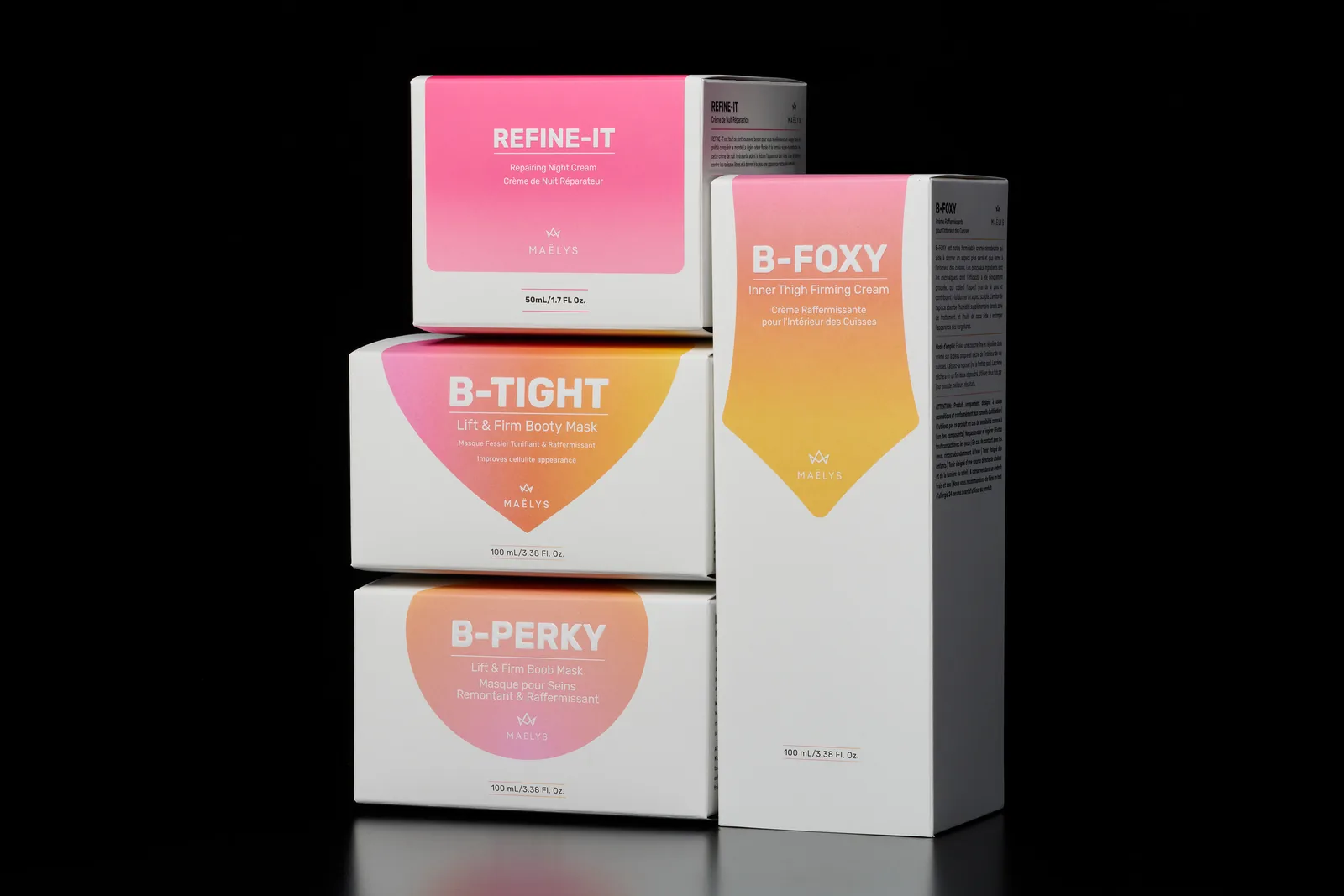

Skincare packaging has to protect an unstable formula, carry a growing list of legal copy, and sell the product on a shelf. This guide covers what the carton does, how to choose the board, and what has to fit on the panel.
Why Skincare Needs Special Packaging
Skincare is harder to package than most consumer products, for one reason: the thing inside is chemically unstable.
The actives that sell a product are also the ones that break down. Vitamin C, particularly L-ascorbic acid, oxidizes on contact with air and degrades on exposure to light, heat and moisture. Retinol breaks down in light, heat and oxygen. Peptides, plant oils and many natural extracts behave similarly.
What matters for packaging is the word photolabile, meaning light-sensitive. And the detail most brands miss is that this is not only about UV. Visible light degrades several common actives too. A tinted bottle may block ultraviolet while letting plenty of visible light through. An opaque carton blocks all of it.
That gives skincare packaging three jobs that ordinary consumer packaging does not have:
- Protect an unstable formula from light, air, moisture and heat
- Carry legally required copy that keeps growing, on a small pack
- Sell the product on a crowded shelf or as a thumbnail online
Those three are shared between the bottle and the carton, and they are usually specified by different suppliers at different times. That split is where most problems start.
What a Skincare Carton Actually Does
Skincare packaging comes in two parts. Primary packaging is the bottle, jar, tube or pump that touches the product. Secondary packaging is the printed carton around it. They do different jobs, and asking one to do the other’s is the most common specification error in the category.
Two of those belong to the carton alone, and both are worth checking before you spend anything.
Light protection. A clear bottle transmits everything. A tinted one filters some wavelengths and passes others. A printed carton blocks all of it. So a light-sensitive formula in a clear or lightly tinted container is depending on its carton more than most briefs acknowledge.
There is a settled way to prove this rather than assume it. Pharmaceutical photostability testing exposes the product twice, once in the bottle alone and once in the full commercial packaging, and compares both against a sample kept in the dark. If the packaged version matches the dark control, the packaging is doing its job. The useful finding from that method: a clear bottle can be acceptable when the product ships and stores inside a light-blocking carton.
Worth knowing which rules apply to you. That testing standard governs drug products. In the US, sunscreens, acne treatments, anti-dandruff products and skin protectants are over-the-counter drugs, so it is part of their regulatory picture. A moisturizer or serum sold as a cosmetic carries no such requirement, but the same test is available to any brand that wants proof rather than an assumption.
Panel space. Ingredients, net quantity, business details, warnings and period-after-opening all have to appear somewhere legible. On a 30ml bottle they rarely fit without shrinking type to the edge of readability. A carton adds surfaces. That is a structural decision made at dieline stage, not a graphics decision made afterwards, which is why it gets discovered late and expensively.
Choosing the Board for a Skincare Carton
Board choice sets what is possible downstream, so it comes before artwork.
SBS, solid bleached sulfate, is the default for skincare and beauty. It is a clean white board made from bleached chemical pulp, chosen for print quality and surface finish. FBB, folding boxboard, is a bending grade that scores and folds without cracking. Chipboard or greyboard, is a low-grade recycled board used to build rigid boxes, which is why rigid boxes are wrapped rather than printed directly.
Thickness is measured in points, where one point is a thousandth of an inch. The practical range for a skincare carton runs from 14pt to 28pt.
Three rules decide most specifications:
- 28pt is a hard ceiling. Heavier board damages the press.
- 18pt is the practical minimum if you want an emboss. Below that the relief will not hold.
- Emboss registration holds to ±0.3mm, which is the tolerance that decides whether a raised logo sits where the artwork says it should.
There is no industry-standard caliper for skincare. It depends on the carton’s size, the weight it carries and where it sits on a shelf. A tall narrow carton holding a heavy glass jar needs more stiffness than a flat one holding a tube. Specify against the structure, not a rule of thumb.
Print and Finish
Two things matter more in skincare than in most categories, and both are about consistency rather than impact.
Color has to hold across a range. A skincare line is rarely one product. It is four to twelve items that sit together on a shelf and in a photograph, and a variant that drifts looks like a counterfeit. This is why G7 color management matters more than press specification for a beauty program. Our guide to G7 color management covers what the certification controls, and the detail worth knowing is that it expires annually.
Multi-variant ranges have a setup problem. Running eight variants as eight separate jobs multiplies makeready. Paint on Press exists for this, testing up to 20 foil and finish variations from a single setup, which is usually what makes a range economic.
On finishes, one distinction has consequences beyond appearance. Soft touch means two different things. Film lamination bonds a plastic film to the printed sheet in an extra pass. Aqueous soft-touch coating is water-based, applied inline, and adds no film layer. Arkay runs the coating and no longer offers the film.
That is not just a production preference. Under EU rules, a paper pack carrying five percent or more plastic is treated as single-use plastic, which makes a film laminate a recyclability decision as much as a tactile one. Our comparison of soft-touch lamination and coating sets out the difference.
Finishing is also where perceived value is bought. A controlled 2018 study found an identical product in premium versus economy packaging rated 45% higher in expected value, with buyers saying they would pay 30% more, against a production cost difference of under 9%.
What Has to Fit on the Panel
Every mandatory element competes with the design for space, and the list is growing.
One point most 2026 content gets wrong: fragrance allergen labeling under MoCRA is not yet in force in the US. The FDA missed its December 2025 deadline; the proposed rule was expected during 2026, and enforcement is unlikely before 2027. Today you can still list “fragrance” without breaking out components.
Why a carton buyer should care: the expected scope is roughly sixty allergens. That is a meaningful block of copy arriving on a panel that is already tight. If you are tooling a carton now for a fragranced product, check whether the layout can absorb it later without a re-plate.
Our guide to cosmetic packaging compliance covers US labeling requirements, MoCRA and Proposition 65 in full.
Sustainability and Recyclability
Recyclability is driven by the board, with finishes assessed against it, which is why the finish decisions above matter here.
Three regulatory points are frequently misreported:
- The EU recycled content mandate is plastic-only. It does not apply to paper or fiber packaging.
- Recyclability grades A, B and C exist, but the criteria defining them do not yet. The delegated acts are not due until 2028.
- A paper pack with five percent or more plastic counts as single-use plastic, which is the direct consequence of a film lamination.
In the US, seven states have enacted packaging extended producer responsibility laws, per the Product Stewardship Institute and the individual state programs, and as of September 2026 only Oregon and Colorado are billing. Fees adjust for design, lower for mono-material and curbside-recyclable construction, higher for non-fiber components such as laminates, foils and plastic windows.
Arkay’s fiber is triple-certified to FSC, SFI and PEFC, the Roanoke plant is carbon-neutral and holds BRCGS packaging safety certification, and the company holds an EcoVadis Platinum rating held consecutively since 2022. Per-project sustainability spec sheets covering substrate certification, finish composition and recyclability are available on request. Our sustainability credentials set out what each covers.
How Arkay Works With Skincare Brands
Our part of a skincare program is the printed carton. Bottles, jars, tubes, droppers and pumps come from primary packaging suppliers, and we work alongside them rather than replacing them.
We print offset on solid bleached sulfate board only, 14 to 28pt, from a carbon-neutral 140,000 square foot plant in Roanoke, Virginia, for cosmetics and personal care and wellness brands. Color is held to G7 standards. Finishing runs in-house: emboss and deboss at ±0.3mm, inline cold foil, offline hot foil, and inline soft-touch aqueous coating.
After four generations and a century of folding carton production since 1922, the value we add is usually earlier than brands expect: at dieline stage, when the panel layout and the structure can still change.
Send Us the Formula Brief and the Bottle Spec
Let’s talk about the carton while it can still change without cost.
Two questions are worth answering before artwork starts. Does your formula need the carton for light protection? And does your mandatory copy fit the panels you have? Both are answerable in a conversation, and both are expensive to discover after tooling.
Send us the bottle dimensions and material, the markets you sell into, and the formula’s light sensitivity if you know it. If you do not know it, that is a useful conversation on its own.
Reach out to Arkay’s team with a spec, or with a bottle and an open question.
Two guides are worth reading alongside this one: cosmetic packaging lead times on how a carton calendar runs, and how to write a packaging brief on the production fields most templates leave out.
Frequently Asked Questions
How to pack skincare products?
Start with what the formula cannot tolerate, because that decides everything else. If the actives are light-sensitive, which most vitamin C and retinol formulas are, the pack needs a light barrier, and that is usually the carton rather than the bottle. Then check that the legally required copy fits: ingredients, net quantity, business details, warnings and period-after-opening. On a small bottle it rarely does, which is the second reason most skincare needs a carton. After that comes board choice, then finish, then transit testing. Working in that order avoids the expensive discovery, which is finding out at artwork stage that the structure has to change.
Is 95% of beauty packaging thrown away?
That figure comes from the British Beauty Council’s Planet Positive Beauty Guide, and its fuller breakdown is more useful: around 14% of empties reach a recycling plant and about 9% are actually recycled. Two things are worth understanding before applying it to your own pack. It describes beauty packaging overall, which is dominated by mixed-material primary containers combining plastic, metal and pumps, and those are genuinely hard to recycle. A paperboard carton is at the other end of that range, since fiber is one of the most widely accepted curbside materials. What moves a carton out of that stream is a plastic component such as a film lamination or a window.
Does my skincare product need photostability testing?
It depends whether your product is legally a cosmetic or an over-the-counter drug. Sunscreens, acne treatments, anti-dandruff products and skin protectants are OTC drugs in the United States, and photostability sits inside their testing expectations. A moisturizer or serum sold as a cosmetic carries no equivalent requirement. That said, the pharmaceutical method is the only established way to answer whether your packaging protects your formula, and any brand can run it voluntarily. It is the difference between believing the carton works and being able to show it.
Do I need a carton if the bottle already carries the branding?
Two reasons usually decide it, and neither is appearance. The first is light protection, if the formula is light-sensitive and the container is clear or lightly tinted. The second is panel space, because a small bottle rarely holds the full ingredient declaration, net quantity, business details and warnings without shrinking type to the edge of legibility. A carton adds surfaces. Retail presentation and transit protection are real benefits too, but they tend to follow rather than drive the decision.
What caliper should a skincare carton be?
There is no industry-standard figure, because it depends on the carton’s size, the weight it carries and where it sits on a shelf. The working range is 14 to 28pt, where 28pt is a hard ceiling because heavier board damages the press, and 18pt is the practical minimum if the design carries an emboss. A tall narrow carton holding a heavy glass jar needs more stiffness than a flat one holding a tube of the same weight. Specify against the structure rather than a rule of thumb.
Do I have to list fragrance allergens on a skincare carton yet?
Not yet in the United States, though it is coming. The FDA missed its December 2025 deadline for fragrance allergen labeling under MoCRA, the proposed rule was expected during 2026, and enforcement is unlikely before 2027. As things stand there is no federal requirement to disclose individual allergens, and listing fragrance remains sufficient. The practical consequence is about timing rather than compliance: the expected scope is roughly sixty allergens, and panel space committed now is expensive to re-plate later.
Can a carton with a soft-touch or laminated finish still be recycled?
It depends which finish, and the threshold is specific. Under EU rules a paper-based pack carrying five percent or more plastic is treated as single-use plastic rather than fiber. A soft-touch or gloss film lamination bonds a separate plastic layer to the board, so it is the finish most likely to cross that line. An aqueous soft-touch coating is water-based and applied inline with no film layer, achieving a comparable feel while leaving the pack fiber-based. Recyclability is anchored to the underlying board, with finishes assessed against it.
Why does a serum in a glass dropper need five Amazon test samples?
Because it trips Amazon’s fragility definition twice over. Under its Ships in Product Packaging guidelines, any product containing glass, ceramic, porcelain or clay counts as fragile, and so does any liquid. A serum in a glass dropper bottle is both. A fragile product needs five complete samples tested through a certified laboratory, with no self-test route, and every sample has to pass damage-free. A non-fragile rigid pack under fifty pounds can self-test with a single sample, which is faster and less costly.

.jpg)