
A fragrance carton has to do two things that pull against each other. It has to make what is inside feel worth more than the liquid, and from 2026 it has to justify its own size to a regulator.
These are the eight trends currently shaping that, and most of them land on the carton.
8 Luxury Perfume Packaging Trends
1. Lightweight luxury
The clearest shift in premium fragrance is away from mass. Prestige used to be signaled by heavy glass and thick rigid board. It is now signaled by a textured surface or a distinctive silhouette.
That matters commercially because it moves value onto the decorated surface, which is the carton. A well-finished folding carton can carry the same signal as a heavier construction at lower weight and lower freight cost.
2. Finishes built for a camera
Most people now see a fragrance on a screen before they hold it. A flat photograph cannot convey weight, so the finishes that survive the translation are the ones that catch light: foil, emboss, spot gloss against matte.
This is a direct brief to the carton. Emboss depth and foil placement are decided at dieline stage, and they are what a product photograph has to work with.
3. Exposed bottles make the carton the only decorated surface
A visible trend in premium launches is stripping decoration off the bottle, sometimes removing the label entirely so the glass and the liquid do the work.
When that happens the carton is carrying the entire brand expression. It is the only printed surface in the pack, which raises the standard it has to meet rather than lowering it.
4. Simpler construction and fewer materials
Mono-material construction means fewer glued joints, fewer components and easier separation at end of life. It is being driven by cost and by regulation rather than by taste.
For a carton that means questioning every non-paper element: a window, a foil, a laminate, a magnet. Each one is now a cost as well as a design decision, because extended producer responsibility fees adjust upward for non-fiber components on a fiber pack.
5. Regulation shaping the structure itself
This is the trend most fragrance brands have not priced in. EU packaging rules prohibit packaging with features that exist only to inflate perceived product volume, naming double walls, false bottoms and unnecessary layers.
That is a description of how luxury fragrance cartons have traditionally been built. Collars, raised platforms and oversized outers are exactly the constructions the rule targets. Product protection remains a legitimate reason for structure, so a genuinely protective insert is defensible. A structure whose only job is to look expensive is not.
Two related points are routinely misreported. The recycled-content requirement is plastic only and does not apply to paperboard. And the recyclability grades A, B and C exist, but the criteria defining them are not published yet, so nobody can tell you your carton’s grade today.
6. Aqueous coating replacing film lamination
Soft-touch has been a default premium finish for years, but it comes in two forms that behave very differently.
A film lamination bonds a plastic film to the printed sheet in an extra pass. An aqueous soft-touch coating is water-based, applied inline on press, and adds no film layer at all.
The difference is now regulatory as well as practical. A paper pack carrying five percent or more plastic is treated as single-use plastic under EU rules, and a film laminate is the finish most likely to take a carton across that line. Arkay runs the coating and no longer offers the film.
7. Refillable formats, and what the numbers really show
Refill gets more attention than its share of sales currently justifies. In US prestige fragrance, refillables account for around 5 percent of sales, having grown 69 percent over two years, while one in five consumers say they prefer brands offering a refill.
The gap between one in five saying and five percent buying is the useful part. Refill is real and growing from a small base, and adoption is slower than the coverage suggests. For a carton program it usually means a second pack format rather than a replacement for the first.
8. Minis and discovery sets
Small formats have become a primary route to trial, and discovery sets are carton-heavy by nature: multiple small cartons, or one structured outer holding several vials.
This is the format where the carton is most clearly the product. A discovery set is bought for the presentation as much as the contents, and gift sets already account for over a quarter of US prestige fragrance sales in the fourth quarter.
What to Consider When Choosing a Luxury Perfume Carton
Five decisions, in the order they get made.
Rigid box or folding carton
A folding carton is die-cut from a single sheet, scored, folded and glued, and ships flat. A rigid box is built from greyboard into a permanent shape, wrapped with a separately printed sheet, and ships assembled.
The difference that rarely gets mentioned is freight: with a rigid box you pay to ship and store air, on every unit, for the life of the program. Rigid also uses a low-grade recycled board underneath, which is why it has to be wrapped rather than printed directly. The trend toward lighter luxury runs toward decorated paperboard rather than away from it.
Structure and opening
The common premium formats are magnetic closure, drawer or matchbox style, book-style with a hinged lid, shoulder boxes with an inner collar, and gatefold. What separates them is choreography: how many movements it takes to open, and what is revealed at each one.
Construction detail, tooling cost and minimum volumes differ enough between converters that these should come from your supplier in writing, tied to your dieline.
Holding the bottle still
Worth understanding because it is often specified wrong. Cushioning and retention are different jobs. Cushioning absorbs shock by crushing, and protecting a fragile item that way takes real thickness. A fitted paperboard insert of a few millimeters is not cushioning. It is a retention device that stops the bottle moving and building momentum.
For a retail fragrance pack, retention is usually the right job. It just should not be confused with the other one.
Board and caliper
There is no published standard caliper for fragrance. The working range is 14 to 28pt, where 28pt is a hard ceiling because heavier board damages the press, and 18pt is the practical minimum if the design carries an emboss. A tall carton holding a heavy flacon needs more stiffness than a flat one holding the same weight.
Finish
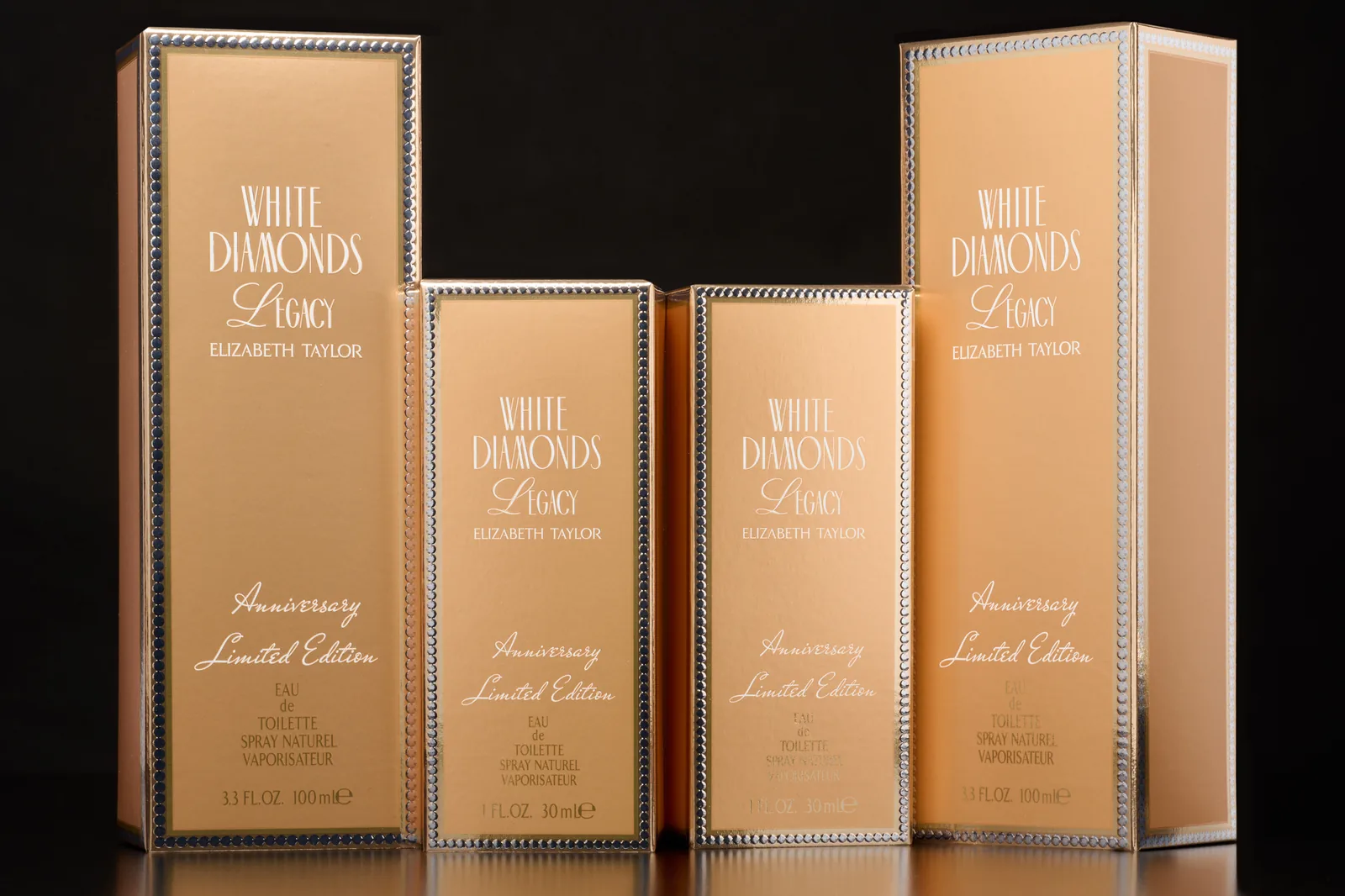
Foil stamping presses a heated die through a metallized carrier so the color layer bonds to the board, and combined with embossing it produces raised metallic relief, which remains the most reliable way to make a flat panel read as expensive. Emboss registration is the specification that decides whether that relief lands where the artwork says: at Arkay it holds to ±0.3mm.
The finish decision is also the recyclability decision, per trend 6 above.
How Arkay Builds Fragrance Cartons
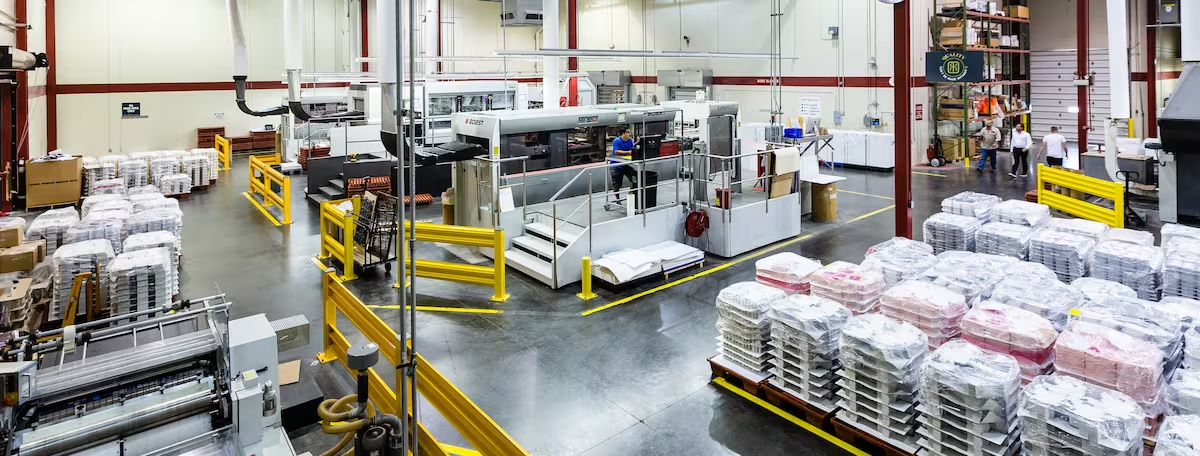
We print offset on solid bleached sulfate board only, 14 to 28pt, from a carbon-neutral 140,000 square foot plant in Roanoke, Virginia. Color is held to G7 standards, which matters for a fragrance range because four facings have to agree on a shelf and a reprint has to agree with the original run.
Finishing runs in-house. Emboss and deboss to ±0.3mm, inline cold foil and offline hot foil stamping, and inline specialty coating through two double flexo coaters for pearlescent, gold and silver effects. Where a tactile finish is wanted we run inline soft-touch aqueous coating rather than film lamination.
For brands running several fragrances or sizes, Paint on Press tests up to 20 foil and finish variations from a single setup under real press conditions, which is usually what makes a multi-variant program economic.
We make folding cartons only. Bottles, caps, pumps and non-paper inserts come from elsewhere, and we work alongside those suppliers. Most of this work sits alongside our cosmetics and luxury spirits programs, which share the same finishing demands.
Fiber is triple-certified to FSC, SFI and PEFC, and the plant holds BRCGS packaging safety certification and an EcoVadis Platinum rating held consecutively since 2022. Our sustainability credentials set out what each covers.
Prototyping runs through our design studio in Hauppauge, New York, where a concept can become a physical mock-up as fast as one day when urgency demands it and typically within a week.
Bring Us a Bottle and a Dieline
Let’s talk about the carton before the artwork is locked.
The decisions that are expensive to reverse happen early: the structure, the caliper, whether a finish survives a fold, and whether the pack’s volume can be justified under rules that now ask that question.
Send us the bottle dimensions, the markets you are selling into, and the finish direction if you have one. If the EU is one of those markets, say so and we will flag the structural questions before they become a re-tool.
Reach out to Arkay’s team with a spec, or with a structure you are unsure about.
Two guides go deeper: fragrance packaging on the finishes themselves, and rigid packaging on the formats Arkay does not make.
Frequently Asked Questions
When should a carton supplier see the bottle dieline?
Before the carton structure is fixed, which is earlier than most fragrance programs manage it. The carton has to hold a specific bottle at a specific weight, and the two decisions that are expensive to reverse, the structure and the caliper, both depend on the bottle’s dimensions and mass. Bringing a converter in once artwork is approved means any structural problem gets solved by adding material or adding an insert, which is the point at which packs get heavier and harder to justify under the EU minimisation rules. Send the bottle dimensions and weight at the same time as the creative direction.
What is the difference between a rigid perfume box and a folding carton?
Construction and economics, more than appearance. A folding carton is printed and die-cut from a single sheet of paperboard, then scored, folded and glued, and it ships flat to be erected at the filling line. A rigid box is built from chipboard or greyboard cut and corner-stayed into a permanent shape, then wrapped with a separately printed sheet, and it ships already assembled. That last difference is the cost driver nobody mentions: with a rigid box you pay freight and warehousing on air. The greyboard itself is a low-grade recycled board, which is precisely why it has to be wrapped rather than printed directly.
What caliper should a luxury perfume carton be?
There is no published industry norm for fragrance specifically, and any supplier quoting one is generalizing. What can be stated is the working range: Arkay runs solid bleached sulfate from 14 to 28pt, where 28pt is a hard ceiling because heavier board damages the press, and 18pt is the practical minimum if the design carries an emboss. Within that range the decision follows the structure and the bottle weight rather than a rule of thumb, because a tall narrow carton holding a heavy flacon needs more stiffness than a flat one holding the same weight. Specify against the dieline, not against a number.
Is a fitted paperboard insert the same as cushioning?
No, and the distinction matters when a bottle arrives broken. Cushioning works by destroying itself: it absorbs shock by crushing and deforming rather than transmitting it, and the packaging literature indicates that genuinely protecting a fragile item often takes two to three inches of it. A fitted paperboard platform of a few millimeters is not doing that. It is a retention device, holding the bottle still so it cannot move, gain momentum and strike something. Both jobs are legitimate and a good fragrance pack usually needs immobilization more than absorption, but they should not be confused in a specification.
What replaced soft-touch lamination on a premium carton?
Inline soft-touch aqueous coating is the direct substitute, and the difference is structural rather than cosmetic. Soft-touch film lamination bonds a separate plastic film, typically BOPP, to the printed sheet in an additional pass. An aqueous soft-touch coating is waterborne and applied inline on press, adding no film layer to the board. That matters beyond production efficiency: under EU rules a paper pack carrying five percent or more plastic is treated as single-use plastic, so a laminate is a regulatory decision as well as a tactile one. Arkay runs the coating and no longer offers the film.
Does foil stamping stop a fragrance carton being recyclable?
Not on its own, because recyclability is anchored to the underlying paperboard and finishes are assessed against it rather than judged in isolation. The threshold that matters in the EU is different: a paper-based pack carrying five percent or more plastic is treated as single-use plastic. A foil stamp applies a very thin metallized layer and rarely approaches that, whereas a film lamination bonds a whole plastic layer to the sheet and is the finish most likely to cross it. The honest caveat is that the EU recyclability grading criteria are not published yet, so nobody can tell you a grade today.