
Single-source packaging means buying from one supplier instead of several. For a folding carton program, the real question is not how many invoices you get. It is how many companies touch the carton between the artwork and the pallet, because that is where color drifts, dielines get redrawn, and defects end up with no owner.
This guide covers what consolidating actually buys you, the two risks worth planning for, and the cases where splitting the work is the right call.
The Benefits of Single-Source Packaging
Three benefits do most of the work.
Less paperwork
One invoice, one contact, one delivery schedule, instead of four of each. That is an administrative convenience on its own. It also removes the coordination load a packaging manager absorbs personally: chasing four schedules, reconciling four sets of paperwork, and being the only person who knows where the job is.
Better quality
One team answers for the finished carton rather than a portion of it, working to one set of press conditions and one approved master standard. That is what holds color between runs, and why a defect has an owner instead of a dispute. The finished pack becomes the acceptance point, the only point that ever mattered to the brand.
Stronger control
One schedule to track, rather than handoffs you only notice as each one fails. A delay becomes visible while it is still a delay, not when it arrives as a missed delivery date. And there is one number to call when the answer matters that day.
Two more follow from the same structure. Communication, because a structural question and a color question go to the same people. Scalability, because the plant that runs the pilot runs the volume program on the same equipment.
On cost, the honest framing is not a lower unit price. It is better specifications, higher production efficiency, and less of the waste and rework that handoffs generate. A quote comparison will not show it. A year of reprints, freight, and schedule slippage will.
The consolidation data is worth reading carefully. Sievo’s 2025 State of Spend analysis, covering roughly $403 billion of consumer goods procurement data, found that top-performing procurement organizations run about 500 suppliers per $1 billion of spend, at roughly $2.1 million per supplier. Weaker performers run closer to 1,100, at roughly $917,000 each. That argues for concentration, not for reducing a category to exactly one, and the same analysis recommends keeping the top few suppliers below a threshold share of category spend.
The Risks of Single-Source Packaging
Two risks deserve a plan, and a supplier who will not name them is not being useful.
Supply problems
If your one supplier hits a shutdown, a shortage, or a shift in priorities, output stops rather than slows. Resilinc’s 2024 monitoring recorded a 38% year-over-year increase in global supply chain disruptions, with factory fires the leading category for the sixth consecutive year. This is a live risk, not a theoretical one.
The instructive case is still the 2000 fire at an Albuquerque semiconductor plant. By Fast Company’s account, Nokia and Ericsson both depended on it for around 40% of a critical component. Nokia redesigned around the gap immediately. Ericsson did not. The lesson is not “never single-source.” It is to know your recovery plan before you need it.
Less price tension
With no competing bid on the table, and switching costs that make leaving hard to threaten credibly, commercial discipline has to come from the relationship rather than from the market.
When splitting the work is right
Procurement guidance going back to Treleven and Schweikhart’s 1988 analysis in the Journal of Operations Management names four conditions where dual sourcing earns its cost:
- Business-critical or safety-critical items
- Volatile regions
- Standardized items where competition genuinely moves price
- A large reliability gap between available suppliers
A folding carton usually meets none of them. It is rarely the most business-critical packaging component, since the primary container normally is, and carton specifications transfer between competent converters more cleanly than most components do.
Splitting a carton program across two converters hedges an unlikely event, and pays continuously for the handoff failures described below. The better hedge is a partner deep enough to absorb disruption without passing it through. Our packaging supply chain guide reaches the same conclusion from the risk side: the mitigation for single-source risk is usually depth, not duplication.
What “Single-Source Packaging” Actually Means
The phrase applies to two arrangements that have almost nothing in common.
One supplier for every packaging format. A single vendor quotes the corrugated shippers, the foam, the film, the labels, the pallets, and the cartons. Fewer invoices, fewer relationships, consolidated freight. That supplier is frequently a distributor, so much of what it sells is made somewhere else.
One manufacturer for every stage of one format. A single converter owns the whole production path of the folding carton: structural design, prepress, plate making, printing, coating, foil, embossing, die-cutting, stripping, gluing, and quality control. Fewer handoffs, one accountable party, one set of press conditions.
The first is a purchasing decision, the second a production decision. Almost everything written about single-source packaging covers the first, while almost every problem brands complain about comes from the second.
One test separates them: ask where the work is physically done, and on whose equipment. Consolidating formats reduces the number of companies you buy from. Consolidating stages reduces the number that touch your carton. Only the second predicts whether your color matches next year.
Single Sourcing vs. Sole Sourcing vs. Dual Sourcing
The procurement vocabulary here is precise, and using it loosely creates unnecessary anxiety.
The distinction worth carrying: single sourcing is a strategy, sole sourcing is a situation. Most worry about “single source” is really worry about sole sourcing, where a buyer has no alternative and knows it. Choosing one supplier from several is a different position, because the option to leave disciplines the relationship.
The Chartered Institute of Procurement and Supply groups the genuine risks of both into three areas: lack of competition, exposure to major disruption, and limits on innovation.
Single Source vs. Single Brand Packaging Equipment
One other meaning of the phrase is worth separating out, because searching for it turns up machinery rather than packaging.
In the equipment world, single source means buying a complete packaging line, the filler, the cartoner, the case packer, and the conveyors, from one supplier who integrates and commissions it. Single brand is narrower: every machine carries the same manufacturer’s badge. The argument is about who owns the line when two machines fail to talk to each other.
That is a different purchase. Consolidating a carton program is about who converts the paperboard, not who supplies the machines that fill it. The two touch at one point: a carton has to run on the line you already own, so the structure, the caliper, and the grain direction are specified against that equipment. Arkay makes folding cartons and does not supply packaging machinery, so it works to your line rather than selling you one.
What Goes Wrong With Multiple Packaging Vendors
A folding carton is not a single operation. It moves through structural design, prepress, plate making, sheeting, printing, coating and finishing, die-cutting, waste stripping, folding and gluing, quality control, and packing.
A split program hands the job across a company boundary somewhere in that sequence, and the failures cluster at those boundaries rather than inside the stages. Every vendor can perform its own step correctly and the carton can still be wrong.
1. Color moves between vendors, and between runs
Color on paperboard is not a file property. It comes out of board whiteness, ink pigment lot, press condition, and ambient humidity, all of which affect dot gain. Inside one plant on a controlled press, those variables are known and correctable.
Add a second company’s press, ink system, and board lot, and the variables multiply while the control does not. That is why the standard mitigation is a physical master sample rather than a digital file: a printed reference is the only thing two presses can be measured against. Enforcing it across a vendor boundary is hard. Verifying it is harder.
2. A dieline locked too early comes back as a redraw
Finalize a structure before the company that will cut it has checked it against its own tooling, and the corrections do not arrive as edits. They arrive as structural revisions, which means the artwork built on that dieline is wrong too.
Catching that early costs you a revised drawing. Catching it late costs you a rejected pallet.
3. Nobody owns the seams
Every vendor answers for its own stage, to its own tolerances. Nobody answers for the transition between two stages, because no contract assigns it.
That is where problems hide. A carton that prints correctly, die-cuts correctly, then fails at the gluer produces a dispute rather than a fix, because each party can show it met its own specification. Consolidation does not make anyone more careful. It removes the ambiguity about who answers for the result.
4. Freight legs and queue time stack up
Each additional company adds a physical shipment between stages, plus a wait for that vendor’s production schedule. Those additions sit on top of production time, not inside it. This is the least discussed and most predictable cost of a split program. It is not a risk that might materialize. It is arithmetic.
5. Quality control fragments
The usual worry about single sourcing is that one quality function becomes a single point of failure. A split carton program produces the opposite problem: no quality function is accountable for the finished carton, only several accountable for their own portion. A defect emerging from the interaction of two stages, which covers most of the interesting ones, has no owner at all.
What You Still Need Other Suppliers For
Consolidating a carton program does not consolidate a packaging stack.
A brand still buys its primary container elsewhere: the bottle, the tube, the jar, the closure, the pump. Labels, corrugated shippers, and non-paper inserts come from elsewhere again. Arkay makes secondary folding cartons and works alongside those suppliers rather than in place of them.
Cartons also ship directly to the contract manufacturer or co-packer a brand nominates. The two roles differ: a co-packer packages product the brand supplies, while a contract manufacturer makes the product itself and usually handles the packaging too. Either can be the delivery destination, and neither changes who holds the specification or the color standard. Our contract packaging page sets out who supplies what in that chain.
How Arkay Runs a Carton Program Under One Roof
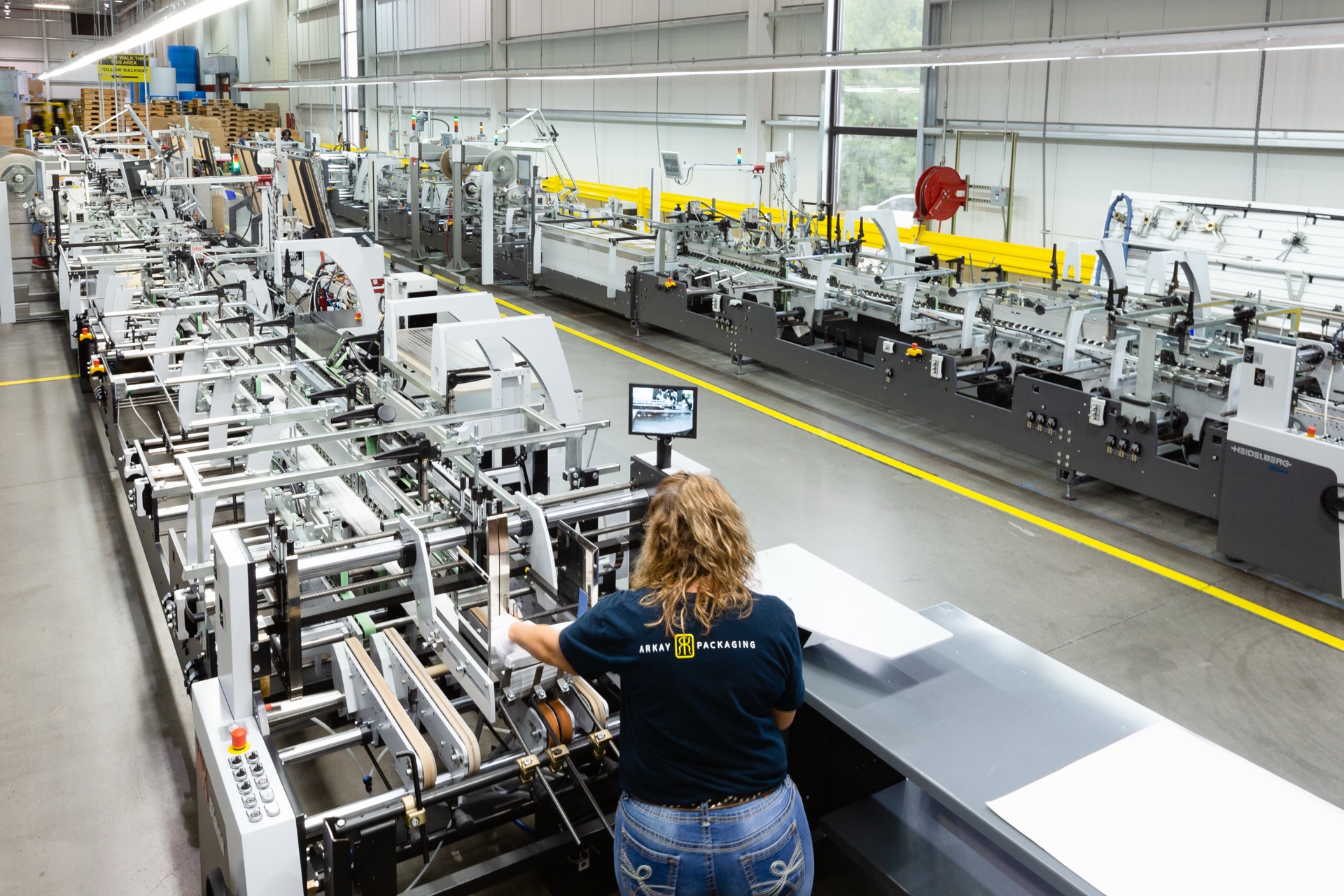
Four generations and more than 100 years of manufacturing have pushed Arkay toward depth in one format rather than breadth across many. The 140,000 sq. ft. facility in Roanoke, VA, runs prepress, offset printing, foil stamping, embossing, inline flexo specialty coating, die-cutting, gluing, and quality control as one continuous operation, and the design studio in Hauppauge, NY, handles structural development and mock-ups.
Three specifics follow from that, and each maps onto a failure named above:
- Printing and finishing happen on the same floor, so an emboss registers to printed artwork at a tolerance of ±0.3mm. That claim depends on both operations sharing one reference.
- The plant is G7 color management certified, which turns the master standard set at approval into a measurable commitment rather than a stated intention. That makes G7 color management the practical answer to color drift between runs.
- Board is specified in-house across an SBS range of 14 to 28pt, so structural behavior is a known quantity rather than a variable arriving with each delivery.
Arkay works as a collaborative partner with brand teams and their designers throughout. The production capabilities list is the short version; the packaging production process walkthrough is the long one, stage by stage.
Map Your Carton Program With Us
Let us talk about how many companies currently touch your carton.
Tell us what the program looks like now: how many products, how many versions, where the artwork comes from, and which vendors handle which stages. We will tell you where the handoffs are costing you, whether consolidation suits your volumes, and what it would and would not change. If the honest answer is that your current setup works, that is worth knowing too.
Reach out to Arkay’s team with your current setup, or with a program you are about to scope.
Our guide to choosing a packaging manufacturer covers what to ask before you commit, and packaging management covers running the relationship afterward. Where accountability for the finished carton sits is a packaging quality assurance question, and packaging procurement covers how all of it fits a wider sourcing process.
Frequently Asked Questions
What is the difference between a packaging distributor and a packaging manufacturer?
A manufacturer makes the packaging in its own plant, on its own equipment, and controls the process that produces it. A distributor sells packaging across many formats and usually has it made elsewhere. That is why a distributor can quote corrugated, foam, film, labels, and cartons, while a manufacturer typically quotes one format in depth. The practical test: ask where the work is physically done, and on whose equipment. Neither model is wrong. They solve different problems, because a distributor consolidates purchasing and a manufacturer consolidates production.
Is single-source packaging the same as vertical integration?
They overlap, but they are not the same claim. Vertical integration describes a manufacturer that owns the successive stages of its own production process, which is a fact about how that company is built. Single sourcing describes a buyer’s decision to use one supplier, which is a fact about purchasing strategy. The two meet when a brand single-sources to a vertically integrated manufacturer, and that combination is what removes the handoffs. A brand can also single-source to a company that subcontracts most of the work. The handoffs are still there. The buyer just no longer sees them.
Does using one packaging supplier actually save money, or just look simpler?
It depends on which kind of consolidation you mean. Consolidating purchasing across formats mostly saves administrative effort, which is real but modest. Consolidating the production stages of one format targets a bigger cost: the rework, the reprints, the freight between vendors, and the schedule slippage that handoffs create. The saving shows up in defects and delays avoided rather than in a lower unit price, which is why it is worth judging on total cost rather than on the quote.
What should a supply agreement cover when one manufacturer handles every stage?
The things that stop being somebody else’s problem. Name who holds the approved color standard and in what form, since a physical master sample is what future runs get measured against. Set out how a structural change is authorized and who pays for re-tooling. Agree what happens to your dies and plates if the relationship ends, because they are the practical barrier to moving. And define the quality standard for the finished carton rather than for each stage. Once production is consolidated, the finished pack is the only meaningful acceptance point.
Who is accountable when a defect happens across multiple vendors?
Whoever can be shown to have missed a written tolerance, which is why the tolerances matter more than the goodwill. Each vendor answers for its own stage against its own inputs, so a defect emerging from the interaction of two stages often has no clear owner and no contractual remedy. You can close that gap without consolidating, by specifying the handoffs explicitly: define the condition the material has to be in when it leaves one vendor and arrives at the next, and name who inspects it at that point. Most split programs never do this, which is why the disputes are so hard to settle.
How long does it take to qualify a new packaging supplier?
Longer than a purchase order, shorter than most people fear. The work is qualification rather than paperwork: running real samples, matching the approved color standard, confirming the structure on the new converter’s equipment, and recutting tooling if the die does not transfer. The timeline varies with how many products are in the program, how complex the finishes are, and whether the incumbent keeps running while you qualify. This matters strategically because it is the real cost of leaving a supplier, and it is what makes switching under pressure difficult.