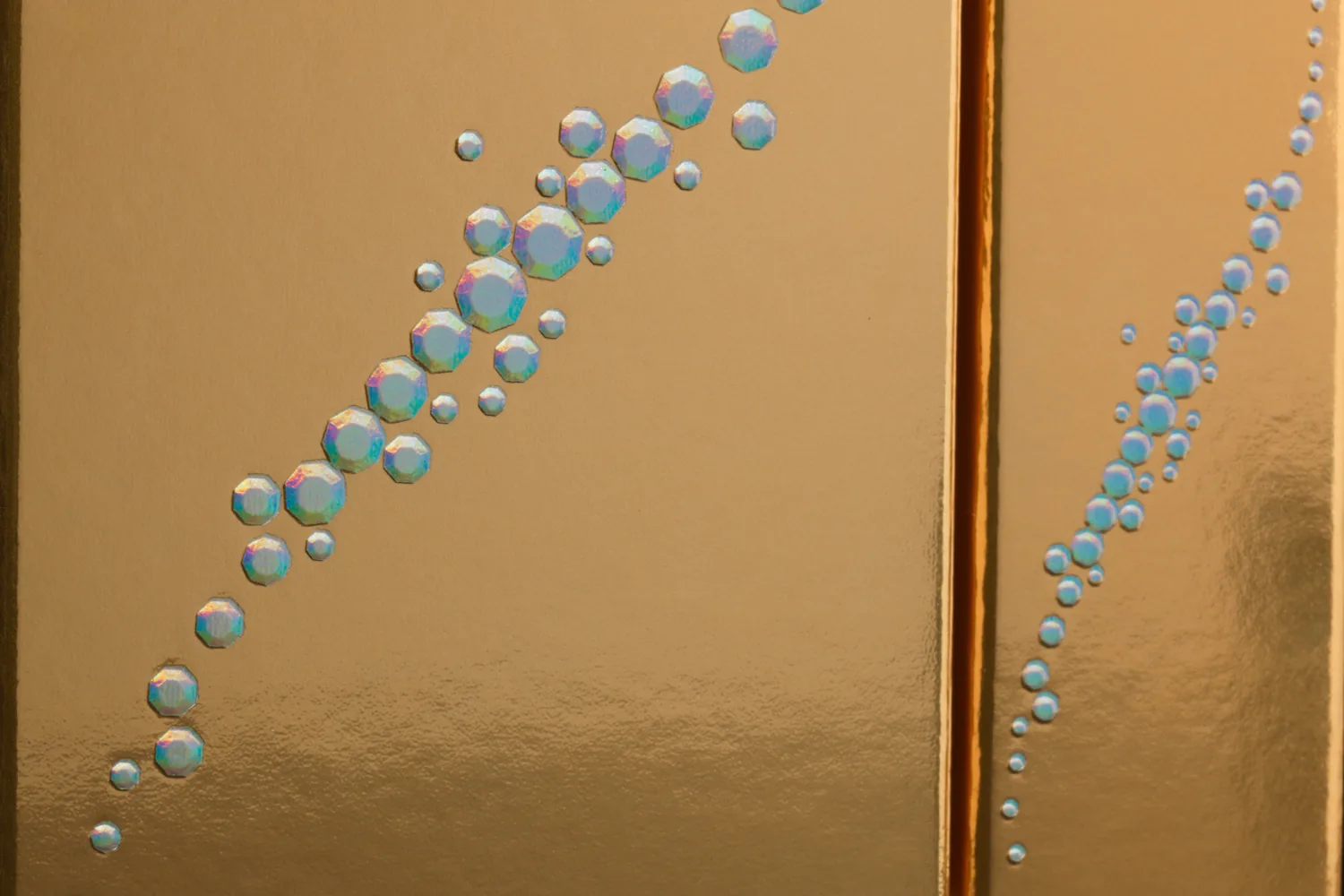

Tilt a holographic carton and the color moves with it. That is the appeal of holographic packaging: a rainbow created by light rather than ink, used on beauty, fragrance, limited-edition, and gift cartons wherever a brand wants the box to catch the eye. Arkay Packaging, a folding carton manufacturer owned by the same family for four generations and in operation since 1922, runs hot foil stamping, inline cold foil, embossing, and inline pearlescent, gold, and silver coating on solid bleached sulfate (SBS) paperboard.
What Is Holographic Packaging?
Holographic packaging is packaging decorated with a layer that diffracts light, splitting white light into its colors so they shift with the viewing angle.
The effect comes from fine grooves pressed into a lacquer layer on polyester film and backed with a thin coat of aluminum. Kluge, which builds foil stamping presses, puts the density at roughly 2,000 lines per millimeter in its hologram stamping guide, far too fine to see without a microscope.
Holographic Foil vs. Metallic Foil
Both foils pair a carrier film with a metal layer and an adhesive. The difference is the surface: Metallic foil is smooth, while holographic foil carries a pressed-in diffraction pattern.
What Are the Benefits of Holographic Packaging?
Holographic packaging adds shelf appeal, perceived value, and, with the right foil, brand protection. Some benefits credited to it come from other formats and do not carry over to a folding carton.
- Shelf appeal: The shifting rainbow catches store lighting and draws the eye to the carton.
- Perceived value: A holographic accent gives beauty, snack, and gift cartons an upscale, futuristic, or collector-edition feel.
- Brand protection: A registered or custom image gives retailers and shoppers a visible mark to check, one layer of anti-counterfeiting packaging.
- Barrier protection: Metallized film pouches block moisture, air, and light, but on a folding carton the effect is decorative only.
How Is Holographic Foil Applied to Packaging?
Holographic foil is usually applied to packaging by hot foil stamping: Heat and pressure from a metal die bond the holographic layer to the printed sheet wherever the die strikes. The process matches gold and silver foil stamping; only the foil roll changes.
Step by Step: Holographic Foil Stamping on a Carton
- Separate the foil artwork. Supply the foil area as solid vector shapes on its own layer.
- Choose the foil. Pick a stock pattern, or originate a custom pattern or image.
- Make the die. Cut a flat or sculpted die from the foil line art.
- Print and coat first. The sheet is printed and coated before the foil goes on.
- Stamp. Heat and pressure transfer the holographic layer, and the polyester carrier peels away.
- Convert. The sheet is die-cut, folded, and glued into cartons.
Holographic Foil Stamping vs. Holographic Lamination
Stamping places the effect only where the die strikes; lamination bonds a holographic film across the whole sheet. Holographic board carries the effect before printing starts.
Types of Holographic Effects for Folding Cartons
The main holographic effects are stock patterns, custom patterns, and registered images, used as selective accents or full coverage.
Selective accents are usually the safer choice: One holographic element against a quiet field reads as deliberate, while too much foil competes with the artwork. Spot UV coating relies on the same contrast, and the same restraint applies when combining packaging finishes.
What Products Use Holographic Packaging?
Holographic packaging is used where visual impact is the point. On folding cartons, the most common uses are:
- Beauty and cosmetics: Accents for color cosmetics and trend-led lines on cosmetics cartons.
- Fragrance: A detail that echoes the light play of a glass bottle on fragrance packaging.
- Collectibles and limited editions: A finish that helps a run feel collectible on limited edition packaging.
- Electronics, confectionery, and gifts: A mark for a new model, or seasonal shelf impact.
Beyond cartons, holographic effects also appear on flexible pouches and Mylar bags, rigid boxes, and security labels and tapes.
Premium and luxury brands tend to save holographic finishes for limited editions, anniversaries, and seasonal collections, so the finish marks a moment without changing the core line. It suits a playful or tech-forward brand and distracts on a carton meant to read calm.
Is Holographic Packaging Recyclable?
Holographic packaging can be recyclable, depending on how the effect is applied, what the carton is made of, and what local recycling accepts. Stamped transfer foil on paperboard has repulped well in testing, and FSEA, the Foil & Specialty Effects Association, names foil-laminated board as the harder case.
In a 2020 FSEA-commissioned study, Georgia Tech repulped foil-stamped 12pt card stock under simulated industrial conditions: About 75% came back as usable fiber, with less than 0.1% rejects. The sample was gold metallic foil, not holographic, though holographic transfer foils share its carrier-and-metal construction. FSEA reported in 2021 that these findings were added to the recyclability design guidance from the American Forest & Paper Association (AF&PA), which notes the guidance is not a mandatory standard.
Arkay ties recyclability to the board itself and can supply spec sheets per project on board certification (FSC, SFI, PEFC), finish makeup, and recyclability. For how repulping is tested and scored, see packaging recyclability.
Is Holographic Foil Right for Your Packaging?
1. Start With What the Effect Should Say
Holographic foil signals energy, novelty, and celebration. Check that this fits the product and the shopper.
2. Choose an Accent or a Panel
A single holographic logo or border leaves the artwork in charge. A full holographic panel puts the finish first, so keep claims and product imagery on flat-ink areas beside it.
3. Match the Route to Your Recyclability Claim
Stamped transfer foil and foil-laminated board behave differently in recycling, so choose the route with the claim in mind.
4. Approve a Physical Sample
A screen or PDF can’t show diffraction. Review a stamped sample on the production board, under light close to where the carton will sell.
How Arkay Specifies Light-Catching Finishes on Cartons
With a century of carton manufacturing behind it, Arkay treats foil and finish as part of the specification. At the carbon-neutral Roanoke, Virginia, plant, offline hot foil stamping runs alongside embossing registered to ±0.3mm, a margin about as thin as three stacked sheets of copy paper. Inline cold foil runs on the sheet-fed offset presses, and two double flexo coaters add pearlescent, gold, and silver effects in the same pass, giving an iridescent look without foil. All of it runs on SBS paperboard from 14 to 28pt, or 0.014 to 0.028 inches thick.
Paint on Press, the proprietary process Arkay built under Chairman Emeritus Howard Kaneff, shows up to 20 finish variations side by side on production board. The Design Studio in Hauppauge, NY, typically delivers a physical mock-up of a concept within one week. See the full range of capabilities.
Talk Through the Effect You Want at the Shelf
Let’s talk about the look you want your carton to have at the shelf. Tell us about the product and the effect you have in mind, and our team will walk you through everything Arkay can do, from foil stamping and embossing to pearlescent coating and Paint on Press. Start the conversation.