
The choice between domestic vs offshore packaging manufacturing is usually framed as a price decision. It rarely is.
Offshore manufacturing generally delivers a lower unit price at high volume on simple cartons. Domestic manufacturing generally delivers shorter lead times, direct press access, stronger IP protection, and a lower total landed cost for premium, fast-moving, or frequently revised SKUs. Neither is categorically correct, and most large brands run both.
Domestic vs Offshore Packaging at a Glance
Domestic means your cartons are printed, finished, die-cut, and glued inside your own country, then trucked to your fill site. Offshore means production in a lower-cost country, with finished cartons moving by ocean freight through a port, customs, and a domestic distribution leg before they reach the filling line.
The distinction that matters is not geography. It is the length and rigidity of the chain between approving a proof and cartons arriving at the fill site. Offshore adds distance, a customs boundary, a time-zone gap, and a container booking. Every one of those is a place a schedule can slip, and none appear on the quote.
A third model sits between them. Nearshore production in Mexico or Canada keeps transit in days and time zones close while retaining some labor-cost advantage.
Why Brands Choose Domestic Packaging Manufacturing
Four reasons account for most switches, and none of them is patriotism.
Speed, and more importantly reversibility. A domestic program carries a production window and a truck. An offshore one carries production, ocean transit, customs, drayage, and a planning buffer held against all of it. The consequence is not simply that offshore is slower. Once a container is loaded, the specification inside it is fixed for the voyage, so a regulatory copy change or a retailer-mandated update discovered mid-transit cannot be applied to stock already at sea. That rigidity bites hardest at launches, on faster-than-forecast reorders, and on corrections.
Press access. A brand color is not a file. It is a physical standard, matched on a specific substrate under specific press conditions and approved against a physical sample. Being in the room when a sheet is pulled lets you approve or reject against the actual board. Remote approval from a photograph removes the two variables that matter most, ambient lighting and the physical surface. A G7 color management certified operation calibrates to a shared gray-balance definition, which is what makes color repeatable between runs; the real test is whether run two, six months later, matches run one on the shelf beside it.
Finish complexity. Cartons carrying foil, embossing, or tight registration have more ways to miss, and each miss is more expensive to correct at distance.
Supplier availability is improving. The Reshoring Initiative reports US reshoring and foreign direct investment job announcements reached roughly 244,000 in 2025, against about 11,000 a year in 2010. For a packaging buyer that means the domestic supplier base is being invested in rather than wound down, so capacity, equipment, and qualified labor are likelier to be there when you need them. It is a statement about availability, not a recommendation.
When Offshore Sourcing Makes Sense
Offshore is the right answer more often than domestic suppliers like to admit.
It works when the carton is simple, volume is high and stable, the forecast is one you actually trust, artwork is settled, and the landed-cost model still favors it after honest rework provisioning. A mature SKU with two-color graphics, predictable annual volume, and no pending regulatory change is close to the ideal offshore candidate: the fixed costs of importing amortize well, and the risks that make offshore expensive rarely fire.
It works badly when demand is volatile, copy is unsettled, the launch date is externally fixed, or the structure is a brand asset worth protecting. Volatile demand plus a long replenishment window is a particularly expensive combination, because you pay for the forecast error twice, once in obsolete stock and once in expedited freight.
The hybrid model is the most common outcome at scale. Baseline volume offshore, with launches, limited editions, versioned SKUs, and replenishment held domestically. It requires both plants qualified to the same physical standard, which is a real cost, and it buys genuine resilience. How many suppliers to hold is a separate question, covered in our guide to single-source packaging.
What Does Total Cost Include?
The quoted unit price is the most visible number in a packaging decision and the least complete. It describes the carton leaving the plant, not the carton arriving at your fill site on the day you need it.
Hidden Costs of Offshore
None of these appear on a supplier quote, and together they routinely close much of the apparent gap.
- Freight and drayage. Ocean rates move with fuel, capacity, and route disruption. Add port fees, drayage, and the domestic trucking leg.
- Duties, tariffs, and brokerage. Set by governments rather than suppliers, so they can move after a program is priced and locked.
- Inventory carrying cost. A long transit window means capital sits in containers and warehouses instead of working.
- Safety stock. A supply chain you cannot replenish quickly forces buffer inventory against a forecast. That stock is a cost whether or not you sell through it, and obsolete stock after an artwork change is a write-off.
- Quality assurance travel. Airfare, hotel, and several days of a packaging manager’s time, per approval. Most brands stop attending and accept remote sign-off instead.
- Rework and expedite. A missed run means a reprint on a new transit cycle or air freight at multiples of ocean cost. This is the largest variable in the model and the one most often left out of it.
A Total Landed Cost Check You Can Run
Take one representative SKU and one year. Start with quoted unit price times annual volume. Add freight, duties, brokerage, drayage, and domestic delivery. Add inventory carrying cost, meaning average inventory value times your cost of capital, including the safety stock the lead time forces. Add qualification and approval travel. Then add an honest rework provision, using your own history if you have it and the cost of one reprint plus one expedited shipment if you do not. Divide by annual units, and run the same steps for the domestic quote.
Most of the argument between sourcing and finance disappears once both options are expressed in the same currency. Run it first on the SKU with the most artwork changes, because that is where the two models diverge fastest.
How Do Sustainability and IP Protection Compare?
These are usually treated separately. They belong together, because both are areas where offshore is not worse in principle and is harder to verify in practice.
Chain of custody. FSC and SFI certification follows the fiber through every transfer of ownership. A longer chain does not invalidate the claim, but it means more links to document and more parties whose certification has to stay current.
Regulatory change. Extended producer responsibility schemes in several US states now attach fees to packaging placed on the market. Responding to a rule change is a specification change, and that is faster where the press is closer.
Freight emissions. Ocean freight is relatively efficient per ton-mile, so the routine difference is smaller than many assume. The exception matters: an expedited air shipment to recover a missed date can exceed the entire remaining transport footprint of the program. Emissions risk and schedule risk are the same risk.
IP exposure is structural. Manufacturing a carton requires handing over the complete specification: the dieline, the structural design, the print-ready artwork, the foil and emboss die art, and the brand assets. That package is, functionally, everything needed to produce an identical carton without you. Three exposures follow. A distinctive structure is often a brand’s most defensible physical asset and the easiest to copy once a die exists. Cartons produced beyond the ordered quantity have value to someone, and genuine packaging entering an unauthorized channel is harder to detect than a counterfeit because it is real. And authentic-quality packaging is what makes a counterfeit product convincing at the shelf.
None of this means offshore manufacturing is unsafe. It means protection has to be engineered rather than assumed, through contractual ownership of tooling, jurisdiction-appropriate registrations, and enforceable confidentiality terms drafted by local counsel. Authentication features are a complementary layer, and our overview of anti-counterfeiting packaging covers which survive a production environment.
How Do You Decide Between Domestic and Offshore Suppliers?
Run these per SKU rather than across the portfolio. Most brands find the answer differs by product line.
- SKU velocity and volatility. Is demand stable enough that a long replenishment window is tolerable?
- Margin headroom. Does the product carry enough margin that unit price is not the binding constraint? Premium positioning usually buys room to optimize for reliability instead.
- Launch timing. Is there a fixed external date? Retail resets do not move because a container did.
- Finish complexity. Foil, embossing, tight registration, or specialty coating all raise the value of press access and the cost of a miss.
- Regulatory category. Is copy subject to change by regulators or retailers? Regulated categories favor short correction cycles.
- Structural distinctiveness. Is the structure itself a brand asset worth protecting?
A useful tiebreaker: ask what happens if the next run is wrong. If the honest answer is a missed launch or a write-off, you are buying speed of correction, and that is what proximity is for. Our guide to cosmetic packaging lead times breaks the carton calendar down stage by stage.
Which Packaging Manufacturers Offer Reliable Domestic Production?
Judge a domestic manufacturer on what it controls rather than on where it is. Four criteria separate a real alternative to offshore from a broker with a domestic address: production under its own roof, meaning printing, finishing, die-cutting, and gluing happen on its own equipment rather than at a subcontractor; verifiable color management against a documented physical standard; press access, including what pre-production validation exists if you cannot attend; and delivery control, meaning who moves the finished cartons and what happens when a carrier does not show.
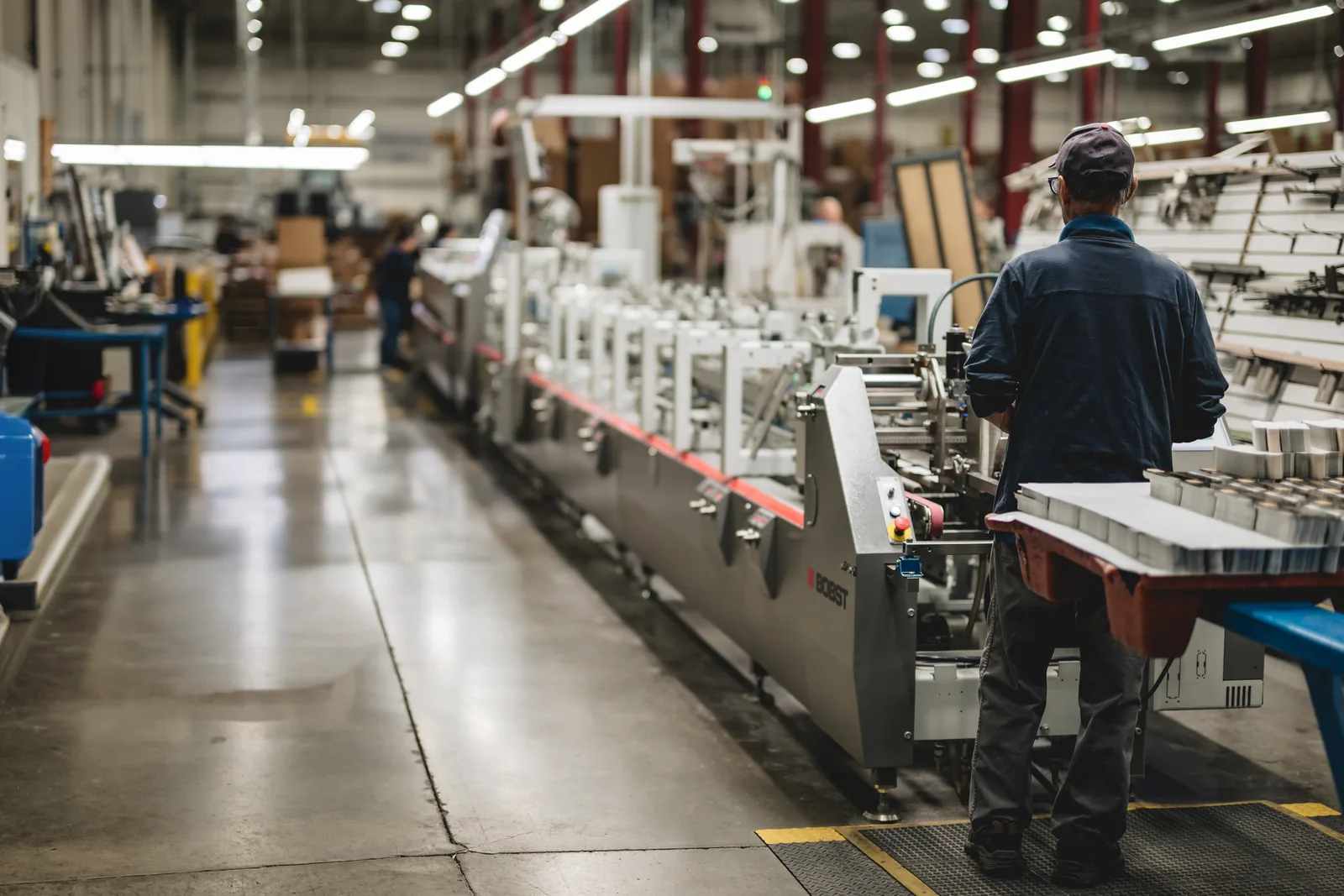
Arkay manufactures 100% of its folding cartons in the United States, at a 140,000 sq. ft. carbon-neutral facility in Roanoke, Virginia, where the company moved production from New York in 1996. Prepress, offset printing, finishing, die-cutting, and gluing run as one operation on site, and Arkay operates its own trucks rather than relying entirely on third-party carriers. Color is held to G7 certification against a physical standard, and Paint on Press, the proprietary pre-production process developed under Chairman Emeritus Howard Kaneff, tests up to 20 finish variations on the actual production press before a full run is committed. Founded in 1922 and now in its fourth generation of family ownership, Arkay works with brand teams across cosmetics, personal care, spirits, food, and consumer electronics.
Map Your Sourcing Decision With Us
Let us talk about where your cartons should be made. Tell us the SKU, the finish specification, the volume, and the date you have to hit, and we will tell you honestly whether domestic production changes the economics for that program or whether your current arrangement is already the right one.
Reach out to Arkay’s team with a program you are scoping or re-sourcing.
If you are earlier in the process, our guide to choosing a packaging manufacturer covers the questions worth asking any supplier, and what a packaging supply chain actually contains maps the stages a carton passes through before it reaches your filling line.
.jpg)