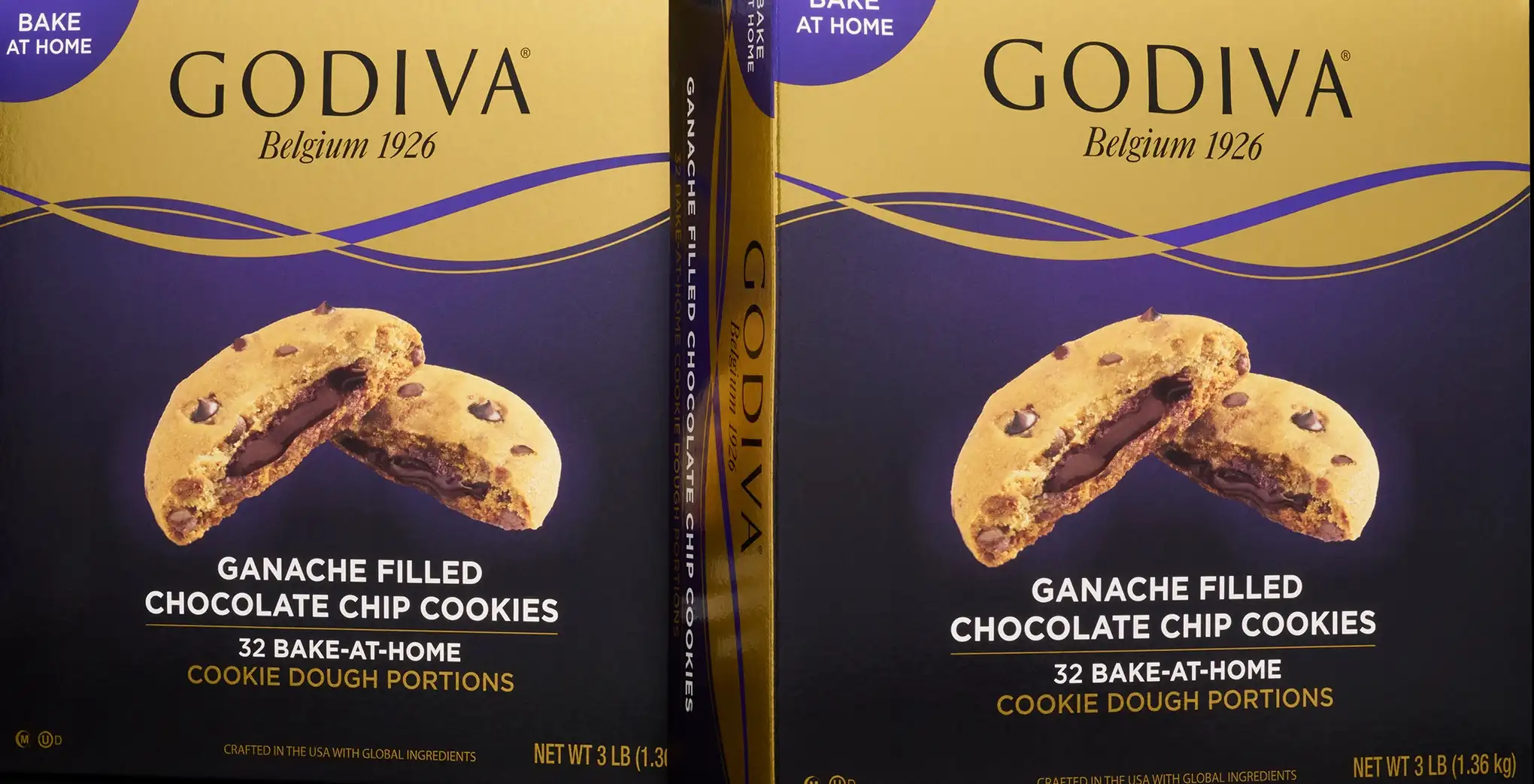

Chocolate Packaging Design: The 6 Decisions That Matter
Most published material on chocolate packaging is visual: image boards, design showcases, awards galleries. Useful for direction, silent on whether a given design can actually be made, passed by a quality team, or shipped in July.
Six decisions determine that, and they run roughly in this order:
- Format. Tuck-end carton, bar sleeve, tray and sleeve, book-style, rigid box. This sets what everything else can do.
- Board and caliper. Weight governs how the pack feels in the hand and whether finishing reads cleanly or exposes the surface.
- Barrier. Chocolate’s fat migrates into untreated board, so a grease barrier is a functional requirement rather than an upgrade.
- Inks and adhesives. Chocolate absorbs odor from both, which makes this a food-safety decision.
- Finishing. Foil, emboss, and specialty coating, each limited by the board underneath and by registration tolerance.
- Compliance evidence. Food-contact status and certification, which a brand’s quality team will ask for before a purchase order.
The rest of this article works through them.
What Actually Makes Chocolate Packaging Premium
Almost everything a customer registers as quality traces back to two measurable properties.
Caliper, and Why the Hand Notices Before the Eye
Board thickness governs how a box behaves when it is picked up. Heavier caliper resists flex and denting, so the structure holds its shape under a thumb rather than yielding, and that resistance is what reads as substance. Arkay prints on solid bleached sulfate paperboard from 14 to 28pt, with 28pt as a hard ceiling.
Caliper also sets a floor on what finishing can achieve. Foil stamping and embossing both work by deforming or bonding to a surface under pressure, and a thin or soft sheet gives them nothing to work against. The practical result is that on inadequate board, decoration does not rescue a pack, it exposes it: every surface irregularity gets highlighted rather than hidden. Substrate choice comes before finish choice, not after it, and our guide to paperboard packaging covers how grades and calipers differ.
Registration Tolerance, and Why Combined Effects Read as Precise or Poorly Made
Premium chocolate packaging usually stacks effects: foil over an embossed shape, a debossed logo inside a coated panel, a metallic edge against an uncoated field. Whether that reads as precise or as sloppy comes down to registration, which is how accurately one process lands relative to another.
Arkay holds embossing registration to a tolerance of plus or minus 0.3mm. That number is the difference between a foiled emboss where the metallic sits exactly inside the relief, and one where a visible sliver of unfoiled board shows along one edge. Nobody looking at the second version thinks about registration tolerance. They think the box looks poorly made. Our comparison of embossing and debossing covers how the two techniques differ and where each earns its place.
The Finishing Vocabulary, and What Each One Physically Does
Foil stamping transfers metallic or pigmented foil into the board under heat and pressure, producing an effect that is simultaneously metallic, dimensional, and tactile. It remains the standard for brand marks on high-tier packaging because no printed ink reproduces specular metal. Our guide to foil stamping covers the hot and cold routes.
Embossing and debossing use paired dies to raise or recess an element relative to the surface. Embossed relief catches moving light along its edges; debossing creates a quieter, recessed impression that reads as restraint.
Inline specialty coating applies pearlescent, gold, or silver effects in the same pass as printing, through double flexo coaters. Being inline matters commercially: the effect arrives without a separate production pass.
Inline soft-touch aqueous coating produces a velvety surface without bonding a plastic film to the board, which keeps the carton in the standard paper recycling stream.
Uncoated and textured stocks signal craft rather than gloss, and are usually most effective paired with a single metallic or spot-color element for contrast rather than used across a whole pack.
Why a Folding Carton Competes With a Rigid Box
Rigid setup boxes use chipboard several times thicker than folding carton board, wrapped in printed paper, assembled pre-formed so they never fold flat. They are the default at the very top of the gifting market, and they carry real freight and tooling cost because of it.
A folding carton reaches a comparable premium read by a different route: print quality, coating, finishing, and structural engineering rather than raw board mass. It ships flat and erects at the packer. For a great deal of premium chocolate, particularly anything sold at scale or shipped any distance, that is the more sensible answer, and the gap in perceived quality is narrower than the gap in cost. Our guide to folding cartons covers the format fundamentals.
Types of Chocolate Packaging, and Who Makes What
Format conversations go wrong when appearance and manufacturing get conflated. Two boxes that look similar on a shelf can come from entirely different suppliers.
The insert point deserves emphasis, because cavity trays are close to universal in boxed chocolate and they are routinely assumed to come from whoever printed the box. They do not. The outer carton is engineered to a fixed internal footprint, and the insert supplier builds a tray to that footprint. The two are co-designed and separately manufactured, which means the specification has to be shared deliberately rather than assumed. A brand planning an assortment box is managing two suppliers, and knowing that at design stage is considerably easier than discovering it at tooling stage.
The Structural Decisions Behind an Unboxing
Unboxing gets discussed as a feeling. Mechanically it is sequential information reveal, and each step in that sequence is a structural decision made at carton-engineering stage rather than a print decision made later.
A sleeve slides to expose a tray. A lid lifts to expose a printed interior. A drawer pulls to expose cavities in a deliberate order. Which of those a pack does, and how much resistance each movement carries, is determined by the structure. Graphics decorate the reveal; they do not create it.
Gifting shifts the brief structurally rather than cosmetically. It pushes toward closed, opaque formats, because surprise matters more than shelf transparency. It requires interior structure to organize an assortment. And it moves finishing spend from outward-facing shelf impact toward the opening moment: interior print, foil on the underside of a lid, a printed tray. The logic is straightforward once stated: for gifted chocolate, the person who opens the box is frequently not the person who bought it, so the pack has to work twice, on different surfaces, for different people.
What Chocolate Does to a Carton
This is where chocolate stops being a generic premium category and becomes a genuinely difficult engineering problem.
1. Fat Bloom
Cocoa butter is fully solid near 5 degrees Celsius and fully liquid above roughly 36, and it exists in several crystal forms. Bloom is driven by temperature cycling rather than heat alone. Research on fat bloom under cycling conditions found that cycling between 20 and 29 degrees forms separated fat crystals on the surface, while a wider 20 to 32 degree cycle roughens the surface, both producing the grayish film consumers read as spoiled product. Steady storage at 16 degrees measurably outperforms cycling between 10 and 25 (Journal of Food Engineering, via ScienceDirect).
Melting behavior varies by type: dark chocolate melts around 31 to 34 degrees, milk 30 to 32, white 28 to 30, with ideal storage between 15 and 18 (Cargo Handbook). That is a narrower window than most packaged goods live inside, and it is why summer distribution is an engineering question for this category rather than a footnote.
2. Sugar Bloom, Which Is a Different Problem
Sugar bloom looks related and is not. Condensation forms on the chocolate surface, moisture dissolves surface sugar, then evaporates and leaves larger recrystallized sugar behind as a dusty matte layer. Prevention targets constant temperature around 17 to 20 degrees with humidity below 50 percent (Callebaut).
There is a counterintuitive consequence worth knowing. Pre-chilling or freezing chocolate before a hot-weather shipment is actively discouraged, because cold product meeting warm ambient air condenses moisture on its surface and directly causes the sugar bloom the chilling was meant to prevent (EasyPost shipping guidance). It is a good illustration of why this category rewards knowing the mechanism rather than applying a general instinct.
3. What the Carton Can and Cannot Do About Either
Worth being straight about. A carton cannot fix a broken cold chain. If a pallet sits on a dock at 35 degrees, no paperboard structure will prevent bloom.
What a carton does affect is the rate at which the interior temperature follows the exterior. A well-closed structure with minimal void space, and a functional tray-in-sleeve arrangement, slows that transfer. Worth noting that this is a thermal measure rather than a volume one, which matters for the packaging-minimization rules discussed below. Slower transfer means shallower cycling for a given ambient swing, and since cycling amplitude is what drives bloom, that is a real contribution rather than a marketing one. It is a mitigation, not a solution, and describing it as anything more would be dishonest.
4. Fat Migration and the Grease Barrier
Chocolate’s fat content migrates into untreated paperboard by direct diffusion. The visible result is grease show-through, staining that darkens the board from the inside out and eventually degrades both print and structural integrity.
The answer is a barrier coating, and chocolate is a named end-use case for high-barrier coated boards specifically because of this. Barrier chemistries include polymer films and, more relevant for food contact, styrene-butadiene and styrene-acrylic emulsion coatings applied directly to the board (Stora Enso; H.B. Fuller). The choice interacts with recyclability, which is why it belongs in an early specification conversation rather than a late one.
5. Odor and Taint, and the One Fact That Should Change How You Choose a Supplier
Chocolate’s fat matrix readily absorbs volatile compounds from its environment, a phenomenon food scientists call flavor scalping (Comprehensive Reviews in Food Science and Food Safety).
Here is the detail that reframes the whole subject. Chocolate is so reliably absorbent that the packaging industry uses it as the reference test medium for detecting odor transfer. In the standard Robinson taint test, a folded sample of packaging material is sealed in a jar with 15 grams of grated chocolate at 20 degrees Celsius and 75 percent relative humidity for 48 hours, and the chocolate is then assessed for off-flavor. Documented taint sources include residual solvents, plasticizers, printing inks, and adhesives (Blommer technical guidance; Bakery and Snacks).
Read that again in commercial terms. The industry’s chosen instrument for finding out whether packaging ruins food is chocolate. Which means that on a chocolate carton, the ink and adhesive specification is not a printing preference, it is a product-quality decision with a direct route to what the customer tastes. No amount of design excellence compensates for a carton that taints the product inside it, and this is the single strongest reason the identity of the carton manufacturer matters on a confectionery program.
6. Mineral Oil Migration
Mineral oil hydrocarbons, MOSH and MOAH, originate in two places: recycled paperboard fiber, largely from mineral-oil-based inks in the original newsprint feedstock, and non-food-grade printing inks and adhesives. They migrate primarily through the gas phase inside a closed pack, and high-fat foods, with chocolate named specifically, are at elevated risk because these compounds are lipophilic. MOAH is the toxicologically significant fraction, carrying mutagenicity and carcinogenicity concerns, while MOSH accumulates in tissue (Food Packaging Forum; ConfectioneryNews). Documented migration into food packaged in recycled board has been measured at several mg/kg and has exceeded 100 mg/kg in some cases (Fengler et al., Packaging Technology and Science).
The regulatory position is worth stating accurately, because it is often overstated. Germany’s Federal Institute for Risk Assessment has urged that mineral oil migration from recycled board into food be urgently minimized, recommending virgin fiber, mineral-oil-free inks, and functional barriers, and Switzerland sets binding migration limits that recycled board in direct food contact has to be shown to meet (Food Packaging Forum). But there is currently no EU-wide binding limit specifically for MOAH from printing inks. This is an active regulatory frontier rather than settled law, and a brand planning a multi-year program should treat it as likely to tighten.
The practical implication is direct: certified virgin fiber is the recommended mitigation, which makes recycled content and mineral oil exposure a genuine trade-off rather than a free choice. Our guide to PCR packaging covers the recycled-fiber side of that decision in full.
7. Light, Moisture, and Shelf Life
Light accelerates fat oxidation and bloom, and humidity drives the sugar bloom mechanism above. Both lead back to the same three carton levers: barrier coating, closure integrity, and opacity, including how much print coverage sits over any transparent window. A window sells the product and admits light, and that trade is a decision rather than a default.
Food-Contact Compliance for a Chocolate Carton
Compliance for a printed food carton is narrower than general packaging guidance suggests, and four things carry most of it.
In the United States, a food-contact substance is regulated as an indirect food additive, with paper and paperboard components covered by 21 CFR Part 176 (eCFR). A material qualifies through an explicit listing, prior sanctioned status, generally recognized as safe status for the specific use, a threshold of regulation exemption, or a Food Contact Notification.
In the European Union, Regulation (EC) 1935/2004 Article 3 requires that materials not endanger health, not alter food composition unacceptably, and not degrade the food’s organoleptic characteristics. That last clause is the legal basis for taint control, which makes the odor problem above a compliance matter and not only a quality one. Regulation (EC) 2023/2006 adds Good Manufacturing Practice obligations (legislation.gov.uk).
On inks, the European Printing Ink Association has retired the phrase “low migration ink” in favor of “printing inks for food contact materials,” and stresses documentation passing down the supply chain, because migration testing on paperboard is harder to standardize than on plastics (EuPIA).
A functional barrier is the technical concept underneath any grease-barrier claim: a layer that reduces migration below a legal limit, or to non-detectable levels. It has to be demonstrated by testing or modeling rather than asserted, and the burden sits with the converter (PackagingLaw.com).
In practice most of this is verified through BRCGS Packaging Materials certification, which explicitly covers facilities supplying packaging into chocolate and confectionery and requires a documented hazard-management system alongside factory, process, and personnel controls (Intertek). It lets a brand’s quality team qualify a supplier without auditing the plant themselves, and for a category this sensitive to ink and adhesive taint it carries more weight than it does elsewhere. Arkay is BRCGS packaging safety certified.
Sustainability in Chocolate Packaging
The category has one well-known structural problem and a straightforward answer to it.
The foil and paper wrapper is a recycling failure by construction. Metallized film laminated to paper cannot be separated by curbside sorting equipment, flexible film jams sorting machinery, and most bar wrappers are too small for sorters to capture reliably (EcoEnclose). The clean answer is mono-material construction: an all-paperboard carton with no foil lamination, no metallized coating, and no plastic window, which stays in the standard paper stream. That is a genuine design constraint, because it rules out several effects common in the category. Our guide to what makes packaging recyclable covers how those assessments work.
Two EU regulations matter for brands selling into that market. The Packaging and Packaging Waste Regulation brings a packaging-minimization duty and a ban on deceptive packaging, prohibiting double walls and false bottoms used to give the impression of a larger product volume, from 12 August 2026, with a 50 percent empty-space cap for grouped and e-commerce packaging from 1 January 2030 (ComplianceGate). That cap is measured against the product’s outer dimensions and counts void fillers, which makes it a dated constraint on the oversized-box convention in gifting. Separately, the EU Deforestation Regulation requires cocoa to be traceable to plot of origin from 30 December 2026 for large and medium operators (ConfectioneryNews), which is pushing provenance content onto packs that would otherwise have stayed decorative.
Arkay’s own position is anchored to certification rather than claims: FSC, SFI, and PEFC certified fiber, carbon-neutral operations, and an EcoVadis Platinum rating in the top 1 percent of rated companies globally, held consecutively since 2022. Every one of those is third-party verified rather than self-declared, which is the distinction a retailer’s compliance team is actually testing for. Details sit on our sustainability page.
Design Direction Worth Considering
Briefly, because the technical decisions above matter more than the aesthetic ones and the evidence base here is thinner.
Restraint continues to read as craftsmanship in this category, with simplified layouts letting a single foiled or embossed element carry the weight. Provenance and single-origin storytelling remains strong, and there is a non-obvious reason it is getting stronger: EUDR traceability requirements are pushing origin data onto packs that might otherwise have stayed decorative, which means provenance is becoming partly a compliance surface rather than purely a narrative one.
Treating all six sides of a carton as usable narrative space is a genuine structural argument for the folding-carton format, since a printed carton offers more continuous decorated surface than a wrapped rigid box does. Illustration-led identity paired with uncoated stock continues to signal small-batch production effectively. Limited editions and personalization remain active, though these move faster than a specification cycle, which is an argument for structures that can carry variable print without new tooling.
How Arkay Builds Cartons for Confectionery Brands
Arkay has been manufacturing folding cartons since 1922, now in its fourth generation of family ownership, and produces packaging for premium confectionery, including work for Godiva. The capabilities that matter for chocolate line up unusually directly with the requirements set out above.
BRCGS packaging safety certification is the credential a confectionery quality team asks for, and the reason it can be answered without a plant audit. FSC, SFI, and PEFC certified virgin fiber is the recommended mitigation for the mineral oil exposure described earlier, which makes Arkay’s substrate position a food-safety position rather than only a sustainability one. Embossing registration held to plus or minus 0.3mm is why a combined foil and emboss on a gift lid reads as precise. Inline specialty and soft-touch aqueous coating, applied through double flexo coaters in the same pass as printing, delivers pearlescent, gold, and silver effects without a separate production pass, which matters in a category where fourth-quarter finishing capacity is the constraint that bites first. And all-paperboard construction is the mono-material answer to the wrapper recycling problem, produced at a single 140,000 sq. ft. carbon-neutral facility in Roanoke, VA.
For color depth beyond a single specified shade, Paint on Press, Arkay’s proprietary process developed under Chairman Emeritus Howard Kaneff, runs up to 20 variations within a controlled process.
The front end matters in a category this seasonal. At the Design Studio in Hauppauge, NY, a brand team can bring an idea and leave with a physical mock-up, typically within one week and as fast as one day when urgency demands it. For a Valentine’s or holiday program, being able to hold a structure early is often the difference between a considered decision and a rushed one. Arkay’s team works alongside brand teams, designers, and food quality leads, including on food and nutraceutical programs where compliance and presentation have to be solved together rather than in sequence.
Three boundaries worth stating plainly, because they save time.
Arkay manufactures folding cartons, not rigid setup boxes, and not the foil or film wrapper around a bar. Arkay also does not produce cavity trays or inserts, and works alongside the specialist suppliers who do.
Arkay does not apply grease-barrier coatings. That work runs on conventional inks, and Arkay prints UV, so the two are not compatible in the same process. This matters for how the barrier decision described earlier gets made rather than whether it gets made: on a chocolate program the barrier is settled as a board specification with the mill and the brand’s quality team, upstream of printing, rather than as a coating added at the converter. It is also worth remembering where a premium chocolate carton usually sits, which is outside a tray or a wrapper rather than against the product. Where the board is genuinely in direct contact with a fat-rich product, raise the barrier requirement at the substrate conversation and raise it early.
Specify a Carton Your Chocolate Can Live In
You have a design you like, a launch window, and a product that melts at 31 degrees and picks up whatever the carton smells of.
That is a solvable brief, and it is solved earliest at the specification stage: barrier before graphics, ink and adhesive chosen against the product rather than the palette, structure sized to a tray somebody else is making. Bring it while those things are still open.
Reach out to Arkay’s team to talk through a confectionery carton, or bring a structure to the Design Studio in Hauppauge, NY and leave with something you can hold, typically inside a week.
%20(1).jpg)