
Recycling symbols on packaging tell you what a material is, whether it holds recycled content, who paid for its recovery, or how to dispose of it. Few of them promise that a local program will accept the pack, and on a carton, every mark is a claim the brand owns.
Most people read the chasing arrows as proof that a pack is recyclable. The recycling symbols printed on packaging say several different things, and only some of them speak to recycling at all.
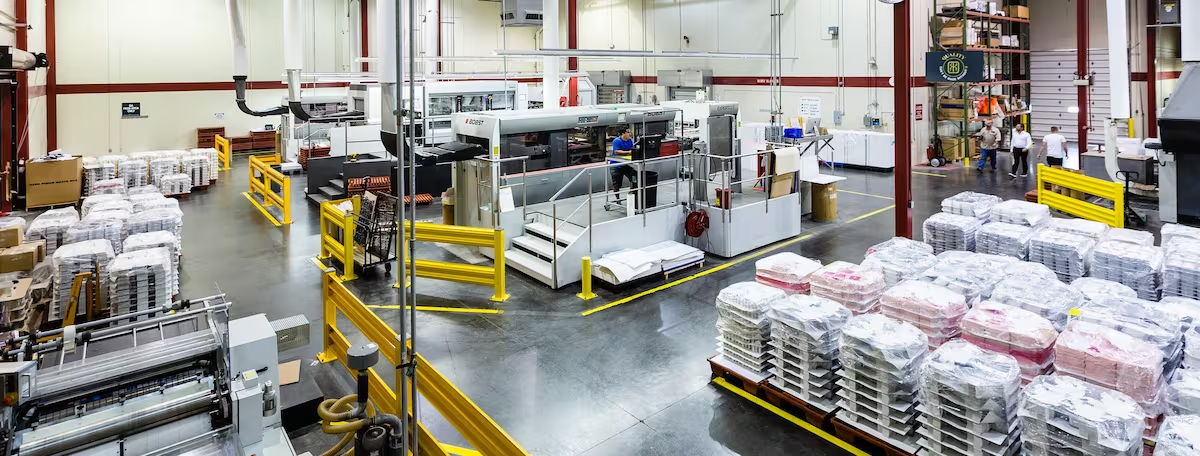
For the brand printing them, each mark is also a claim, and US rules decide what a recycling symbol can say. Arkay Packaging, a fourth-generation, family-owned folding carton manufacturer, has made premium cartons since 1922 and holds FSC, SFI, and PEFC certification for the paperboard it converts.
What Recycling Symbols on Packaging Mean
Recycling symbols on packaging identify what a material is, whether it contains recycled content, whether a producer paid for its recovery, or how to dispose of it. On their own, they don’t tell you whether your local program accepts the item.
The Möbius Loop
The Möbius loop, three arrows chasing each other in a triangle, is the familiar recycling symbol. It signals that an item is designed to be recyclable in principle. With a percentage inside or beside it, the loop states recycled content instead: where the material came from, not where it can go next.
Plastic Resin Codes 1 to 7
The numbers 1 to 7 inside a triangle are resin identification codes, maintained by ASTM International as standard D7611. They tell recyclers which plastic an item is made from. A 2013 revision replaced the chasing arrows around the number with a solid triangle, although the older version is still common.
Whatever the number, the code identifies the resin, not whether an item is recyclable.
Paper and Cardboard Codes
Paper-based packaging has its own material codes, set out in a 1997 European Commission decision: PAP 20 for corrugated board, PAP 21 for other paperboard, such as folding cartons, and PAP 22 for paper. Like resin codes, they identify the material rather than its recyclability. Their use is voluntary under that decision.
The Green Dot
The Green Dot, two interlocking arrows in a circle, shows that a producer has paid a fee to a national packaging recovery scheme in Europe. PRO Europe, which licenses the mark, describes it as a financing symbol rather than an eco-label. It doesn’t say whether the pack itself is recyclable.
How2Recycle Labels
How2Recycle is an on-pack label used in the US and Canada. Each label assigns a part of the pack to a category, such as Widely Recyclable or Check Locally, based on how many people have access to recycling it.
FSC, SFI, and PEFC Logos
The FSC, SFI, and PEFC logos are sourcing marks. They show that the wood fiber in paper or board came from certified or controlled sources, tracked through a certified supply chain. They are not recycling symbols, even when an FSC label includes a recycled-content loop.
Compostable and Anti-Litter Marks
Compostable marks, such as the BPI mark in North America and the Seedling in Europe, certify that an item breaks down in industrial composting facilities. The Tidyman, a figure dropping litter into a bin, is an anti-litter reminder licensed by Keep Britain Tidy and makes no recycling claim.
Recycling Symbols on Paperboard Boxes: Which Marks Apply
The recycling symbols that appear on paperboard boxes, such as folding cartons, fall into three groups:
- Recycling or disposal marks: the Möbius loop, a “please recycle” line, or a How2Recycle label.
- Material codes: PAP 21 for folding cartons, used mainly for European markets.
- Sourcing marks: the FSC logo on packaging, or its SFI or PEFC equivalent. Our guide to FSC label types and logo rules explains how those labels work.
What a paperboard recycling symbol can truthfully say depends on the carton as made: the board, and the coatings, foils, and adhesives on it. Recyclability follows the substrate first and the finishes second, which our design-for-recycling guidance covers in detail.
Is How2Recycle Required in the US? What the Law Says
No US law requires the How2Recycle label. How2Recycle is a membership program run by GreenBlue, a nonprofit, and brands choose whether to join. What the law does govern is any claim that a package is recyclable, whichever symbol or label carries it.
How2Recycle Label Types
The label sorts each part of a package into one of four categories:
- Widely Recyclable: recycling access is available to more than 60% of people.
- Check Locally: access is available to between 20% and 60% of people.
- Store Drop-off: in the US, the item can be taken to a participating retail drop-off location.
- Not Yet Recyclable: fewer than 20% of Americans or Canadians have access to recycling it.
The FTC Green Guides and the 60% Test
Under the Federal Trade Commission’s Green Guides, a package can be called recyclable without qualification only when recycling facilities are available to a substantial majority of the consumers or communities where it is sold, which the Guides define as 60%. Below that threshold, the claim needs a qualifier.
The Guides also treat a resin code placed prominently on the front of a pack as a recyclable claim, while a code placed inconspicuously generally is not. The current Guides date from 2012, and the FTC’s Green Guides page lists no revised version as of October 2026.
California SB 343
California’s SB 343 restricts the chasing-arrows symbol and the word “recyclable” unless the material type is collected by programs serving at least 60% of Californians and sorted by facilities serving at least 60% of those programs. The restrictions apply to items manufactured from October 4, 2026, 18 months after CalRecycle published its final material characterization study.
In July 2026, a federal court issued a preliminary injunction that pauses enforcement of the labeling restrictions by California’s attorney general while a lawsuit by a coalition of food, packaging, and retail trade groups proceeds. GreenBlue has noted that SB 343 remains an active law, so brands selling in California should confirm the current status before finalizing artwork.
Which Recycling Labels a Cosmetics Carton Should Carry
A cosmetics carton should carry only the recycling marks that its own board and finishes can support. The jar, tube, or bottle inside carries its own.
For the carton itself, a brand has three options: no recycling mark, which makes no claim; a qualified instruction, such as “check locally,” where access is limited; or a How2Recycle label for members of the program. Each has to pass the same test: can the brand substantiate the claim under the Green Guides and, for California, SB 343?
Our overview of cosmetic packaging compliance rules covers the other labels a beauty carton needs, and our guide to retailer standards for beauty packaging covers retailer material requirements. Brands selling outside the US meet other marks too: France, for example, requires the Triman logo and sorting information on household packaging.
How to Choose the Mark for Your Carton
1. Confirm the Board and Finishes First
The mark follows the specification. Confirm the board grade, such as the SBS paperboard grades used for premium cartons, and every coating, foil, and adhesive on it, including aqueous coatings.
2. Match the Claim to Recycling Access
If recycling for the carton, as made, is available to at least 60% of people where it is sold, an unqualified claim is possible. If not, use qualified wording such as “check locally,” or leave the claim off.
3. Choose One Clear Mark
Stacking a loop, a code, and a label on one small panel confuses readers. One disposal mark alongside any sourcing mark keeps the message clear.
4. Plan the Mark at the Prepress Stage
Panel position, size, contrast, and clear space are set against the dieline during packaging prepress. Small cosmetics cartons have little free space, so placing the mark early keeps it from crowding the brand artwork.
5. Get Legal Review Before Print
The brand owns the claim. Have the final artwork, including every mark, reviewed against current federal and state rules before it goes to press.
How Arkay Documents the Carton Behind Your Label
With more than 100 years of carton manufacturing across four generations of family ownership, Arkay supplies the specification that a brand’s recycling mark rests on. Arkay holds FSC, SFI, and PEFC chain-of-custody certification, so a carton made on certified board can carry the matching sourcing mark under that scheme’s labeling rules.
Arkay’s sustainability spec sheets, available on request for each project, cover the board’s certification, the finish composition, and the carton’s recyclability characteristics. During prepress, the mark’s position and size are checked against the dieline with your design team, and the Design Studio in Hauppauge, NY, can produce a physical mock-up of the actual panel. The claim, the artwork, and the final sign-off stay with the brand.
Talk to Our Team About Your Carton Specification
Let’s talk about the board, finishes, and marks for your next carton. Share the markets you sell into and the claims you want to make, and we will share the carton specification your team needs to choose the mark. Talk to our team.
Frequently Asked Questions
What does the recycling symbol 21 mean on a box?
It is the material code PAP 21, which identifies non-corrugated fiberboard: the paperboard used for folding cartons and similar boxes. The code comes from the European material-coding system, where 20 marks corrugated board and 22 marks paper. It describes the material, not whether a local program will recycle the box.
Does a folding carton need a recycling symbol at all?
No federal rule requires a recycling symbol on a folding carton. Adding one makes a recyclability claim the brand must be able to support under the FTC Green Guides, while leaving it off makes no claim. The choice belongs to the brand, based on its board, its finishes, and the markets it sells into.
Can a carton carry both an FSC logo and a How2Recycle label?
Yes. The two make different claims: the FSC logo says where the fiber came from, and the How2Recycle label tells the reader how to dispose of the pack. Each follows its own rules, so the FSC logo needs certified board supplied through certified companies, and the How2Recycle label is available to members of the program.
- 16 CFR 260.12, Recyclable Claims (FTC Green Guides, via Cornell Legal Information Institute)
- Green Guides (Federal Trade Commission)
- Frequently Asked Questions (How2Recycle)
- How2Recycle Decision Matrix (Packaging World)
- CalRecycle Publishes a Final Material Characterization Study (Farella Braun + Martel, 2025)
- Federal Court Pauses California’s Enforcement of SB 343 (PackagingLaw.com, 2026)
- How2Recycle Statement on the SB 343 Injunction (GreenBlue, 2026)
- Why Are Some Resin Codes a Solid Triangle and Others Chasing Arrows? (PackagingLaw.com)
- Understanding Recycling Resin Identification Codes (University of Illinois Extension, 2025)
- Commission Decision 97/129/EC, Identification System for Packaging Materials (European Commission, 1997)
- The Green Dot Trademark (PRO Europe)
- Why BPI (Biodegradable Products Institute)
- Industrial Compostable Products (DIN CERTCO)
- The Tidyman Trademark (Keep Britain Tidy)
- Info-tri and Triman Logo Guidelines (Ecomundo)